
- Why Rhododendron Ponticum Matters in the UK
Rhododendron ponticum is a showy, purple-flowered evergreen that Britain planted for beauty and now spends millions trying to remove. Across the UK, rhododendron ponticum smothers woodland, heathland and riverbanks. The Woodland Trust says it spent £360,000 in a single year on invasive plant control, including rhododendron removal (Woodland Trust).
If you have ever asked “what is rhododendron ponticum?”, “are rhododendrons invasive?” or “how do I get rid of it?”, this guide answers all three. You will learn how to identify rhododendron ponticum, how it differs from garden hybrids and the variegated form, what UK law says, how climate change affects its spread, and which removal methods work best. We also cover a surprising link between rhododendron nectar and mad honey.
What Is Rhododendron Ponticum?
Rhododendron ponticum, also called pontic rhododendron or ponticum rhododendron, is an evergreen shrub in the heath family (Ericaceae). It is native to two separate regions: the Iberian Peninsula (southern Portugal and Spain) and the Black Sea basin, including northern Turkey, Georgia and the Caucasus (Wikipedia). Linnaeus named it after Pontus, an ancient kingdom on the Black Sea coast.
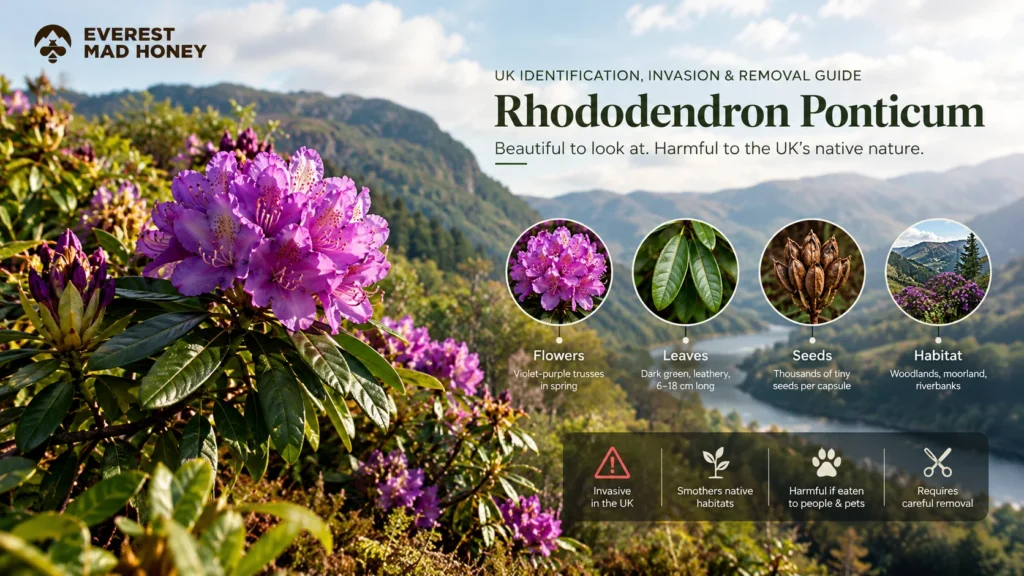
Quick facts:
- Size: up to 5 m in the wild, rarely 8 m; RHS lists 2.5-4 m in gardens.
- Leaves: evergreen, dark green, leathery, 6-18 cm long.
- Flowers: violet-purple trusses of 10 to 20 funnel-shaped blooms in spring.
- Fruit: a dry capsule packed with tiny seeds.
- UK status: listed as an invasive non-native species in Great Britain (RHS).
- Safety: harmful if eaten, to people and pets.
In its homeland it is neither vigorous nor invasive. The trouble started only after it left home (National Trust for Scotland).
How Rhododendron Ponticum Reached the UK
Rhododendron ponticum arrived in Britain as an ornamental shrub in 1763 and was later planted as cover for game birds (Wikipedia). Fossils show it grew here before the last ice age but never recolonised afterwards, so Britain’s native ecology developed without it.
The Victorians did the rest. According to the National Trust for Scotland, it became popular in the woods around estate houses, as a shelter belt, as game cover and as rootstock for grafting hybrid varieties. Invasions still tend to centre on old estates and nearby settlements (NTS).
From those gardens the plant escaped by seed. NTS reports that a single bush can release around a million seeds into the wider landscape, which explains how a garden shrub became one of Britain’s most invasive land plants.
Rhododendron Hybrid or Pure Species? Ponticum and Variegatum Explained
Much of the wild “ponticum” in the UK is not a pure species. NTS explains that cross-breeding with frost-hardy rhododendrons from north-east America produced hybrid vigour and helped the plant cope with colder British winters. Garden collections of named rhododendron cultivars are generally not the problem; it is the vigorous hybrid form of R. ponticum that has run wild.
Rhododendron ponticum variegatum is a different matter. The RHS describes it as a compact shrub with creamy-white leaf margins and mauve spring flowers, and does not classify it as invasive. It is also sold as ‘Silver Edge’.
| Feature | Rhododendron ponticum | R. ponticum ‘Variegatum’ |
|---|---|---|
| Height and spread (RHS) | 2.5-4 m | 1-1.5 m |
| Leaves | Plain dark green | Dark green with cream-white edge |
| Flowers | Purple | Mauve |
| UK invasive status (RHS) | Invasive non-native | Not classed as invasive |
One caution: variegated plants can revert to plain green growth (Oregon State University), and grafted rhododendrons can sucker from the rootstock below the graft (Wikipedia). Buy from a reputable UK nursery and remove any plain green shoots promptly. Sources: RHS ‘Variegatum’, NTS.
How to Identify Rhododendron Ponticum
To identify rhododendron ponticum, check leaves, flowers, size and location together. No single feature is enough.
- Leaves: evergreen, dark green, leathery and oval to narrow, 6-18 cm long, with a paler underside.
- Flowers: rounded trusses of funnel-shaped violet-purple blooms in spring, often with greenish-yellow spots on the upper petal.
- Size and habit: a dense, suckering, multi-stemmed shrub that typically reaches 5 m and forms thickets with a closed canopy.
- Seed capsules: dry capsules, 1.5-2.5 cm long, that release numerous tiny seeds after flowering.
- Habitat: acidic soils, woodland edges, moorland and areas near old estates, especially in western Britain.
Be careful with lookalikes. Cherry laurel (Prunus laurocerasus) also has glossy evergreen leaves, but it carries white upright flower spikes rather than purple trusses. Wikipedia notes that telling the two apart is a recurring problem where they grow mixed together in woodland.
Wear gloves when handling the plant, as RHS warns it is harmful if eaten. If you are unsure, ask your local wildlife trust or council before cutting anything (RHS).
Are Rhododendrons Invasive? What Ponticum Does to UK Woodland
Rhododendron ponticum is invasive in the UK, although many garden cultivars are not. The damage comes from several directions at once:
- Shade and soil: a mature canopy displaces ground flora, and heavy leaf litter acidifies and degrades the soil (NTS).
- Temperate rainforest: these rare habitats cover just 1% of UK land, and the Woodland Trust says ponticum is choking them. NTS reports that almost half of the core areas of Scotland’s rainforest are affected.
- Livestock and wildlife: the leaves are toxic to most herbivores, including sheep and deer, so ponticum reduces grazing.
- Waterways and heathland: overhanging bushes shade streams, and seed spreads easily onto damp, acidic heath and bog.
- Tree disease: imported rhododendron can carry Phytophthora ramorum, which can kill more than 150 plant species and has led to large-scale felling of larch plantations (Woodland Trust).
- Pollinators: research reported on Wikipedia found the nectar paralysed a solitary mining bee, while buff-tailed bumblebees were not affected.
So when gardeners ask whether rhododendrons are invasive, the honest answer is “this one is, while most named garden cultivars are not”.
Rhododendron Ponticum and Climate Change in the UK
Rhododendron ponticum does best in the mild, wet, acidic conditions of western Britain. A peer-reviewed study of Snowdonia found the UK invasion has been more intense in the cooler, wetter west and north-west (Manzoor et al., 2018).
The same study offers a surprise. Under every combination of climate and land-cover scenario it tested, ponticum’s range in Wales was projected to contract by 2050. That is a regional model, not a UK-wide forecast, and it is no reason to wait. Seeds already in the soil, and the speed of regrowth, mean today’s infestations stay costly for years.
The wider risk is trade and a changing climate. The Woodland Trust warns that both make new invasive species introductions more likely. Controlling ponticum now protects woodland that will need to be resilient later.
Is Rhododendron Ponticum Illegal in the UK?
It is legal to own rhododendron ponticum, but not to let it escape. The plant is listed on Schedule 9 of the Wildlife and Countryside Act 1981. RHS confirms it is not banned from sale, yet it is an offence to plant it or cause it to grow in the wild in Great Britain (RHS).
In practice, that means a garden owner should stop seed and suckers spreading into neighbouring land, hedgerows or woodland. The Woodland Trust goes further and urges gardeners not to buy or plant it at all.
Details differ across England, Scotland, Wales and Northern Ireland, so check with your local authority or the relevant conservation agency before large clearances. This is general information, not legal advice.
How to Get Rid of Rhododendron Ponticum
There is no one-off fix, because the follow-up matters as much as the first clearance. NTS advises keeping up surveillance and control for at least five years, since seedlings and layered stems are always missed the first time (NTS). The methods it describes:
| Method | Best for | Main drawback |
|---|---|---|
| Stem treatment (herbicide into drilled stem) | Medium to mature bushes; reports of 99% kill | Needs tools and training |
| Grubbing up | Seedlings and small plants | Roots easily left behind |
| Stump treatment | Dense stands, previously cut multi-stem plants | Stumps regrow; needs chainsaw licence; dry weather only |
| Foliar spraying | Dense, low multi-stemmed plants | Collateral damage and run-off risk |
| Lever and mulch | Medium to large plants, no chemicals | Very labour-intensive |
For a typical garden:
- Confirm the plant is ponticum, not cherry laurel or a named cultivar.
- Match the method to plant size, and use herbicides strictly to the label, away from water.
- Work in dry weather and wear gloves, as all parts are harmful if eaten.
- Dispose of material responsibly. Never dump cuttings in the countryside.
- Re-check the site every few months and remove regrowth immediately.
Treated wood can be stacked to dry for firewood, or turned into charcoal and biochar, as NTS does at Inverewe Garden. For large infestations, hire a qualified contractor.
Better Garden Plants Than Rhododendron Ponticum
You can keep the look without the risk. NTS’s community scheme replaces cleared ponticum with sterile rhododendron cultivars, so ask your nursery for named, non-invasive varieties. Other acid-loving garden plants such as camellias, pieris and azaleas suit the same soils.
For a screen or hedge, which is how ponticum is often used, native hedging such as hazel or holly gives wildlife value without the spread. Whatever you choose, buy from a reputable UK nursery and check the label.
The Other Side of Rhododendron: Mad Honey
Rhododendron has a second story beyond the garden. Its leaves and nectar contain grayanotoxins, natural compounds that protect the plant from herbivores. Honey made from rhododendron nectar is known as mad honey, and Wikipedia notes that honey from rhododendron ponticum pollen can be poisonous in sufficient quantities (source). Most honey bees avoid the flowers, while some subspecies tolerate the toxin.
That is why true mad honey is a specialty product from high-altitude regions, not something produced in British gardens. Everest Mad Honey sells wild-harvested mad honey from Solukhumbu, Nepal, where Himalayan rhododendron forests bloom each spring. Every batch is lab-tested and traceable, with free insured worldwide shipping and delivery in 12-14 business days.
Mad honey is potent and should be treated with respect. If you are pregnant, have a heart condition or take medication, speak to your GP first, and check Food Standards Agency guidance for UK buyers. To learn more, read our guides on what mad honey is and grayanotoxin.
Rhododendron Ponticum FAQs
What is rhododendron ponticum?
It is an evergreen shrub native to Iberia and the Black Sea region, introduced to Britain in 1763 and now listed as an invasive non-native species in Great Britain.
How do I identify rhododendron ponticum?
Look for leathery dark-green leaves up to 18 cm, violet-purple flower trusses in spring, dense multi-stemmed growth and acidic or woodland-edge sites.
How do I get rid of rhododendron ponticum?
Use stem or stump treatment for mature bushes, grub up seedlings, and follow up for at least five years.
Are rhododendrons invasive?
R. ponticum is. Most named garden cultivars are not, though some grafted plants can sucker from the rootstock.
Is rhododendron ponticum illegal in the UK?
Not to own or sell, but it is an offence to plant it or cause it to grow in the wild in Great Britain.
Is variegatum invasive?
RHS does not classify R. ponticum ‘Variegatum’ as invasive, but watch for green reversion.
Conclusion
Rhododendron ponticum shows how a garden favourite can become an ecological problem. Learn to identify it, never plant it in the wild, remove it early, and commit to years of follow-up. The same genus that harms British woods also produces Himalayan mad honey, a reminder that a plant’s story depends on where it grows.
Sources
- Woodland Trust: Rhododendron is destroying our native wildlife
- National Trust for Scotland: The problem with Rhododendron ponticum
- RHS: Rhododendron ponticum
- RHS: Rhododendron ponticum ‘Variegatum’
- Wikipedia: Rhododendron ponticum
- Manzoor et al. (2018), Frontiers in Plant Science
- Oregon State University: R. ponticum ‘Variegatum’