
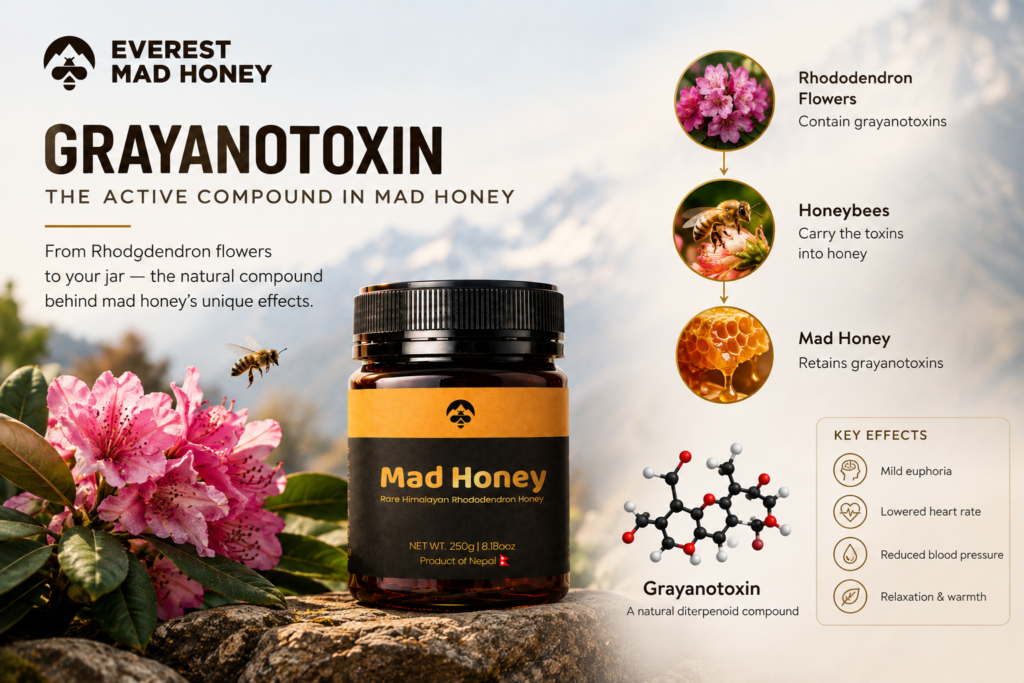
Introduction: The Compound That Makes Mad Honey Mad
Grayanotoxin is the single compound responsible for everything that sets mad honey apart from every other honey on Earth. It is a naturally occurring neurotoxin produced by certain Rhododendron plants, carried into honey by foraging bees, and consumed by humans for over 2,400 documented years — as a traditional medicine, a folk remedy, an aphrodisiac, and one of the most unusual natural substances available today.
If you have been searching for information about grayanotoxins, grayanotoxin mad honey, grayanotoxin effects, or grayanotoxin benefits, this is the most comprehensive, science-backed guide available online. We cover every dimension of this fascinating compound — from its molecular chemistry and its mechanism of action in the human body, to its documented traditional uses, the latest scientific research, the European Food Safety Authority’s official risk assessment, and what you need to know before buying or consuming grayanotoxin honey.
Whether you are a first-time buyer in the United Kingdom or the United States, a researcher exploring the pharmacology, or simply curious about what makes mad honey work, this guide gives you the complete picture — with peer-reviewed references throughout.
Let us begin with the basics.
What Is Grayanotoxin? A Scientific Definition
Grayanotoxin (abbreviated GTX) is a naturally occurring diterpenoid compound produced by plants in the Ericaceae family — most notably specific species within the genus Rhododendron. In the language of chemistry, grayanotoxins are classified as polyhydroxylated cyclic hydrocarbons that do not contain nitrogen, distinguishing them from many other plant-derived toxins like alkaloids.
The term “grayanotoxin” derives from Asa Gray, one of the most important American botanists of the 19th century. Before the name was standardised, the compound was also known as andromedotoxin, rhodotoxin, and acetylandromedol in older scientific literature — all referring to the same family of compounds.
Grayanotoxins are classified as neurotoxins because they act on the nervous system — specifically on voltage-gated sodium channels (Nav) in cell membranes. This mechanism is what produces the distinctive physiological effects associated with mad honey consumption: the warming sensation, the relaxation, the lowered blood pressure, and — at higher doses — the more pronounced cardiovascular effects.
Critically, grayanotoxin is not a synthetic chemical. It is a naturally occurring plant defence compound that has existed for millions of years in Rhododendron species. When bees forage on the nectar of these plants, grayanotoxins pass into the honey they produce — creating what the world knows as grayanotoxin honey, or more commonly, mad honey.
The Grayanotoxin Family: 18 Variants and Counting
Grayanotoxin is not a single molecule — it is a family of closely related compounds. Scientists have identified at least 18 distinct forms of grayanotoxin, each designated by a Roman numeral (grayanotoxin I, II, III, and so on). A 2024 review published in Molecules documented 193 newly identified grayanane diterpenoids across 15 distinct carbon skeleton types within the Ericaceae family, demonstrating how much structural diversity exists within this compound class (Molecules, 2024).
The Key Players: Grayanotoxin I and III
Among the 18 forms, grayanotoxin I (GTX I) and grayanotoxin III (GTX III) are the most significant for human exposure through mad honey.
Grayanotoxin III is the principal toxic isomer found in Rhododendron plants. It is present in the highest concentrations in Rhododendron nectar and is the primary compound transferred from flower to bee to honey.
Grayanotoxin I is also toxic and bioactive. Research indicates that GTX I and III together are primarily responsible for the cardiovascular and neurological effects associated with grayanotoxin mad honey consumption. The European Food Safety Authority’s 2023 risk assessment specifically focused on GTX I and III as the compounds of concern in honey (EFSA Journal, 2023).
Grayanotoxin II is considered less toxic than I and III, though it contributes to the overall compound profile of the honey.
Why the Variant Matters
Different Rhododendron species produce different ratios and concentrations of grayanotoxin variants. This is one of the reasons why mad honey potency varies so significantly between regions (Nepal versus Turkey), seasons (spring versus autumn), and even individual batches from the same cliff. The specific mix of GTX I, II, and III in any given jar of mad honey is unique to that harvest — which is precisely why batch-level lab testing is non-negotiable for any responsible brand.
Where Do Grayanotoxins Come From?
Grayanotoxins are not exclusive to a single plant. They are found across multiple genera within the Ericaceae family — one of the largest flowering plant families in the world.
The Primary Sources
Rhododendron — By far the most important source. Over 700 species of Rhododendron exist worldwide, but only a small number produce grayanotoxin-rich nectar in significant concentrations. The key species include high-altitude Himalayan Rhododendrons in Nepal (particularly Rhododendron arboreum) and Rhododendron ponticum and Rhododendron luteum in Turkey’s Black Sea region.
Pieris — Also known as lily of the valley shrub. Several Pieris species contain grayanotoxins in their leaves and nectar.
Kalmia — Mountain laurel (Kalmia latifolia), native to the eastern United States, contains grayanotoxins. This is one of the documented sources of grayanotoxin-containing honey in North America, though far less concentrated than Himalayan sources.
Leucothoe and Agarista — Additional Ericaceae genera that produce grayanotoxins, though they are less significant in the context of honey production.
Geographic Distribution
| Region | Key Plants | Honey Significance |
|---|---|---|
| Nepal (Himalayas) | High-altitude Rhododendron species | Primary source of the world’s most potent mad honey |
| Turkey (Black Sea) | R. ponticum, R. luteum | Second major source; well-documented deli bal tradition |
| Eastern United States | Kalmia latifolia, western azalea | Rare, low-concentration grayanotoxin honey |
| China (Yunnan) | Various Rhododendron species | Traditional medicine use; limited honey production |
| Japan, Korea | R. brachycarpum, R. aureum | Folk medicine use; limited honey context |
Grayanotoxins are present in nearly all parts of a producing plant — leaves, stems, flowers, pollen, and nectar. However, for grayanotoxin honey production, it is the nectar concentration that matters most.
How Grayanotoxins Enter Honey: The Nectar Pathway
The process by which grayanotoxins end up in your jar of mad honey is elegantly simple — and entirely natural.
Step 1: The Plants Produce Grayanotoxin-Rich Nectar
Certain Rhododendron species produce nectar containing measurable concentrations of grayanotoxins. The plants likely evolved this as a defence mechanism — grayanotoxins deter many herbivores from eating the leaves and flowers. The compound is present across the plant, but in the nectar it becomes accessible to pollinators.
Step 2: Bees Forage on the Nectar
In Nepal, the giant Himalayan honey bee (Apis laboriosa) forages on Rhododendron nectar at altitudes between 2,500 and 4,000 metres. Because these high-altitude environments are often dominated by dense Rhododendron forests, the bees have limited access to other nectar sources — creating a near-monofloral foraging pattern.
In Turkey, managed hives of Apis mellifera forage on Rhododendron ponticum and Rhododendron luteum, but because the bees also access a wider variety of flowers, the grayanotoxin concentration in Turkish honey is typically lower than in Nepalese honey.
Step 3: The Compounds Pass Through Into Honey
Critically, the bees’ honey-making process does not neutralise or filter out the grayanotoxins. As bees convert nectar into honey through enzymatic processing and water evaporation inside the hive, the grayanotoxin compounds pass through largely intact. The finished honey retains a meaningful concentration of the compounds originally present in the nectar.
Why Concentration Varies
The grayanotoxin concentration in any given batch of mad honey is determined by several interacting factors:
- Altitude — Higher elevation Rhododendrons tend to produce more concentrated nectar
- Season — Spring-harvest honey (April–June in Nepal) typically contains the highest grayanotoxin levels, coinciding with peak Rhododendron bloom
- Weather — Historical accounts note that honey produced during dry spells at high elevations can be more potent
- Foraging exclusivity — The fewer non-Rhododendron flowers available, the higher the grayanotoxin concentration
- Rhododendron species mix — Different species produce different ratios of GTX I, II, and III
This variability is natural and unavoidable — and it is precisely why every batch of grayanotoxin honey should be independently lab-tested before sale. No two harvests are identical.
How Grayanotoxin Works in the Body: The Sodium Channel Mechanism
Understanding how grayanotoxin effects manifest in the human body requires a look at its molecular target: voltage-gated sodium channels.
Voltage-Gated Sodium Channels (Nav)
Voltage-gated sodium channels are protein structures embedded in the cell membranes of neurons, muscle cells, and cardiac cells. They control the flow of sodium ions in and out of cells, which is essential for generating electrical signals — the action potentials that allow your nerves to fire, your muscles to contract, and your heart to beat in rhythm.
Under normal conditions, sodium channels open briefly to allow an electrical impulse, then quickly close (inactivate) to reset the cell for the next signal. This open-close cycle happens thousands of times per second.
What Grayanotoxin Does
Grayanotoxin I binds to voltage-gated sodium channels — specifically at a site in the D4S6 transmembrane segment — and holds them in a partially open state (Kimura et al., 2000, FEBS Letters). This prevents normal inactivation. The result is a sustained inflow of sodium ions that shifts the activation potential in the direction of hyperpolarisation.
In plain language: grayanotoxin keeps the electrical “gate” ajar. Sodium ions continue flowing when they should not, which disrupts the normal rhythm of nerve and muscle cell signalling.
This mechanism places grayanotoxin in the same pharmacological category as other well-known sodium channel toxins including aconitine (from monkshood), veratridine (from false hellebore), and batrachotoxin (from poison dart frogs) — though each has a distinct binding profile and potency.
The Downstream Effects
The persistent sodium channel activation triggers a cascade of physiological responses:
- Increased vagal tone — The vagus nerve becomes overactive, slowing the heart rate (bradycardia) and lowering blood pressure (hypotension)
- Acetylcholine release — The initial depolarisation causes increased release of acetylcholine, a neurotransmitter that amplifies the parasympathetic (“rest and digest”) response
- Muscarinic receptor activation — Research in rats has shown that cardiac M2 muscarinic receptors are involved in grayanotoxin-induced bradycardia, which is why atropine (a muscarinic antagonist) is effective as a treatment
- Central nervous system effects — Animal studies demonstrated that even small doses injected directly into the brain caused marked bradycardia and respiratory depression, suggesting the CNS plays a significant role in the overall response
This mechanism explains why grayanotoxin effects are primarily cardiovascular and neurological — and why dosage is so critical.
Grayanotoxin Effects at Different Doses: From Relaxation to Risk
The experience of consuming grayanotoxin mad honey exists on a spectrum determined almost entirely by dose.
Low Dose (1 teaspoon or less)
At small, carefully measured amounts, grayanotoxin produces effects that millions of traditional users across Nepal and Turkey have valued for centuries:
- A mild, warm sensation spreading through the body
- Gentle relaxation and a sense of calm
- Subtle euphoria — a mood lift, not an intense high
- Slight lowering of blood pressure
- Enhanced sensory awareness for some users
- Mild tingling, particularly in the limbs and chest
Onset typically occurs within 30 minutes to 2 hours. Effects generally last several hours and resolve naturally. This is the experience that traditional Himalayan and Turkish communities have managed safely for generations.
Moderate Dose (1–2 tablespoons)
At moderate doses, the effects intensify:
- More pronounced dizziness and lightheadedness
- Noticeable sweating
- Significant relaxation — some users describe difficulty standing
- Blurred vision
- Tingling and numbness in the extremities
- Lowered heart rate becoming perceptible
This is the threshold where the experience transitions from pleasant to potentially uncomfortable for inexperienced users.
High Dose / Overconsumption
At higher doses, grayanotoxin’s effects on sodium channels and vagal tone become clinically significant:
- Severe bradycardia (heart rate dropping well below normal)
- Significant hypotension (dangerously low blood pressure)
- Nausea, vomiting, and diarrhoea
- Impaired consciousness (reported in approximately 67% of clinical poisoning cases)
- In rare cases: atrioventricular (AV) block, syncope, or respiratory depression
Clinical literature from the University of Utah Poison Control notes that significant effects can occur after doses of a tablespoon or less, depending on the batch’s grayanotoxin concentration (University of Utah, 2025).
The Critical Takeaway
The difference between a pleasant experience and a medical emergency is dose. This is not a substance to be casual about. Start small, wait patiently, and never consume more until you understand how a specific batch affects you.
Grayanotoxin Benefits: Traditional Uses and Emerging Research
While grayanotoxin is classified as a toxin, the Rhododendron plants that produce it — and the honey that contains it — have been used in traditional medicine across Asia, Europe, and the Americas for centuries. A growing body of scientific research is beginning to investigate whether these traditional uses have pharmacological validity.
Documented Traditional Uses
Anti-hypertensive (blood pressure lowering) — The most widely documented traditional use of grayanotoxin honey across both Nepal and Turkey. Grayanotoxin’s mechanism of lowering blood pressure through increased vagal tone and bradycardia provides a plausible pharmacological basis for this folk application, though controlled human trials are lacking.
Analgesic (pain relief) — Rhododendron extracts containing grayanoids have been used in Chinese traditional medicine to treat abdominal pain, headaches (cephalgia), and rheumatoid arthritis. A systematic review in the Journal of Ethnopharmacology (2022) found that more than 50 grayanoid compounds exhibited significant analgesic activity at doses below 1 mg/kg in animal models (Journal of Ethnopharmacology, 2022).
Anti-inflammatory — Multiple studies have demonstrated anti-inflammatory activity in Rhododendron extracts. Extracts from Rhododendron arboreum flowers showed significant anti-inflammatory effects against carrageenan-induced inflammation and prostaglandin E2 pathways in animal models (Popescu & Kopp, 2013, Journal of Ethnopharmacology).
Gastrointestinal — Mad honey has been traditionally used in Turkey and Nepal as a folk remedy for peptic ulcer disease, dyspepsia (indigestion), and gastritis.
Aphrodisiac — Perhaps the most commercially popular traditional use. Mad honey has been consumed as a sexual stimulant in both Nepal and Turkey for generations, and this remains one of the primary drivers of global demand.
Antimicrobial — Compounds isolated from Rhododendron simsii demonstrated antibacterial activity, with novel grayanane diterpenoids showing promise against common pathogens (Frontiers in Pharmacology, 2024).
Antioxidant — Research on grayanotoxin and Rhododendron honey has identified antioxidant properties, though studies remain in early stages.
Important Context
It is essential to emphasise that while traditional uses are well-documented and some pharmacological research is encouraging, grayanotoxin honey is a food product, not a medicine. Modern clinical evidence for specific therapeutic claims in humans remains limited. No regulatory body has approved grayanotoxin or mad honey for the treatment of any medical condition. Always consult a healthcare provider before using mad honey for any health-related purpose.
Safety Profile and the EFSA Risk Assessment
Understanding the safety profile of grayanotoxin is critical for anyone considering purchasing or consuming grayanotoxin mad honey.
The EFSA 2023 Assessment
In 2023, the European Food Safety Authority’s CONTAM Panel published the most comprehensive official risk assessment of grayanotoxins in honey to date. Key findings include:
- Reference point established: The CONTAM Panel derived a reference point of 15.3 µg/kg body weight for the sum of GTX I and III, based on reduced heart rate observed in rats
- Acute effects confirmed: Oral exposure to grayanotoxins is associated with acute intoxication affecting the cardiovascular system, nervous system, and muscles
- Genotoxicity evidence: The assessment noted evidence of chromosomal damage in mice exposed to GTX III or honey containing GTX I and III, though the mechanism remains unknown
- No chronic toxicity data: Without long-term studies, the Panel could not establish a reference point for chronic exposure effects
(EFSA Journal, 2023, Vol. 21, e07866)
Clinical Outcomes in Humans
A 2025 review published in the Journal of Applied Toxicology synthesised research on grayanotoxin poisoning and therapeutic implications. Key clinical data from reported cases indicates:
- Onset: Symptoms typically appear within 30 minutes to 2 hours
- Duration: Most cases resolve within 24 hours with supportive care
- Common symptoms: Dizziness, hypotension, bradycardia, nausea, vomiting (present in nearly all cases)
- Impaired consciousness: Reported in approximately 67% of clinical cases
- Treatment: Intravenous fluids and atropine are almost always effective
- Mortality: No deaths have been reported in modern clinical literature
(Aryal, 2025, Journal of Applied Toxicology)
Who Should Avoid Grayanotoxin Honey
- Individuals with existing heart conditions or bradycardia
- People taking cardiac medications (beta-blockers, calcium channel blockers, digoxin)
- Anyone with chronically low blood pressure
- Pregnant or breastfeeding women
- Children under 18
- Anyone who has never consumed mad honey before without first reading dosage guidance
Grayanotoxin Honey Dosage Guide: How to Consume Safely
If you are buying grayanotoxin honey for sale online, understanding correct dosage is non-negotiable. The margin between a pleasant experience and an unpleasant one is narrow — and it varies between batches.
Recommended Starting Protocol
| Experience Level | Suggested Starting Dose | Wait Time | Notes |
|---|---|---|---|
| First-time user | 1 teaspoon (approximately 5g) | 2+ hours | Start here regardless of what you have read elsewhere |
| Intermediate user | 1–2 teaspoons | 1–2 hours | Only after multiple successful low-dose experiences |
| Experienced user | Up to 1 tablespoon | 1 hour | Traditional Nepali dose — only with batch familiarity |
Golden Rules
- Start with the smallest dose — One teaspoon maximum for your first experience with any new batch
- Wait — Do not consume more for at least 2 hours. Effects can take time to manifest
- Never consume on a full stomach — Many traditional users recommend taking mad honey on an empty stomach or with light food
- Never stack doses — Do not take additional amounts because you “don’t feel anything yet”
- Keep it infrequent — Traditional use has always been occasional, not daily
- Store responsibly — Keep out of reach of children and anyone who has not been briefed on correct usage
Why Lab Testing Matters for Grayanotoxin Honey
Because grayanotoxin concentration varies naturally between harvests, lab testing is the single most important quality and safety measure for any brand selling mad honey.
The Problem Without Testing
Without independent lab testing, neither the seller nor the buyer knows the grayanotoxin concentration of a specific batch. A batch from a high-altitude spring harvest might contain several times the concentration of an autumn batch from lower elevation — and there is no way to tell from appearance, taste, or smell alone.
This means dosage guidance based on volume (“take one teaspoon”) is only meaningful if you know the potency of the batch you are consuming.
What Good Lab Testing Looks Like
A trustworthy brand should provide:
- Quantified grayanotoxin values — Actual GTX I and/or GTX III concentrations, not just “tested” or “pure”
- Named laboratory — An independent, accredited testing facility
- Batch identifier — Results tied to the specific batch you are purchasing
- Testing methodology — The analytical method used (LC-MS is the gold standard)
Everest Mad Honey provides independent batch-level lab testing with traceable results for every harvest — so you always know what you are consuming.
Where to Buy Authentic Grayanotoxin Honey
If you are looking for grayanotoxin honey for sale or searching for where to buy grayanotoxin honey online, choosing the right source is critical. The mad honey market includes genuine products alongside diluted, untested, and outright fake alternatives.
What to Look For
- Lab-tested with published results — Non-negotiable. Without GTX quantification, you are buying unknown product
- Specific Nepalese sourcing — Named districts (Solukhumbu, Lamjung, Gorkha), altitude, and harvesting community
- Dark reddish-brown colour — Authentic Himalayan mad honey is not golden
- Bitter-sweet taste with throat tingle — The grayanotoxin signature
- Dosage guidance included — Responsible brands educate their customers
- Transparent shipping and pricing — No hidden costs
Why Everest Mad Honey Is the Smart Choice
Everest Mad Honey delivers everything a buyer of authentic grayanotoxin honey needs:
- Batch-level independent lab testing with traceable grayanotoxin results
- Direct Himalayan sourcing from Gurung honey-hunting communities in Nepal
- The most competitive pricing in the market — genuine product without the premium markup
- Free insured worldwide shipping to the United States, the United Kingdom, and 180+ countries
- Clear dosage guidance with every order
- No additives, no processing, no dilution — pure, raw cliff honey
→ Buy Authentic Grayanotoxin Honey — Free Worldwide Shipping
Frequently Asked Questions About Grayanotoxin
What is grayanotoxin?
Grayanotoxin is a naturally occurring diterpenoid neurotoxin produced by certain Rhododendron plants in the Ericaceae family. When bees forage on Rhododendron nectar, the compound transfers into the honey they produce — creating what is known as mad honey or grayanotoxin honey.
Is grayanotoxin dangerous?
At low, controlled doses, grayanotoxin has been consumed safely in Nepal and Turkey for centuries. At higher doses, it can cause bradycardia (slowed heart rate), hypotension (low blood pressure), nausea, and impaired consciousness. No deaths have been reported in modern clinical literature. The key to safety is responsible dosage and purchasing lab-tested product.
What are grayanotoxin effects?
At small doses, effects include mild warmth, relaxation, gentle euphoria, and lowered blood pressure — typically lasting several hours. At higher doses, effects can include dizziness, significant bradycardia, hypotension, nausea, and in severe cases, atrioventricular heart block. Effects depend entirely on dose and batch potency.
What are grayanotoxin benefits?
Traditional uses across Nepal, Turkey, China, and Korea include blood pressure management, pain relief, anti-inflammatory applications, digestive support, and use as a natural aphrodisiac. Scientific research has confirmed anti-inflammatory, analgesic, and antimicrobial activity in laboratory settings, though controlled human clinical trials remain limited.
Where can I buy grayanotoxin honey?
Authentic grayanotoxin honey is available online from specialist mad honey sellers. Everest Mad Honey offers lab-tested, batch-traceable Himalayan mad honey with free insured worldwide shipping to the US, UK, and 180+ countries.
Is grayanotoxin honey legal?
Yes. Grayanotoxin is not a controlled substance in the United States, the United Kingdom, or most countries worldwide. Mad honey is classified as a food product, not a drug. Always check your local import regulations before ordering internationally.
How much grayanotoxin honey should I take?
First-time users should start with no more than one teaspoon (approximately 5g). Wait at least 2 hours before considering any additional amount. Never exceed one tablespoon in a single session. Always follow dosage guidance provided by your supplier.
Does EFSA consider grayanotoxin honey safe?
The European Food Safety Authority published a risk assessment in 2023 acknowledging acute toxicity risks from grayanotoxin in honey. They established a reference point of 15.3 µg/kg body weight for GTX I and III. The assessment underscores the importance of informed, measured consumption and lab-tested product.
Can I get grayanotoxin honey shipped to the UK or US?
Yes. Everest Mad Honey ships authentic, lab-tested grayanotoxin honey to both the United Kingdom and the United States with free insured delivery.
Conclusion: Respect the Compound, Choose the Right Source
Grayanotoxin is one of the most fascinating naturally occurring compounds in the world — a plant-derived neurotoxin with a 2,400-year documented history of human use, a sophisticated mechanism of action on voltage-gated sodium channels, and a growing body of scientific research exploring its pharmacological potential.
But fascination must come paired with respect. Grayanotoxin is a bioactive compound with real physiological effects. The difference between a pleasant experience and a medical emergency is dose — and the grayanotoxin concentration in any jar of mad honey is invisible to the naked eye. Only batch-level lab testing can tell you what you are actually consuming.
If you are going to buy grayanotoxin honey, buy it from a source that takes testing, sourcing, and safety as seriously as the compound deserves.
Everest Mad Honey delivers lab-tested, batch-traceable, authentically sourced Himalayan mad honey at competitive prices — with free insured worldwide shipping to the United States, the United Kingdom, and over 180 countries.
→ Shop Lab-Tested Grayanotoxin Honey — Free Worldwide Shipping
This guide was written to be the most comprehensive, science-backed resource on grayanotoxin available online. All scientific claims are supported by peer-reviewed sources cited below.
References & Sources
- Jansen, S.A. et al. (2012). “Grayanotoxin Poisoning: ‘Mad Honey Disease’ and Beyond.” Cardiovascular Toxicology, 12, 208–215 — ncbi.nlm.nih.gov/pmc/articles/PMC3404272
- EFSA CONTAM Panel (2023). “Risks for human health related to the presence of grayanotoxins in certain honey.” EFSA Journal, 21(3), e07866 — ncbi.nlm.nih.gov/pmc/articles/PMC9978999
- Aryal, D. et al. (2025). “Grayanotoxins in Mad Honey: Mechanisms of Toxicity, Clinical Management, and Therapeutic Implications.” Journal of Applied Toxicology — Wiley Online Library
- Kimura, T. et al. (2000). “On site of action of grayanotoxin in domain 4 segment 6 of rat skeletal muscle sodium channel.” FEBS Letters, 465(1), 18–22 — pubmed.ncbi.nlm.nih.gov/10620699
- Recent Advances in Grayanane Diterpenes: Isolation, Structural Diversity, and Bioactivities from Ericaceae Family (2018–2024). Molecules — ncbi.nlm.nih.gov/pmc/articles/PMC11013853
- University of Utah Poison Control (2025). “CASE FILES – Mad Honey.” — poisoncontrol.utah.edu
- Islamoglu, M.S. et al. (2021). “Mad Honey Poisoning Case Series.” Cureus, 13(8), e17165 — ncbi.nlm.nih.gov/pmc/articles/PMC8367389
- Popescu, R. & Kopp, B. (2013). “The genus Rhododendron: An ethnopharmacological and toxicological review.” Journal of Ethnopharmacology, 147(1), 42–62 — ScienceDirect
- Yang, Y. et al. (2022). “The efficacy and toxicity of grayanoids as analgesics: A systematic review.” Journal of Ethnopharmacology — ScienceDirect
- ScienceDirect (n.d.). “Grayanotoxin I — Overview.” — sciencedirect.com
- Frontiers in Pharmacology (2024). “Identification of antibacterial constituents from Rhododendron simsii Planch.” — frontiersin.org
- Frontiers in Pharmacology (2026). “A review of Rhododendron molle: traditional uses, clinical applications, phytochemistry, pharmacology, toxicology.” — frontiersin.org
- Kong, L. et al. (2022). “Enantioselective Total Syntheses of Grayanane Diterpenoids.” Journal of the American Chemical Society, 144(12), 5268–5273
- Silici, S. & Atayoglu, A.T. (2015). “Mad honey intoxication: A systematic review on the 1199 cases.”
- Mad honey poisoning presenting with syncopal attack: a case report. International Journal of Emergency Medicine — ncbi.nlm.nih.gov/pmc/articles/PMC10328629
One Response