
30-DAY MONEY-BACK GUARANTEE | FAST GLOBAL DELIVERY TO 180+ COUNTRIES

What Is Mad Honey?
Origin, Effects, Benefits & How to Use It Safely

A deep, research-backed guide to the world’s rarest honey — harvested from Himalayan cliff faces by Gurung honey hunters, prized for centuries, and unlike any honey you have ever tasted.
01 — Origin

Where Does Mad Honey Come From?

Authentic mad honey Nepal stands apart from ordinary honey because of three factors that cannot be replicated anywhere else in the world

Born in the World's Highest Foothills

Mad honey — known locally as deli bal in Turkey and baikh in Nepal — is a rare, naturally psychoactive honey produced in only a handful of regions on Earth. The most prized variety comes from the remote mountain valleys of eastern Nepal, specifically the Solukhumbu and Lamjung districts that sit in the shadow of the Everest range.

What makes this honey different from every other variety in the world is the flower it comes from. Wild Rhododendron species — primarily Rhododendron ponticum and Rhododendron luteum — blanket the Himalayan slopes between 2,500 and 4,000 metres each spring. These flowers produce nectar laced with grayanotoxins, a group of naturally occurring neurotoxins. When the giant Himalayan cliff bee, Apis laboriosa, forages on this nectar and converts it into honey, the grayanotoxins carry through — giving mad honey its distinctive dark colour, bitter-sweet taste, and mild psychoactive effects.

Key fact: Apis laboriosa is the largest honeybee species in the world, with workers measuring up to 3cm. They are entirely wild — they cannot be domesticated or kept in man-made hives — and they build enormous, exposed combs on sheer cliff faces at extreme altitude.

A History Spanning Millennia

Mad honey is not a modern discovery. The earliest recorded account dates back to 401 BC, when the Greek historian Xenophon described his soldiers becoming disoriented after consuming wild honey during their retreat through the Pontic Alps of modern-day Turkey. Centuries later, in 67 BC, King Mithridates VI of Pontus weaponised mad honey against the Roman general Pompey — leaving pots of it along marching routes so that Roman soldiers would eat it and become incapacitated.

In Nepal, the Gurung and Rai communities of the mid-hills have harvested mad honey for at least 11,000 years, using it as a traditional medicine for joint pain, digestive issues, hypertension, and sexual vitality. Today, this ancient tradition continues largely unchanged — and Everest Mad Honey sources directly from these indigenous communities in the Solukhumbu region.

WHERE MAD HONEY COMES FROM

Where Does Authentic Mad Honey Come From?

Real mad honey exists only where wild rhododendron blooms at altitude, so its true sources are very few. 

Nepal (Solukhumbu)

The world's finest mad honey. High-altitude Rhododendron forests, wild Apis laboriosa bees, and peak grayanotoxin concentration. This is where Everest Mad Honey is sourced.

Turkey (Black Sea)

The other historic source — deli bal from the Kaçkar Mountains region. Lower altitude, milder potency, and a long cultural tradition dating to Greek antiquity.

Other Regions

Small quantities exist in parts of India (Uttarakhand), Bhutan, and Myanmar — but volumes are negligible and rarely reach the international market in verified, lab-tested form.

02 — The Science

What Is Grayanotoxin? The Compound That Makes Honey "Mad"

Grayanotoxin is the naturally occurring compound responsible for every property that distinguishes mad honey from ordinary honey — its mild psychoactive effects, its warming body sensation, and its traditional medicinal uses. Understanding what grayanotoxin is and how it works is essential to understanding mad honey itself.

C20H35O7

Grayanotoxin I (GTX-I) is a diterpenoid compound produced by Rhododendron plants as a natural chemical defence. Over 25 subtypes have been identified (GTX-I through GTX-XVIII and beyond), but Grayanotoxin I and Grayanotoxin III are the most abundant in Himalayan mad honey.
WHERE MAD HONEY COMES FROM

How Does Grayanotoxin Work?

Grayanotoxin belongs to a class of compounds called sodium channel modulators. In simple terms, it binds to voltage-gated sodium channels in nerve and muscle cells, keeping them in an “open” state for slightly longer than normal. This causes a prolonged depolarisation — a brief enhancement of nerve signalling — which produces the sensations associated with mad honey: warmth spreading through the body, light-headedness, muscle relaxation, and a gentle feeling of euphoria.

At the low concentrations found in properly dosed mad honey (typically 1–2 teaspoons), these effects are mild and temporary, usually lasting 2–4 hours. The compound is metabolised naturally by the liver and excreted through normal bodily processes, leaving no lasting effects.

Natural Origin

Produced by Rhododendron species as an evolutionary defence against herbivores. The bees are immune to it — they process the nectar normally, and the grayanotoxin passes into the finished honey unchanged.

Mechanism of Action

Binds to voltage-gated Na⁺ channels (site II), prolonging the open state. This modulates nerve signalling rather than blocking it — producing mild, dose-dependent effects on mood and sensation.

Lab Measurable

Grayanotoxin concentration is quantifiable through LC-MS/MS analysis. Every batch of Everest Mad Honey is independently tested, with a certificate showing exact GTX concentration included in your order.

Grayanotoxin Concentration in Mad Honey

Not all mad honey contains the same amount of grayanotoxin. The concentration varies significantly based on several factors: the altitude where the bees foraged, the density of Rhododendron in bloom, the specific Rhododendron species (some produce more grayanotoxin than others), the time of harvest, and the ratio of Rhododendron nectar to other wildflower nectar in the comb.

In Himalayan mad honey from Nepal’s Solukhumbu region, grayanotoxin concentrations typically range from 10–40 ppm (parts per million), depending on the harvest season. Spring harvests (March–May) tend to have the highest concentration because Rhododendron is the dominant flower at altitude during that window. Autumn harvests are generally milder.

Turkish deli bal from the Black Sea coast tends to have lower concentrations — often in the 5–20 ppm range — because the Rhododendron species, altitude, and bee species differ.

Why lab testing matters: Without verified testing, there is no way to know the grayanotoxin content of a jar of mad honey. Everest Mad Honey provides a batch-traceable lab certificate with every order so you know exactly what you are consuming — and can dose responsibly.

The Perilous Climb

The Journey Behind Every Jar of Mad Honey

Every jar of Everest Mad Honey follows the same four-step journey from the remote Himalayan cliffs of Nepal to your door:

01

The Smoke Ceremony

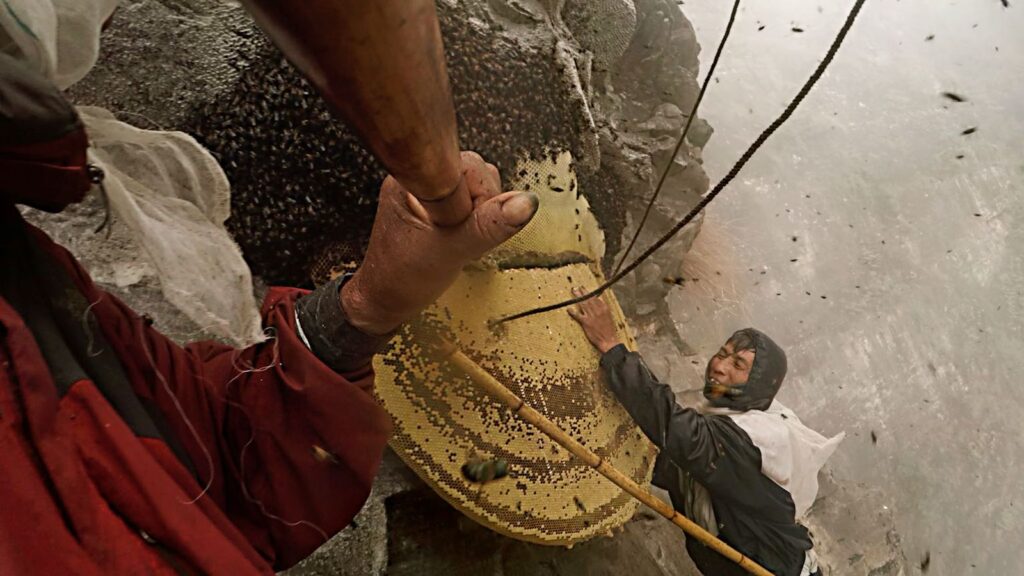
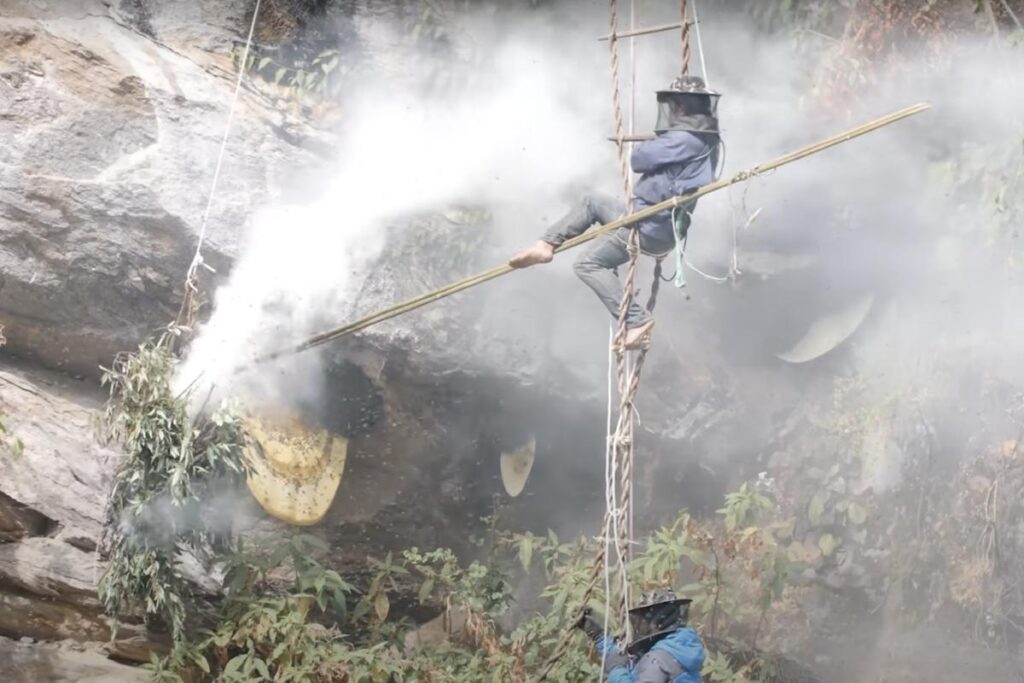
Before approaching the cliff, the hunting party — typically 8–15 experienced Gurung men — performs a traditional offering to the mountain spirits, burning juniper branches and chanting prayers for protection. Bundles of green foliage are then lit at the base of the cliff to produce thick, billowing smoke that rises toward the hive. The smoke calms the Apis laboriosa bees, causing them to gorge on honey and become less aggressive, giving the hunters a window to work.
02

The Descent

One or two of the most experienced hunters descend on handmade rope ladders — woven from bamboo and hemp — anchored to stakes driven into the cliff top. They dangle 50 to 200 metres above the valley floor, exposed to wind, vertigo, and the remaining bees. The ropes have no harnesses. There is no safety net. Every movement is deliberate, practised, and rooted in decades of muscle memory.
03

Cutting the Comb

Using a long bamboo pole called a tango, tipped with a curved blade, the hunter slices through the wax comb. Apis laboriosa combs can be over 1.5 metres across and weigh up to 30 kg. The comb sections fall into woven baskets held open below by a second line of rope. Pieces that miss the basket drop hundreds of metres into the valley and are lost.
04

Extraction & Filtering

Back at the village, the fresh comb is hand-pressed and gravity-strained through cotton cloth. No heat is applied — the honey is never pasteurised, never ultrafiltered, and never blended with honey from managed hives. This preserves the full grayanotoxin profile, the raw enzymes, the pollen spectrum, and the deep, reddish-amber colour that distinguishes authentic Himalayan mad honey.
05

Lab Testing & Packaging

Each batch is sampled and sent for independent laboratory analysis — verifying grayanotoxin concentration, purity, moisture content, and absence of contaminants. Once verified, the honey is sealed in airtight glass jars, assigned a batch code, and packed with its certificate for worldwide shipping. From cliff face to your door — fully traceable, fully transparent.
04 — Potency

What Determines Mad Honey's Strength?

Not all mad honey is created equal. Potency — the concentration of grayanotoxin in the finished honey — varies significantly from jar to jar depending on a combination of environmental, botanical, and biological factors.

Botanical

Rhododendron Species & Density

Over 30 Rhododendron species grow in Nepal alone, and each produces different levels of grayanotoxin. R. ponticum and R. arboreum are among the highest producers. When these species dominate the forage area, the honey is significantly stronger than when the bees access a mixed floral landscape.

Geographical

Altitude & Location

Honey harvested from hives at 3,000–4,000 metres is consistently more potent than honey from lower elevations. At extreme altitude, Rhododendron forms the primary — sometimes the only — nectar source, concentrating grayanotoxin in the comb. The Solukhumbu region sits in this optimal altitude band.

Seasonal

Time of Harvest

Spring harvests (March–May) coincide with peak Rhododendron bloom, producing the most potent mad honey of the year. Autumn harvests draw on a wider mix of late-season wildflowers, diluting the grayanotoxin content. This is why spring-harvest mad honey commands higher prices and stronger effects.

Biological

Bee Species & Foraging Range

Apis laboriosa — the giant Himalayan cliff bee — has a foraging radius of up to 5 km from the hive, far exceeding managed Apis mellifera. This extended range allows them to reach isolated high-altitude Rhododendron patches that no other bee species can access, resulting in higher grayanotoxin concentrations.

Potency by Source — A Quick Comparison

Source RegionTypical GTX RangeBee SpeciesPotency
Nepal — Solukhumbu (Spring)20–40 ppmApis laboriosaStrong
Nepal — Solukhumbu (Autumn)10–20 ppmApis laboriosaMedium
Turkey — Black Sea5–20 ppmApis mellifera caucasicaMild–Medium
India — Uttarakhand5–12 ppmApis ceranaMild
05 — Benefits

Mad Honey Benefits — Traditional & Modern Uses

Used for centuries in Himalayan folk medicine and increasingly studied in modern pharmacological research

💖

Blood Pressure Support

In traditional Gurung medicine, small doses of mad honey have been used to help manage hypertension. Grayanotoxin's effect on sodium channels can produce a mild, temporary reduction in blood pressure. Historical use in the Black Sea region mirrors this practice, where deli bal is taken specifically for cardiovascular support.

🌞

Relaxation & Stress Relief

One of the most widely reported effects of mad honey is a deep sense of calm and relaxation. Users describe gentle muscle relaxation, reduced anxiety, and an overall warming sensation. These properties have made it popular among wellness seekers looking for natural alternatives to support everyday stress management.

🔥

Digestive & Gut Health

In Nepal and Turkey, mad honey has been used traditionally to soothe stomach ulcers, gastritis, and general digestive discomfort. Like other raw honeys, it also contains beneficial enzymes and prebiotics — but the grayanotoxin is believed to add an additional soothing dimension unique to mad honey.

⚡

Energy & Vitality

Gurung hunters have traditionally consumed small amounts of mad honey before physically demanding tasks, believing it enhances endurance and vitality. It is also historically associated with sexual health and libido — a use documented in both Nepalese and Ottoman-era Turkish accounts.

💪

Joint & Muscle Comfort

Applied topically or consumed in small amounts, mad honey has been used in Himalayan folk remedies for joint stiffness, minor muscle aches, and inflammation. The anti-inflammatory properties of raw honey are well documented, and grayanotoxin may contribute an additional analgesic dimension.

🌱

Antioxidant Richness

Raw, unprocessed honey is naturally high in polyphenols and flavonoids — antioxidant compounds that combat oxidative stress. Mad honey from high-altitude Rhododendron sources has been found to contain particularly elevated antioxidant levels compared to lowland honeys, making it a nutrient-dense choice for health-conscious consumers.

What Does the Research Say?

While mad honey's traditional uses span thousands of years, modern scientific research is still catching up. Several peer-reviewed studies have investigated grayanotoxin's pharmacological activity:

A 2014 study published in the Cardiovascular Toxicology journal documented grayanotoxin's mechanism of action on cardiac ion channels, confirming the dose-dependent bradycardic effect that underlies its traditional use for blood pressure management. Researchers at the University of Karadeniz Technical University in Turkey have published multiple papers on the clinical presentation and management of "mad honey intoxication" — providing data that helps define safe dosage ranges.

Recent interest from natural product pharmacology has focused on grayanotoxin's potential as a novel analgesic compound and its antimicrobial properties against certain bacterial strains. However, these studies remain early-stage, and no formal clinical trials have been completed to date.

Mad honey is a traditional food product, not a medicine. The benefits described above are based on historical use and preliminary research — not clinical claims. Always consult a healthcare professional before using mad honey for health purposes.

06 — Dosage

How Much Mad Honey Should You Take?

Mad honey is a potent, naturally active food product — not something to consume by the spoonful the way you might use regular honey. Responsible dosing is essential. The key principle is simple: start low, go slow, and always wait at least 2 hours before considering a second dose.

1 tsp
approximately 5 g

Beginner / First Time

If you have never tried mad honey before, start here. One level teaspoon on an empty or near-empty stomach. Wait at least 2 hours to gauge the effects before deciding whether to take more. Most first-timers feel a gentle warmth and mild relaxation at this dose.

2+ tsp
approximately 10+ g

Experienced / Higher Dose

Some experienced users take up to 2–3 teaspoons. At higher doses, effects are more pronounced and may include noticeable light-headedness, significant body warmth, and a deeper euphoric state. Do not exceed 3 teaspoons in a 24-hour period.

⏱
Take It on an Empty Stomach

For best results, consume mad honey on an empty stomach or at least 1–2 hours after eating. Food in the stomach can delay and mute the effects.

💧
Stay Hydrated

Drink a full glass of water before and after your dose. Hydration supports smoother absorption and helps prevent any potential nausea at higher doses.

🕐
Wait Before Re-Dosing

Effects can take 30–60 minutes to appear. Never take a second dose before 2 hours have passed — the effects are cumulative and can intensify unexpectedly.

🏠
Try It at Home First

Take your first dose in a comfortable, familiar environment. Do not drive or operate machinery for at least 4 hours after consuming mad honey.

Who should avoid mad honey: Pregnant or breastfeeding women, children under 18, individuals with existing heart conditions (especially bradycardia or low blood pressure), and anyone taking cardiac medication should not consume mad honey. If you have any health concerns, consult a healthcare professional before use.

07 — Legality

Is Mad Honey Legal? A Country-by-Country Overview

One of the most common questions from first-time buyers is whether mad honey is legal to purchase, possess, and consume. The short answer: yes, in most countries worldwide.

Mad honey is classified as a speciality food product, not a controlled substance. Grayanotoxin — the naturally occurring compound responsible for its effects — is not scheduled or banned under any major drug control framework, including the US Controlled Substances Act, the UK Misuse of Drugs Act, the Australian Poisons Standard, or the EU Novel Foods Regulation (as it has a long history of traditional consumption).

United States (All 50 States)

Legal. Mad honey is not regulated by the DEA. It is treated as a specialty food product under FDA guidelines. Grayanotoxin is not a controlled substance. Importation for personal use is permitted.

United Kingdom

Legal. Not controlled under the Misuse of Drugs Act 1971 or the Psychoactive Substances Act 2016 (food products are explicitly exempt). Customs treats it as a specialty food item.

Canada

Legal. Grayanotoxin is not listed in Canada's Controlled Drugs and Substances Act. Mad honey enters the country as a specialty food product with no additional restrictions.

European Union

Legal across all EU member states. While the EU Novel Foods Regulation monitors new food ingredients, mad honey has a long documented history of consumption and is not classified as a novel food requiring authorisation.

Australia & New Zealand

Legal. Not listed in the Poisons Standard (SUSMP). The Australian Border Force and FSANZ treat it as a food import. However, strict biosecurity rules apply — all honey imports must meet quarantine requirements.

Middle East & Asia

Legal in Israel, UAE, Saudi Arabia, Japan, South Korea, and most Asian and Middle Eastern countries. Mad honey has cultural significance in the broader region and is not restricted as a substance.

Bottom line: Mad honey is legal to buy, sell, import, and consume in the vast majority of countries worldwide. It is a food product, not a drug. Everest Mad Honey ships to over 180 countries with full customs-compliant documentation, and every jar includes a lab certificate confirming its contents.

What About Customs & Import Duties?

Everest Mad Honey handles all export documentation from Nepal. Your order ships with a proper commercial invoice, phytosanitary certificate (where required), and lab analysis report. In the vast majority of cases, packages clear customs without issue. Free insured shipping includes customs handling — if your package is held or returned, we replace it at no cost.

Import duties vary by country but are generally low for specialty food products. Most customers report no additional charges upon delivery. Some countries (like Australia and New Zealand) may require biosecurity inspection — this is standard for all honey imports, not specific to mad honey.

08 — Varieties

Types of Mad Honey Around the World

While all mad honey shares grayanotoxin as its defining compound, significant differences exist between varieties based on geography, bee species, and floral source

Himalayan mountain peaks in the Solukhumbu region of Nepal
Nepal — Solukhumbu

Himalayan Cliff Honey (Premium Grade)

The most prized and potent variety in the world. Produced by wild Apis laboriosa bees foraging on high-altitude Rhododendron forests between 2,500–4,000m. Distinguished by its deep reddish-amber colour, complex bitter-sweet flavour, and consistently high grayanotoxin concentration. This is what Everest Mad Honey sources and sells.

  • Bee: Apis laboriosa
  • GTX: 10–40 ppm
  • Colour: Dark reddish-amber
  • Taste: Bitter-sweet, complex
  • Season: Spring & Autumn
Lush green mountains of the Black Sea coast in Turkey
Turkey — Black Sea

Deli Bal (Turkish Mad Honey)

The historically famous variety — deli bal translates to "crazy honey" in Turkish. Produced by Apis mellifera caucasica bees in the Kaçkar Mountains region, feeding on R. ponticum and R. luteum. Generally milder than Nepalese varieties, with a lighter amber colour and sweeter, less complex flavour profile.

  • Bee: Apis mellifera caucasica
  • GTX: 5–20 ppm
  • Colour: Golden-amber
  • Taste: Sweet with mild bitterness
  • Season: Spring
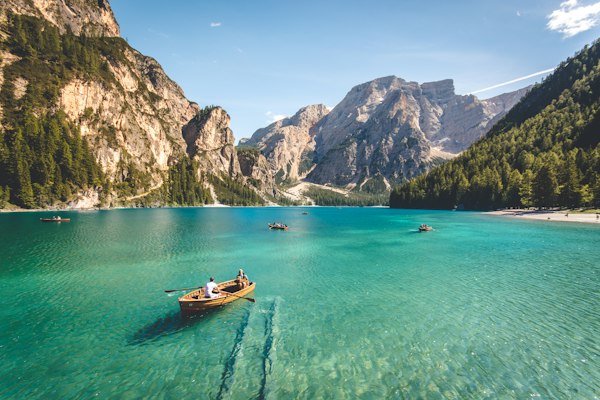
Mountain valleys of the Indian Himalaya near Uttarakhand
India — Uttarakhand

Indian Himalayan Mad Honey

Small quantities of mad honey are produced in the Uttarakhand, Himachal Pradesh, and Meghalaya regions of India. Typically harvested by Apis cerana (the Asian hive bee) and Apis dorsata, feeding on local Rhododendron species. Production volumes are very low, and verified, lab-tested supply rarely reaches international markets.
  • Bee: Apis cerana / dorsata
  • GTX: 5–12 ppm
  • Colour: Light amber
  • Taste: Mild, sweet
  • Season: Spring
Misty mountain landscape in Southeast Asia
Bhutan & Myanmar

Rare Southeast Asian Varieties

Isolated pockets of mad honey production exist in the mountain forests of Bhutan and the Chin Hills of Myanmar, where wild bee populations forage on local Rhododendron. These varieties are extremely rare, almost never exported, and are consumed almost entirely within local communities. No verified commercial supply exists on the international market.

  • Bee: Various wild species
  • GTX: Variable
  • Colour: Variable
  • Taste: Unknown commercially
  • Season: Spring

Why Nepalese Mad Honey Is Considered the Best

Among all varieties, Himalayan cliff honey from Nepal's Solukhumbu region is universally regarded as the gold standard for several reasons:

Higher altitude means denser Rhododendron coverage and less dilution from other nectar sources. Apis laboriosa — a wild species that cannot be domesticated — produces honey with a fuller, more complex grayanotoxin profile than managed bee species. The spring harvest window at 3,000–4,000m coincides with peak Rhododendron bloom, concentrating the active compounds. And the traditional hand-press extraction preserves every raw enzyme, pollen grain, and bioactive compound — nothing is heated, filtered, or diluted.

This is the variety that Everest Mad Honey offers — sourced directly from Gurung communities, independently lab-tested, and shipped worldwide with free insured delivery.

09 — Red Honey

Red Honey — The Rarest & Most Coveted Grade

A legendary variety that appears only in certain spring harvests, red honey represents the pinnacle of Himalayan mad honey

What Makes Red Honey Different?

Red honey is not a separate species or product — it is a naturally occurring grade of Himalayan mad honey that appears when conditions align perfectly during the spring harvest. When Apis laboriosa bees forage almost exclusively on high-altitude Rhododendron arboreum (which produces deep crimson flowers), the resulting honey takes on a distinctive deep red to burgundy colour that is visually striking and immediately recognisable.

This happens rarely. It requires a season where Rhododendron bloom is exceptionally dense, competing nectar sources are minimal, and the cliff hive is positioned within range of a nearly pure R. arboreum stand. When these conditions align — perhaps only one in every three to five spring harvests — the result is a honey with significantly elevated grayanotoxin, a more intense bitter-sweet flavour, and a richer, thicker consistency than standard mad honey.

Red honey is not artificially coloured or blended. Its colour comes entirely from the anthocyanin pigments and flavonoids concentrated in Rhododendron arboreum nectar — the same compounds that give the flowers their red hue. These pigments survive the enzymatic conversion by the bees and remain stable in the finished honey.
Deep red Himalayan mad honey showing its distinctive burgundy colour

The distinctive deep-red hue of authentic Himalayan red honey — naturally derived from Rhododendron arboreum nectar pigments

🌷

Extremely Rare

Red honey appears only in select spring harvests when Rhododendron arboreum dominates the forage. Production is unpredictable and cannot be controlled or replicated artificially.

🔥

Higher Potency

The near-exclusive Rhododendron forage source means significantly less nectar dilution — resulting in grayanotoxin concentrations at the upper end of the spectrum for Himalayan mad honey.

🏆

Collector's Grade

Red honey is the most sought-after variety among serious mad honey enthusiasts and collectors. Limited availability and exceptional quality make it a genuine luxury product.

10 — Effects

What Does Mad Honey Feel Like?

One of the first questions people ask about mad honey is: what does it actually feel like? The experience varies from person to person depending on body weight, tolerance, dosage, and the potency of the specific batch — but there are several consistent, widely-reported effects that define the mad honey experience.

0m Minutes 0–15

The Taste

A distinctive bitter-sweet flavour hits immediately, followed by a mild tingling or warming sensation in the throat. The taste is unmistakable — unlike any regular honey.

30m Minutes 15–45

Onset

A gentle warmth begins to spread from the stomach outward through the body. Muscles begin to relax. Some users feel a mild tingling in the fingertips or a slight flush of the cheeks.

1h Hour 1–3

Peak Effects

Full relaxation, mild euphoria, and a calm, meditative headspace. Users often describe feeling "warm and content" — similar to the deep comfort of a hot bath or a glass of wine, but without impaired cognition.

4h Hour 3–5

Gentle Fade

Effects gradually diminish. Many users report feeling refreshed and well-rested afterward, with no "crash" or hangover. Sleep quality is often improved on the evening of consumption.

Commonly Reported Effects

☀️

Body Warmth

The most universally reported effect. A gentle, radiating warmth that begins in the core and spreads outward — often described as feeling like sitting in front of a fire or stepping into a warm bath.

😌

Mild Euphoria

A subtle lift in mood — a quiet contentment rather than an intense high. Users describe feeling at ease, present, and gently positive. Not intoxicating, not impairing — just pleasantly calm.

🧠

Mental Clarity

Interestingly, many users report that despite the relaxation, their thinking remains clear and focused. This distinguishes mad honey from alcohol or sedatives — the body relaxes while the mind stays sharp.

💤

Improved Sleep

When taken in the evening, mad honey frequently promotes deep, restful sleep. Many users report falling asleep more easily and waking feeling noticeably refreshed — one of the most valued effects for regular users.

What About Negative Effects?

At recommended doses (1–2 teaspoons), negative effects are uncommon. However, excessive consumption can cause temporary nausea, light-headedness, brief episodes of low blood pressure, and in rare cases, slowed heart rate (bradycardia). These effects resolve on their own within a few hours and do not require medical intervention in the vast majority of documented cases. The key to a positive experience is simple: dose responsibly, start low, and wait before taking more.

Individual experience varies: Body weight, metabolism, stomach contents, and personal sensitivity all affect how you experience mad honey. Your first dose should always be conservative — you can always take more next time, but you cannot un-take what you have already consumed.

11 — Shelf Life

How Long Does Mad Honey Last? Storage & Care Guide

One of the remarkable properties of raw honey — including mad honey — is its extraordinary natural shelf life. Thanks to its low moisture content, acidic pH, and naturally occurring hydrogen peroxide, properly stored honey resists bacterial growth and remains edible for years. Archaeological honey over 3,000 years old has been found in Egyptian tombs in still-edible condition.

Mad honey follows the same principles. When stored correctly, it remains safe to consume and retains its grayanotoxin potency for an extended period. Here is what you need to know:

📅

Official Shelf Life: 2–3 Years

Everest Mad Honey labels its products with a conservative shelf life of 2–3 years from harvest date. In practice, properly stored raw honey remains safe to consume well beyond this, though we recommend consuming within this window for optimal potency and flavour.

🌡️

Optimal Temperature: 10–25°C

Store your mad honey at room temperature, away from extreme heat or cold. A kitchen cupboard, pantry, or shelf away from the stove or oven is ideal. Avoid direct sunlight, which can degrade some bioactive compounds over time.

💧

Keep It Dry

Moisture is honey's only real enemy. Always use a clean, dry spoon when scooping mad honey from the jar. Never introduce water, wet utensils, or food particles into the jar — this can raise the moisture content and create conditions for fermentation.

🪐

Airtight Seal Matters

Always close the jar tightly after use. Exposure to air doesn't cause spoilage, but it can accelerate crystallisation and allow ambient moisture to enter. The glass jars used by Everest Mad Honey provide an excellent airtight seal.

Does Mad Honey Lose Potency Over Time?

Grayanotoxin is a relatively stable compound, but research suggests it can degrade slowly when exposed to heat, prolonged UV light, and oxygen. Under proper storage conditions (cool, dark, sealed), the rate of degradation is minimal — you should notice no meaningful difference in effects within the 2–3 year window. After that, potency may gradually decline, though the honey itself remains safe to eat.

✓ Do

  • Store in a cool, dark cupboard (10–25°C)
  • Keep the lid tightly sealed after each use
  • Use a clean, dry spoon every time
  • Consume within 2–3 years for best potency
  • Gently warm crystallised honey in a warm water bath (under 40°C)

✗ Do Not

  • Refrigerate (accelerates crystallisation unnecessarily)
  • Microwave or heat above 40°C (destroys enzymes and may affect GTX)
  • Leave in direct sunlight or near a heat source
  • Introduce wet spoons, fingers, or food particles
  • Transfer to plastic containers (glass is always best)

Crystallisation is normal: If your mad honey crystallises over time, it has not gone bad. Crystallisation is a natural process that occurs in all raw honeys. Simply place the sealed jar in a bowl of warm water (not boiling — under 40°C) for 15–20 minutes and stir gently. The honey will return to its smooth, liquid state with its potency fully intact.

12 — Shop

Experience Authentic Himalayan Mad Honey

Lab-tested, batch-traceable, directly sourced from Gurung communities in Solukhumbu, Nepal — with free insured shipping worldwide

Most Popular

Mad Honey — 250g

$99
Was $130
  • Raw, unfiltered Himalayan cliff honey
  • Lab-tested with batch certificate
  • Free insured worldwide shipping
  • Perfect for first-time buyers
  • Approx. 25–50 servings (1–2 tsp)
Order Now — $99
Best Value

Master Reserve — 500g

$139
Was $250
  • Premium 500g in bespoke silk gift box
  • Lab-tested with batch certificate
  • Free insured worldwide shipping
  • Ideal for gifting & collectors
  • Approx. 50–100 servings (1–2 tsp)
Order Now — $139
📦

Free Worldwide Shipping

🔐

Fully Insured Delivery

🔬

Lab-Tested Every Batch

🌍

Ships to 180+ Countries

👥

Direct Gurung Sourcing