
Mad Honey
From the high cliffs of Nepal to your doorstep — everything you need to know about the world's rarest, most extraordinary honey. History, science, benefits, safety, and how to experience it yourself.
What Is Mad Honey?
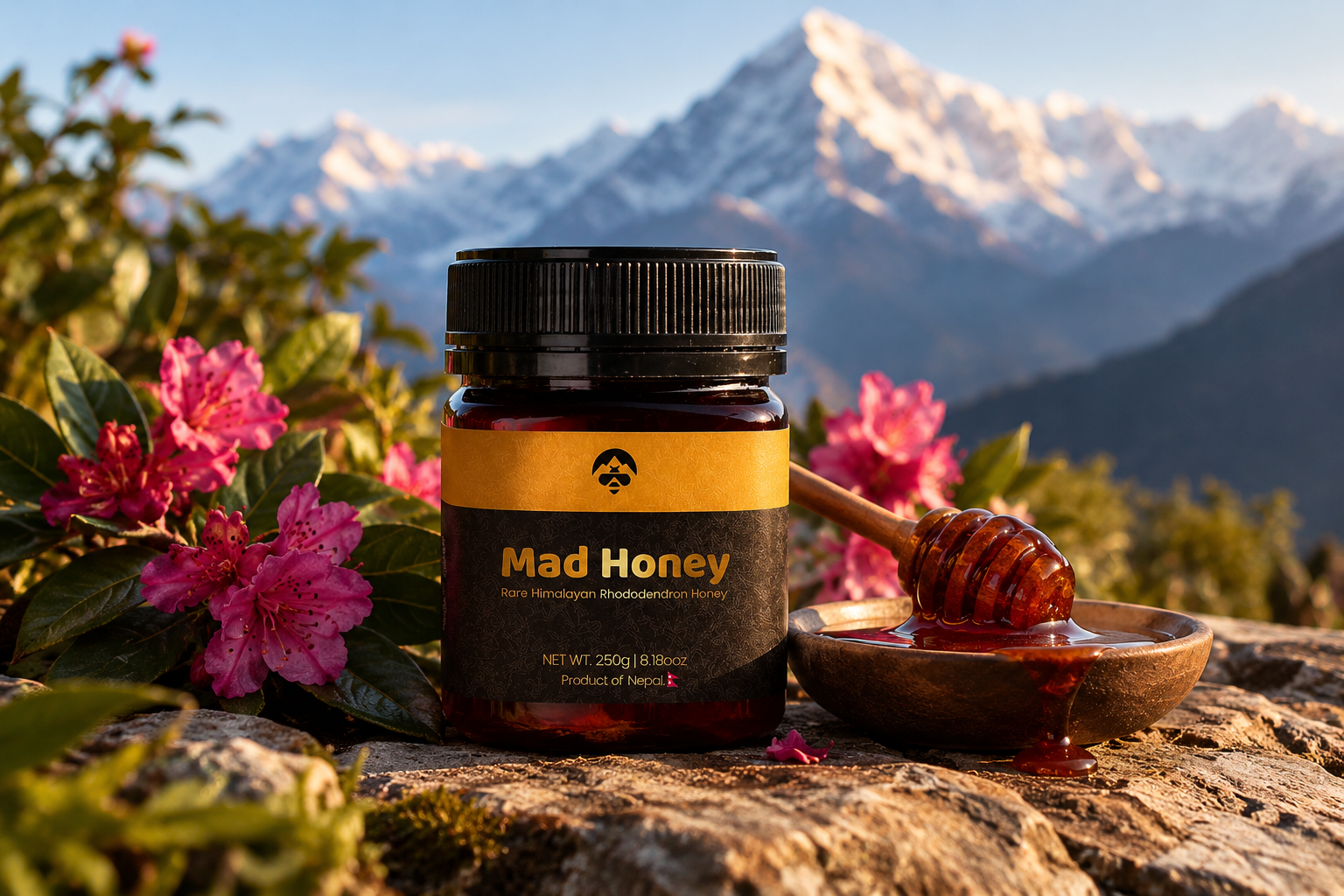
Authentic Himalayan mad honey — deep reddish-brown with natural grayanotoxin compounds
Mad honey is a rare, naturally occurring honey produced when bees forage on the nectar of certain Rhododendron species that grow in high-altitude mountain regions. Unlike regular honey, it contains grayanotoxin — a bioactive compound that produces distinctive effects ranging from mild relaxation and warmth to gentle euphoria.
Known by many names around the world — deli bal in Turkey, cliff honey in Nepal, and miel fou ("crazy honey") in historical French — mad honey has been harvested, traded, and consumed for over 2,500 years. It remains one of the rarest and most sought-after natural substances on earth.
What makes mad honey truly unique is its dual nature. It is both a food and a bioactive substance. In small, measured amounts, it delivers a genuinely one-of-a-kind experience that no other natural food product can replicate.
The science behind mad honey is well-understood. Grayanotoxin works by binding to voltage-gated sodium channels in the body, temporarily modifying how nerve signals are transmitted. This is the same mechanism responsible for both its therapeutic potential and the importance of proper dosing.
Mad honey is produced primarily in two regions: the Himalayan foothills of Nepal, where wild Apis laboriosa (the world's largest honey bee) builds massive hive colonies on sheer cliff faces at elevations of 2,500–4,000 meters, and the Black Sea region of Turkey, where managed hives produce a milder variety called deli bal.
The honey itself is visually and sensorially distinct — a deep reddish-brown color, noticeably thicker than regular honey, with a bittersweet, earthy flavor and a lingering warmth in the throat that conventional honey simply does not have.
"Traditional knowledge has not been invalidated by modern science — it has simply given the molecular explanation as to why this knowledge works."— On the pharmacology of grayanotoxin in traditional honey
100% Natural
No additives. No processing. Straight from hive to jar.
Grayanotoxin
The bioactive compound from Rhododendron nectar.
2,500+ Years
Documented use since ancient Greece & Nepal.
Two Sources
Nepal (Himalayan) and Turkey (Black Sea).
A History Older Than Western Medicine
Mad honey isn't a modern discovery — it has been revered, feared, and weaponized for millennia. Its story stretches from the battlefields of ancient Anatolia to the high cliffs of the Himalayas, woven into the traditions of some of the world's most resilient cultures.
Xenophon and the Ten Thousand
The Greek historian Xenophon recorded the earliest known encounter with mad honey. His retreating army, marching near Trabzon in modern-day Turkey, discovered local honeycombs and consumed them freely. The soldiers were struck by violent vomiting, diarrhea, and disorientation — unable to stand upright. All recovered fully within 24 hours, marking the first documented case of grayanotoxin intoxication in Western history.
Mithridates' Honey Trap
King Mithridates VI of Pontus turned mad honey into a weapon against the Roman Empire. When Pompey's legions advanced through the Black Sea region, Mithridates' allies left pots of mad honey along their path. The Roman soldiers consumed it eagerly — and were incapacitated. What followed was a massacre. Ancient sources estimate between 480 and 1,800 Roman soldiers were killed in what became history's most famous biological ambush.
Aristotle's Observation
Aristotle noted that honey from certain boxwood flowers caused healthy men to "go mad," while intriguingly observing that epileptic patients appeared to recover after consuming it — one of the earliest hints at mad honey's therapeutic potential.
Queen Olga's Stratagem
In the Byzantine Empire, Queen Olga's allies reportedly massacred 5,000 Russian soldiers after incapacitating them with fermented mead made from mad honey — proving the substance's military potential remained well-known centuries after Mithridates.
Europe's "Crazy Honey" Trade
By the 18th century, approximately 25 tons of mad honey were exported annually from Turkey's Black Sea region to Europe, where it was called miel fou — "crazy honey." It was blended into alcoholic beverages, used as a traditional medicine, and sold as an exotic luxury by apothecaries across France, Germany, and Britain.
The Gurung Honey Hunters of Nepal
While Europe traded mad honey as a curiosity, the Gurung people of Nepal had been harvesting it for generations — and still do today. Using handmade rope ladders, smoke torches, and extraordinary courage, Gurung hunters scale vertical cliffs at altitudes exceeding 4,000 meters to collect honeycombs from wild Apis laboriosa colonies. This living tradition is one of the world's most remarkable examples of indigenous knowledge in action.
The Science Catches Up
German scientist P. C. Plugge isolated andromedotoxin (now called grayanotoxin I) from Trabzon honey — finally giving a molecular identity to the compound that had fascinated and confounded humans for two millennia. Modern science could now explain what ancient civilizations had long known through experience.
Years of documented history. From Xenophon's soldiers in 401 BCE to today's Gurung honey hunters in Nepal, mad honey is one of the longest continuously used bioactive substances known to humanity.
How Mad Honey Is Harvested
Mad honey doesn't come from a factory or a farm. It comes from one of the most extreme harvesting traditions on earth — Gurung honey hunters scaling sheer cliff faces thousands of meters above the valley floor, armed with nothing but rope ladders, bamboo poles, and fire.
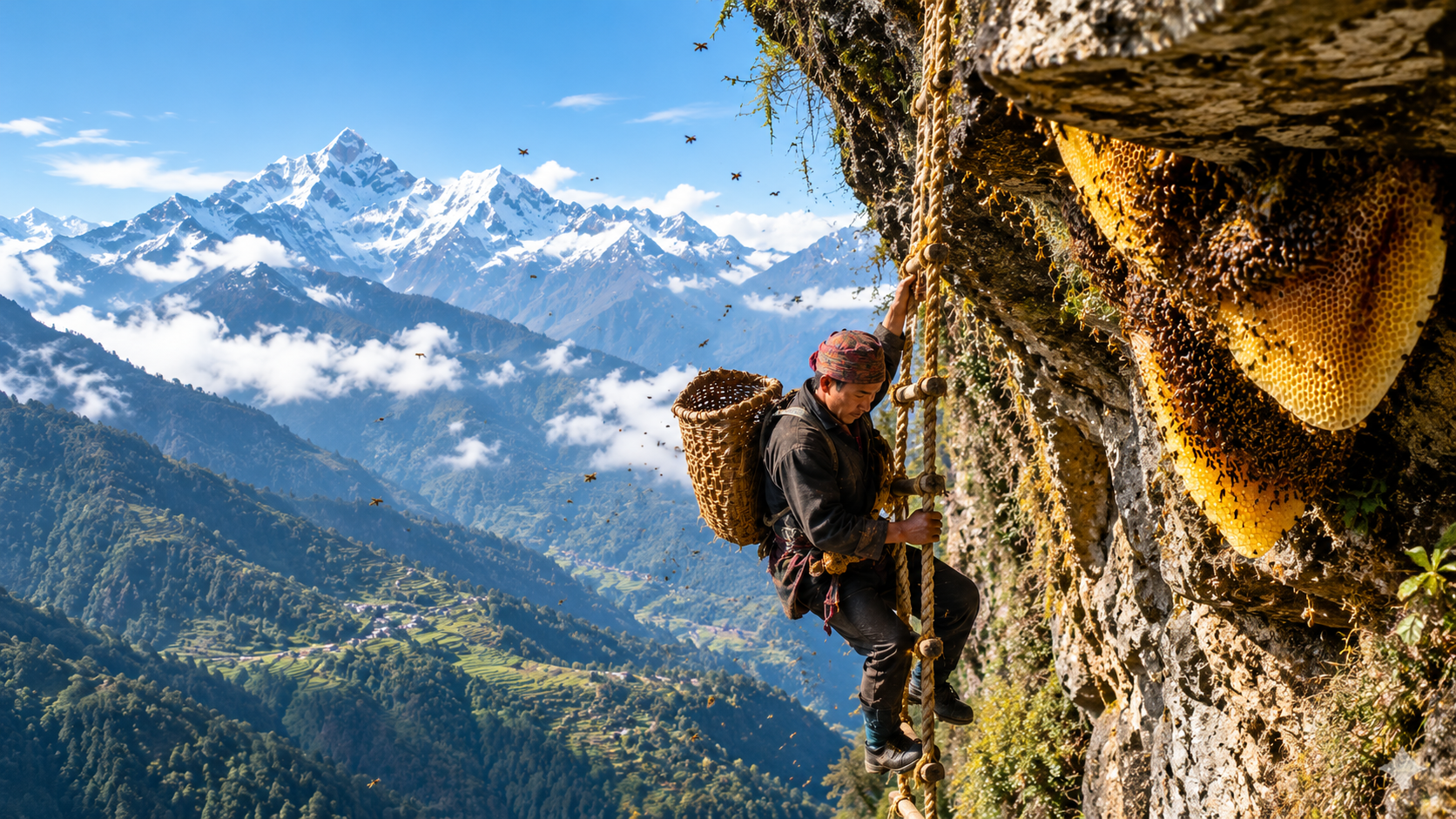
A Gurung honey hunter descends a handmade rope ladder to reach wild bee colonies on a Himalayan cliff face
Rhododendron Season Begins
Everything starts with the bloom. At elevations of 2,500–4,000 meters, certain species of Rhododendron — particularly R. arboreum in Nepal — flower in spring and autumn. Their nectar is naturally rich in grayanotoxin, the compound that gives mad honey its unique properties.
Apis laboriosa Forages
The world's largest honey bee — Apis laboriosa, the Himalayan giant cliff bee — collects this grayanotoxin-rich nectar and produces honey in enormous combs that can reach 1.5 meters in length. These colonies build exclusively on sheer cliff faces, making the honey virtually inaccessible to all but the most skilled hunters.
The Hunters Ascend
Gurung honey hunters from Nepal's hill communities climb using handmade rope ladders anchored to the cliff top. A team below lights fires of green leaves to create smoke that calms the bees. The lead hunter — dangling hundreds of meters above the ground — uses long bamboo poles to cut sections of comb, which are lowered in baskets to the team below.
Extraction & Filtering
The raw honeycomb is carefully separated and the honey is cold-extracted by hand — no heat, no machinery, no processing. This preserves the full spectrum of grayanotoxins, enzymes, and bioactive compounds. The result is a thick, dark, reddish-brown honey unlike anything else in the world.
Lab Testing & Certification
Before any jar leaves Nepal, every batch is sent to an independent third-party laboratory for testing. The analysis confirms grayanotoxin concentration, purity, and food safety — ensuring consistent quality and potency. A batch-traceable lab certificate is included with every jar.
Direct to Your Door
The tested honey is sealed in food-grade glass jars and shipped directly from Nepal to customers worldwide — no middlemen, no warehouses, no resellers. Free insured shipping with real-time tracking delivers your jar in 7–12 business days.
The Himalayan Giant Cliff Bee
Apis laboriosa — Smith, 1871The world's largest honey bee, with a body length of up to 3 centimeters. Apis laboriosa builds single-comb nests exclusively on south-facing cliff walls at altitudes between 2,500 and 4,000 meters — making their honey one of the most inaccessible natural foods on earth. Unlike managed hive bees, these wild colonies cannot be domesticated or farmed, which is why authentic Himalayan mad honey remains so rare.
Spring Harvest
March – May. Higher grayanotoxin. Strongest potency.
Autumn Harvest
October – November. Milder profile. Balanced flavor.
The Science Behind Mad Honey
What gives mad honey its remarkable properties? The answer lies in a single family of naturally occurring compounds — grayanotoxins — and the fascinating way they interact with the human nervous system.
toxin
Grayanotoxin — The Active Compound
Grayanotoxin is a naturally occurring diterpene compound found in the nectar and pollen of over 750 species of Rhododendron. When bees forage on these flowers, the grayanotoxin passes through into their honey — creating what we know as mad honey.
The compound was first isolated by the German scientist P. C. Plugge in 1891, though its effects had been known for millennia. There are three primary types — GTX I, GTX II, and GTX III — with types I and III being the most pharmacologically active.
Grayanotoxin concentration in mad honey varies significantly — from 0.67 to 22.5 mg/kg depending on the Rhododendron species, altitude, season of harvest, and specific batch. This natural variability is precisely why third-party lab testing is essential for ensuring consistent, safe potency.
Three Types of Grayanotoxin
GTX I
Most PotentThe primary bioactive form. Responsible for the majority of mad honey's physiological effects. Also known as andromedotoxin.
GTX II
ModerateFound in lower concentrations. Contributes to the overall effect profile but less pharmacologically active than GTX I.
GTX III
SupportingWorks synergistically with GTX I. Its presence varies by Rhododendron species and contributes to batch-to-batch variation.
How Grayanotoxin Works in the Body
Binding
Grayanotoxin binds to voltage-gated sodium channels on nerve and muscle cells.
Channel Modification
The channels are held in a modified open state, altering how nerve signals are transmitted.
Physiological Effect
At low doses: relaxation, warmth, mild euphoria. The effect is temporary and fully reversible.
Higher antioxidant activity than regular honey. Laboratory analysis shows that mad honey contains significantly elevated levels of phenolic compounds that work synergistically with grayanotoxins, producing antioxidant effects 2 to 3 times greater than conventional commercial honey varieties — as measured by ORAC (Oxygen Radical Absorbance Capacity) testing.
Benefits & Effects of Mad Honey
Mad honey has been used for therapeutic purposes across Nepal and Turkey for centuries. Modern science is beginning to explore and validate many of these traditional applications — though rigorous clinical trials remain limited.
Deep Natural Relaxation
The most widely reported effect of mad honey. Users describe a gentle, calming relaxation that settles through the body — a warmth that eases tension without drowsiness or mental fog. Unlike sedatives, the relaxation feels natural and clear-headed.
Strong Traditional EvidenceImproved Sleep Quality
Many regular users report significantly better sleep when taking a small amount before bedtime. The natural relaxation promotes faster onset and deeper, more restful sleep — making it a popular evening ritual for those who struggle with restlessness.
Moderate EvidenceAntioxidant Powerhouse
Laboratory analysis confirms that mad honey contains 2–3 times the antioxidant activity of conventional honey. Its elevated phenolic compounds work synergistically with grayanotoxins, providing strong free-radical scavenging properties.
Strong Lab EvidenceCalm Mood Elevation
A subtle, gentle mood lift is commonly described — not the intensity of a stimulant, but a quiet sense of well-being and contentment. Users often compare it to the feeling of sitting in warm sunlight on a calm afternoon.
Traditional UseSustained Natural Energy
Unlike the spike-and-crash cycle of caffeine, mad honey delivers steady, sustained energy lasting 2–4 hours. Its natural sugar biochemistry, combined with bioactive compounds, provides a smoother energy curve that supports focus without jitteriness.
Moderate to StrongDigestive Wellness
Traditional use across both Nepal and Turkey includes relief from dyspepsia, gastritis, and stomach discomfort. Mad honey contains prebiotic oligosaccharides that support gut health, alongside antimicrobial properties documented in broader honey research.
Moderate EvidenceTraditional Pain & Wellness Uses
Across centuries of use in Nepal and Turkey, mad honey has been traditionally applied for joint pain and muscle aches, respiratory health (sore throats and congestion), blood pressure regulation, and as a natural tonic for overall vitality. Research indicates grayanotoxin has analgesic properties effective for acute pain, diabetic neuropathy, and rheumatic conditions — though comprehensive human clinical trials are still needed.
Traditional Use — Research OngoingWhat to Expect — The Experience Timeline
Here's what a typical first experience looks like at the recommended starter dose of 1 teaspoon.
Onset
You may not feel anything immediately. A subtle warmth may begin in the stomach.
Building
A gentle warmth spreads. Mild relaxation. A quiet sense of calm settles in.
Peak
Full effects. Deep relaxation, mild euphoria, steady energy. Clear-headed and pleasant.
Gentle Fade
Effects gradually and gently subside. No crash, no hangover. Natural return to baseline.
Types & Varieties of Mad Honey
Not all mad honey is the same. The two primary sources — Nepal and Turkey — produce distinctly different varieties, each with its own character, potency, and harvesting tradition.
Himalayan Mad Honey
The most prized and potent variety. Harvested from wild cliff bee colonies in the world's highest mountain range by indigenous Gurung honey hunters using ancient techniques passed down through generations.
Deli Bal (Turkish Mad Honey)
A milder variety produced in Turkey's verdant Black Sea region. Harvested from managed beehives using conventional beekeeping techniques, making it more commercially accessible but typically lower in potency.
Other Minor Sources
Appalachian (USA)
Rare. From mountain laurel. Historically documented but no commercial production.
Japan & Korea
Small quantities. Heavily regulated. South Korea banned commercial sale in 2005.
Europe (Alps)
Trace amounts from alpine Rhododendron. No reported poisoning cases. Not commercially available.
How to Use Mad Honey — Dosage Guide
Getting the most from mad honey starts with the right dose. Since grayanotoxin concentrations vary naturally between batches, starting low and adjusting gradually is the golden rule. Here's your complete guide.
Starter Dose
~5 gramsPerfect for first-time users. Start here to understand how your body responds. Expect mild warmth and gentle relaxation.
Standard Dose
~5–10 gramsFor experienced users. The sweet spot for most people. Full relaxation, mood elevation, and the complete mad honey experience.
Upper Limit
~15 gramsNever exceed this amount in 24 hours. Higher doses significantly increase the risk of adverse effects. More is not better.
Step-by-Step for First-Timers
Take on an Empty Stomach
Mad honey is best consumed on an empty or near-empty stomach for optimal absorption. Morning or 2–3 hours after your last meal is ideal.
Start With One Level Teaspoon
Measure a single level teaspoon (about 5 grams). Consume it directly or dissolve in lukewarm water or tea — never in hot liquids, which may degrade active compounds.
Wait and Observe
Effects typically begin within 30–60 minutes. Be patient. Do not take a second dose before the 2-hour mark, even if you feel nothing at first.
Adjust in Future Sessions
Based on your first experience, you can gradually adjust your dose upward in small increments. Most people find their sweet spot between 1 and 2 teaspoons.
Safety & Precautions
Mad honey is a bioactive substance and should be treated with respect. When consumed responsibly at recommended doses, it has an excellent safety record — but understanding its risks is essential for every user.
Zero fatalities in a 2015 systematic review of 1,199 documented cases of mad honey intoxication worldwide. While overconsumption can cause temporary, uncomfortable symptoms, no deaths have been attributed to mad honey when consumed in its natural form. Symptoms of overconsumption typically resolve fully within 24 hours.
— Gunduz et al., systematic review of mad honey poisoning cases
Possible Side Effects of Overconsumption
Early Warning Signs
- Dizziness or lightheadedness
- Nausea or stomach discomfort
- Excessive sweating
- Tingling sensation in extremities
- Blurred vision
- Temporary weakness
These symptoms are temporary and typically resolve on their own within a few hours. Rest, hydrate, and wait.
Seek Medical Attention
- Irregular or very slow heartbeat (bradycardia)
- Very low blood pressure (hypotension)
- Difficulty standing or walking
- Loss of consciousness
- Severe nausea and vomiting
- Difficulty breathing
These symptoms require medical attention. Treatment with atropine and IV fluids is standard and effective. Full recovery is expected.
Who Should Avoid Mad Honey
Heart conditions — anyone with arrhythmias, cardiac disease, or heart rhythm disorders
Blood pressure issues — those with low blood pressure or currently taking BP medications
Pregnant or breastfeeding — insufficient safety data for maternal and fetal health
Children under 18 — developing bodies are more sensitive to bioactive compounds
Adults over 75 — increased cardiovascular sensitivity at advanced age
Cardiac / BP medications — potential for dangerous interactions with heart and blood pressure drugs
Blood thinners — grayanotoxin may interact with anticoagulant medications
Bee product allergies — those allergic to honey, bee pollen, or bee stings
⚠ If You Experience Severe Symptoms
Contact emergency services or visit your nearest emergency room immediately. Inform medical professionals that you consumed mad honey (grayanotoxin). The standard treatment is atropine and intravenous fluids, which is highly effective. Full recovery typically occurs within 24 hours. Do not induce vomiting unless directed by a medical professional.
Legal Status of Mad Honey Worldwide
One of the most common questions we receive: is mad honey legal? The short answer — yes, in most countries. Here's the complete, country-by-country breakdown so you can buy and enjoy mad honey with full confidence.
Legal in most major markets worldwide. Mad honey is classified as a natural food product — not a controlled substance — in the vast majority of countries. It is not listed under any international drug convention and can be legally purchased, possessed, and consumed across North America, Europe, and most of Asia and Oceania.
United States
Fully legal in all 50 states. Mad honey is classified as a natural food product by the FDA. There are no federal or state restrictions on purchase, possession, or consumption. It is not listed in the Controlled Substances Act and can be freely imported, sold, and shipped domestically.
FDA regulates honey under 21 CFR Part 101. Mad honey meets all requirements as a natural, unprocessed food product.
United Kingdom
Fully legal throughout the UK. Mad honey is not listed in the Misuse of Drugs Act 1971, the Psychoactive Substances Act 2016, or any other UK legislation restricting its sale or use. It is classified as a natural food product and can be purchased, imported, and consumed without restriction.
UK Food Standards Agency (FSA) treats mad honey as a specialty food product. No import restrictions apply for personal or commercial quantities.
European Union
Legal across all 27 EU member states. Mad honey falls under the EU Honey Directive (Council Directive 2001/110/EC), which defines honey as a natural product. The European Food Safety Authority (EFSA) published a 2023 assessment identifying a combined grayanotoxin I + III concentration of 0.05 mg/kg as a reference threshold — but imposed no outright ban.
Individual member states (Germany, France, Netherlands, etc.) have no additional restrictions on sale or import of mad honey.
Canada
Legal nationwide. Mad honey is not a controlled substance under Canada's Controlled Drugs and Substances Act. The Canadian Food Inspection Agency (CFIA) classifies it as a natural food product. It can be legally imported, sold, and consumed across all provinces and territories.
Imports may be subject to standard CFIA food inspection requirements. No grayanotoxin-specific regulations exist in Canadian law.
Australia
Not banned, but stringent biosecurity applies. Australia's Department of Agriculture enforces some of the world's strictest import biosecurity controls on all honey products. Mad honey is not a prohibited substance, but importing it requires meeting biosecurity clearance and may be subject to inspection or testing at the border.
Australia Biosecurity Act 2015 governs all honey imports. Products must be declared and may require permits. We ship to Australia with full customs documentation.
South Korea
Commercial sale banned since 2005. South Korea is one of the few countries to explicitly ban the commercial sale of mad honey following several documented poisoning incidents. Personal possession in small quantities is not specifically criminalized, but sale and distribution are prohibited.
We do not ship to South Korea in compliance with local regulations.
Nepal & Turkey — Countries of Origin
Deeply rooted in local culture and fully legal. In both Nepal and Turkey, mad honey is a traditional product with centuries of cultural significance. In Nepal's Solukhumbu region, Gurung communities have harvested it for generations as a source of income and traditional medicine. In Turkey's Black Sea region, deli bal (mad honey) is sold openly in local markets and is recognized as a regional specialty. Neither country restricts its production, sale, or export.
Nepal's government recognizes wild honey harvesting as a protected cultural practice. Turkey's Ministry of Agriculture classifies deli bal as a regional food product of the Black Sea provinces.
ⓘ Important Note on Regulations
Laws and regulations can change. While we strive to keep this information accurate and up to date, always check your local laws before purchasing if you are unsure about the legal status in your specific country or region. Everest Mad Honey ships internationally with full customs documentation, ingredient declarations, and lab testing certificates to ensure smooth delivery. If you have questions about shipping to your country, contact our team — we're happy to help.
Why Choose Everest Mad Honey?
The mad honey market is flooded with diluted, untested, and falsely labeled products. Here's why thousands of customers across 30+ countries trust Everest Mad Honey for the authentic experience.
Direct From Source
We source exclusively from Nepal's Solukhumbu region — home to the world's most potent wild mad honey. Our direct partnerships with indigenous Gurung honey hunters eliminate middlemen, ensuring authenticity and fair compensation for the communities who harvest it.
Third-Party Lab Tested
Every batch is independently tested for grayanotoxin concentration, purity, and contaminants. We publish our lab results so you know exactly what you're getting — no guesswork, no surprises. Consistent potency you can trust.
Worldwide Shipping
We ship to 30+ countries with full customs documentation, proper labeling, and insured delivery. Whether you're in the US, UK, Europe, Canada, or Australia — your order arrives safely with tracking every step of the way.
How We Compare
| Quality Factor | Everest Mad Honey | Typical Sellers |
|---|---|---|
| Source Region | ✓ Nepal — Solukhumbu (wild, Himalayan) | Often unverified or blended origin |
| Bee Species | ✓ Apis laboriosa (wild cliff bees) | May use managed Apis mellifera |
| Lab Testing | ✓ Third-party tested every batch | ✗ Rarely tested or self-reported |
| Potency Verification | ✓ GTX concentration verified | ✗ Potency unknown or exaggerated |
| Additives or Dilution | ✓ 100% pure, never diluted | ⚠ Often diluted with regular honey |
| Customs Documentation | ✓ Full docs for smooth delivery | ✗ Minimal, risks seizure at customs |
| Customer Support | ✓ Dedicated team, dosage guidance | ⚠ Limited or no support |
| Money-Back Guarantee | ✓ Full satisfaction guarantee | ✗ No returns on most sellers |
What Our Customers Say
"I've tried mad honey from three different sellers — this is the only one that delivered the real experience. You can taste the difference immediately. Dark, potent, and exactly what I was looking for."James T., United States✓ Verified Buyer
"Brilliant quality. Arrived to the UK within a week, beautifully packaged. I take a teaspoon before bed and sleep like an absolute log. Best purchase I've made this year."Sarah M., United Kingdom✓ Verified Buyer
"Was skeptical at first, but the lab reports convinced me to try Everest. The relaxation is real — gentle, natural, no grogginess the next day. Already ordered my second jar."Michael R., Canada✓ Verified Buyer
Mad Honey FAQ
Everything you need to know about mad honey — answered clearly and honestly. Can't find your question? Reach out to our team anytime.
General Questions
What exactly is mad honey?
Mad honey is a rare, naturally occurring variety of honey produced by bees that forage on the nectar of Rhododendron flowers. These flowers contain grayanotoxin — a naturally occurring diterpene compound — which passes through the bees into their honey. The resulting honey has distinct bioactive properties, including relaxation, mild euphoria, and various traditional medicinal uses.
It's called "mad" honey because of the intoxicating effects that occur when consumed in large quantities — a phenomenon documented since ancient times. At recommended doses, however, the effects are gentle, pleasant, and entirely manageable.
What does mad honey taste like?
Authentic Himalayan mad honey has a dark, rich, slightly bitter taste with earthy undertones — distinctly different from regular honey. Some describe it as bittersweet with a slight tang or medicinal quality. Turkish deli bal tends to be lighter and more floral. The taste is a marker of authenticity — if it tastes exactly like regular honey, it probably is.
Where does mad honey come from?
The two primary sources are Nepal and Turkey. Nepalese mad honey — harvested from wild cliff bee colonies (Apis laboriosa) in the Himalayas at altitudes of 2,500–4,000 meters — is considered the most potent and authentic. Turkish deli bal comes from the Black Sea region and is produced by managed honeybees (Apis mellifera) foraging on Rhododendron ponticum and R. luteum.
Minor sources exist in parts of the Appalachian United States, Japan, Korea, and the European Alps, but none produce commercially significant quantities.
Effects & Safety
What are the benefits of mad honey?
Traditional uses spanning centuries include deep natural relaxation, improved sleep quality, gentle mood elevation, sustained energy, and digestive wellness. Modern research has confirmed that mad honey has 2–3 times higher antioxidant activity than regular honey and has shown preliminary evidence for analgesic (pain-relieving) and anti-inflammatory properties.
It's important to note that while traditional evidence is strong, comprehensive clinical trials are still limited. Mad honey is a natural food product with bioactive properties — not a pharmaceutical.
Is mad honey safe?
Yes — when consumed responsibly at recommended doses. A systematic review of 1,199 documented cases of mad honey intoxication found zero fatalities. The effects of overconsumption are temporary and typically resolve fully within 24 hours. That said, it is a bioactive substance and should be treated with respect. Start low, follow dosage guidelines, and consult a healthcare provider if you have underlying heart conditions or take blood pressure medication.
What are the side effects of mad honey?
At recommended doses (1–2 teaspoons), side effects are rare and mild. Overconsumption can cause dizziness, nausea, excessive sweating, tingling, or blurred vision — these typically resolve within a few hours with rest and hydration.
Significant overconsumption can lead to more serious symptoms including bradycardia (slow heartbeat), hypotension (low blood pressure), or in extreme cases, loss of consciousness. These require medical attention but are treatable with standard protocols (atropine + IV fluids) and full recovery is expected.
Can you overdose on mad honey?
While no deaths have been attributed to mad honey consumed in its natural form, overconsumption can cause uncomfortable symptoms that require medical attention. This is why we strongly recommend never exceeding 3 teaspoons (approximately 15 grams) in any 24-hour period, starting with just 1 teaspoon for your first experience. More is not better — the best experience comes from a controlled, responsible dose.
Who should NOT use mad honey?
Mad honey should be avoided by individuals with heart conditions (arrhythmias, cardiac disease), those with low blood pressure or taking blood pressure medications, pregnant or breastfeeding women, children under 18, adults over 75, those taking blood thinners or cardiac medications, and anyone with bee product allergies. When in doubt, consult your healthcare provider before use.
Legal & Purchase
Is mad honey legal?
Yes — in most countries. Mad honey is legal in the United States (all 50 states), the United Kingdom, all 27 EU member states, Canada, Australia, and most other countries worldwide. It is classified as a natural food product, not a controlled substance. The notable exception is South Korea, which banned commercial sale in 2005. Always verify your local regulations if uncertain.
How is Himalayan mad honey different from Turkish mad honey?
The key differences are potency, source, and method. Himalayan mad honey is produced by wild giant bees (Apis laboriosa) at elevations of 2,500–4,000 meters and is generally stronger, darker, and more earthy in flavor. Turkish deli bal is produced by managed honeybees (Apis mellifera) at lower altitudes and is typically milder, lighter, and more floral. Himalayan honey cannot be farmed — it must be wild-harvested from cliff faces — while Turkish varieties come from managed hives.
How should I store mad honey?
Store in a sealed glass jar at room temperature (50–77°F / 10–25°C), away from direct sunlight. Do not refrigerate — cold temperatures can cause crystallization and affect the texture. If crystallization occurs, gently warm the jar in lukewarm water until it returns to liquid form. Never microwave. Properly stored, mad honey has a shelf life of 2–3 years.
Where can I buy authentic mad honey?
You can purchase authentic, lab-tested Himalayan mad honey directly from everestmadhoney.com. We offer 250g and 500g jars with worldwide shipping. Every batch is third-party tested, and we provide full customs documentation for international orders. Be cautious of sellers on general marketplaces — diluted, untested, and falsely labeled products are common in the mad honey market.
Usage
How much mad honey should I take?
Start with 1 level teaspoon (approximately 5 grams) for your first experience. This is the recommended starter dose. Wait at least 2 hours before considering more. Experienced users typically find their sweet spot at 1–2 teaspoons. Never exceed 3 teaspoons (15 grams) in any 24-hour period. Effects typically begin within 30–60 minutes.
How should I consume mad honey?
Take it on an empty or near-empty stomach for optimal absorption. You can consume it directly from the spoon, dissolve it in lukewarm water or herbal tea, or spread it on toast. Important: never mix with hot liquids, as high temperatures may degrade the active compounds. Avoid combining with alcohol, as both affect blood pressure. Choose a calm, relaxed setting — especially for your first time.
How long do the effects of mad honey last?
At a standard dose, effects typically follow this timeline: onset at 30–60 minutes (subtle warmth and calm), peak at 1–3 hours (full relaxation, gentle mood elevation), and a gradual fade over 3–5 hours. There is no crash or hangover — the return to baseline is smooth and natural. Individual experiences may vary based on body weight, metabolism, and the specific batch's potency.
Still Have Questions?
Our team is here to help. Whether you need dosage guidance, shipping information, or anything else — we respond within 24 hours.
Contact Our TeamExperience the World's Rarest Honey
Harvested from the cliffs of the Himalayas by the world's last honey hunters. Lab-tested, ethically sourced, and shipped directly to your door. Discover what thousands of customers already know.