
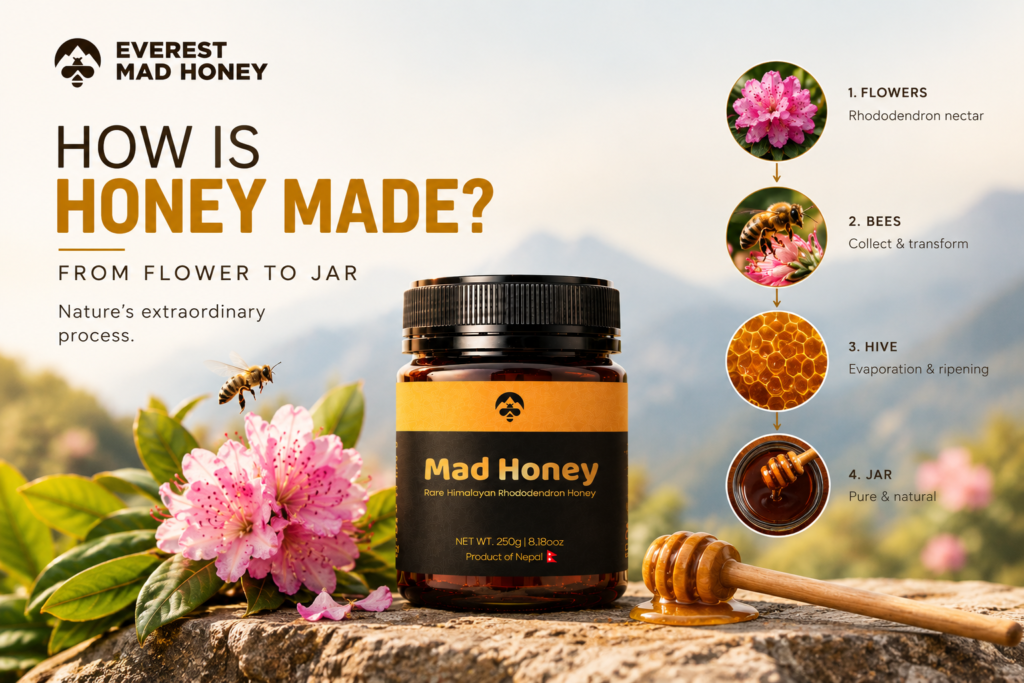
Introduction: One of Nature’s Most Extraordinary Manufacturing Processes
How is honey made? It sounds like a simple question — but the answer reveals one of the most sophisticated natural manufacturing processes on the planet. Every jar of honey you have ever tasted is the end product of an astonishing collaboration between flowering plants, tens of thousands of individual bees, specialised enzymes, precise temperature control, and a preservation system so effective that honey found in ancient Egyptian tombs was still edible thousands of years later.
The journey from flower to jar involves foraging bees visiting up to 150 flowers per trip, a specialised “honey stomach” that begins chemical conversion during flight, mouth-to-mouth transfers between worker bees inside the hive, an evaporation process that reduces water content from 80% down to 18%, and a beeswax seal that creates one of nature’s most perfect storage systems.
And here is what most guides do not tell you: the flowers the bees visit change everything. The same species of bee, following the same biological process, produces wildly different honeys depending on the nectar source — from the mild golden clover honey on your breakfast table to the dark, grayanotoxin-containing mad honey harvested from Himalayan cliff faces. The process is the same; the raw material is what makes the difference.
This is the most comprehensive guide to how honey is made available online — covering the biology, the chemistry, the beekeeping, and the remarkable ways that different nectar sources create different kinds of honey. Whether you are a student, a food enthusiast, a beekeeper, or simply curious, this guide has everything you need.
What Is Honey Made Of? The Chemical Composition
Before we explore how honey is made by bees, it helps to understand what the finished product actually contains. Honey is far more than “sweet stuff” — it is a chemically complex substance with remarkable properties.
The Core Composition
| Component | Approximate Percentage | Role |
|---|---|---|
| Fructose | ~40% | Primary sugar; responsible for honey’s intense sweetness; keeps honey liquid |
| Glucose | ~30% | Secondary sugar; drives crystallisation over time |
| Water | 17–20% | Must stay below ~18% to prevent fermentation |
| Other sugars | ~10% | Over 20 additional complex sugars in trace amounts |
| Enzymes | Trace | Invertase, glucose oxidase, diastase — critical to honey’s creation and preservation |
| Organic acids | Trace | Gluconic acid (primary); gives honey its pH of 3.2–4.5 |
| Minerals | Trace | Potassium, calcium, iron, zinc, magnesium, and others |
| Amino acids | Trace | Proline is the most abundant |
| Vitamins | Trace | Small amounts of B vitamins and vitamin C |
| Antioxidants | Trace | Flavonoids and phenolic acids; vary by floral source |
| Volatile compounds | Trace | Responsible for honey’s aroma and flavour; originate from the nectar source |
Why Composition Matters
The precise ratio of fructose to glucose determines whether your honey stays liquid (high fructose) or crystallises quickly (high glucose). The enzyme content determines its antibacterial potency. The volatile compounds determine its flavour and aroma. And the floral source determines all of these — which is why clover honey, Manuka honey, and Himalayan mad honey taste, look, and behave so differently despite being made by the same fundamental process.
The composition also explains why honey essentially never spoils: its low water activity (typically around 0.56), high sugar concentration, natural acidity, and hydrogen peroxide production create an environment where virtually no microorganism can survive.
How Is Honey Made by Bees? Step 1: Nectar Collection
The process of bees making honey begins not in the hive, but in a flower.
The Foraging Flight
Forager bees — typically the older, more experienced members of the colony — leave the hive and fly up to 5 kilometres (3 miles) in search of flowers producing nectar. A single foraging trip may involve visiting 50 to 150 individual flowers before the bee returns home.
Nectar is a dilute sugar solution produced by flowers specifically to attract pollinators. It is typically 70–80% water, with the remainder being a mixture of three sugars: sucrose, glucose, and fructose. The nectar also contains trace amounts of scent chemicals, amino acids, and other compounds that will eventually contribute to the honey’s flavour profile.
The Honey Stomach
Bees collect nectar using their proboscis — a long, hollow, straw-like tongue designed specifically for reaching into flowers and sucking up liquid. The nectar is stored not in the bee’s regular digestive stomach, but in a specialised organ called the proventriculus or “honey stomach” — a separate chamber that keeps the nectar isolated from the bee’s own digestive system.
The honey stomach can hold up to 40 milligrams of nectar — nearly as much as the bee itself weighs. A bee must visit approximately 100–150 flowers to fill it completely.
Chemistry Begins in Flight
The honey-making process does not wait until the bee returns to the hive. As soon as nectar enters the honey stomach, an enzyme called invertase (secreted from the bee’s salivary and hypopharyngeal glands) begins breaking down the complex sucrose sugar into its simpler components: glucose and fructose. This enzymatic conversion is the first critical chemical transformation in the honey-making process — and it begins during the flight home.
Step 2: Enzymatic Conversion — The Chemistry of Honey-Making
The enzymes that bees add to nectar are what transform a perishable sugar water into one of the most shelf-stable foods on Earth. Understanding this chemistry is central to understanding how honey is made.
The Three Key Enzymes
Invertase (α-glucosidase) is the primary honey-making enzyme. It catalyses the hydrolysis of sucrose into glucose and fructose — the two simple sugars that dominate honey’s composition. This reaction is why honey tastes sweeter than table sugar: fructose is approximately 1.7 times sweeter than sucrose.
Glucose oxidase converts a small portion of the glucose into gluconic acid and hydrogen peroxide. The gluconic acid is responsible for honey’s natural acidity (pH 3.2–4.5), and the hydrogen peroxide provides a powerful antimicrobial defence — one of the reasons honey can last for millennia without spoiling.
Diastase (amylase) breaks down starch and complex carbohydrates into simpler sugars. Its presence in honey is used as a quality indicator — because diastase is heat-sensitive, low diastase levels suggest the honey has been overheated during processing.
The pH Shift
As glucose oxidase produces gluconic acid, the nectar’s pH drops from roughly neutral (around 6.0–7.0) to the acidic range of 3.2–4.5. This acidification is not incidental — it is a critical preservation mechanism. Most harmful bacteria cannot survive at this pH, which is one reason why properly stored honey does not support microbial growth.
Step 3: Trophallaxis — The Hive’s Assembly Line
When the forager bee returns to the hive with a full honey stomach, she does not deposit the nectar directly into storage. Instead, the next stage of how honey is made involves a remarkable social behaviour.
Mouth-to-Mouth Transfer
The forager regurgitates the partially processed nectar and passes it to a younger house bee through a process called trophallaxis — essentially a mouth-to-mouth transfer. The house bee receives the nectar, mixes it with additional enzymes from her own glands, and chews it for approximately 30 minutes. She may then pass it to another house bee, who repeats the process.
This chain of mouth-to-mouth transfers serves two purposes. First, each transfer adds more enzymes, accelerating the chemical breakdown of sucrose and increasing the production of gluconic acid and hydrogen peroxide. Second, each transfer exposes the nectar to air, beginning the critical process of water evaporation.
By the time the nectar has been passed between several bees and deposited into a honeycomb cell, its chemical composition has already shifted significantly from the original nectar.
Step 4: Evaporation and Ripening — From 80% Water to 18%
This is the step that truly transforms nectar into honey — and it is a masterclass in collective engineering.
The Evaporation Challenge
Raw nectar is approximately 70–80% water. Honey needs to be approximately 17–18% water. That means the bees must remove roughly 75% of the nectar’s water content — a remarkable feat of natural dehydration.
How Bees Remove the Water
After depositing the enzyme-enriched nectar into open honeycomb cells, worker bees position themselves around the cells and fan their wings at high speed. This creates a continuous airflow across the surface of the nectar, accelerating evaporation.
The hive itself acts as a precisely controlled drying chamber. Bees maintain an internal hive temperature of approximately 35°C (95°F) — warm enough to aid evaporation but cool enough to prevent damage to the delicate enzymes and sugars. Other bees stationed at the hive entrance fan to circulate fresh, drier air through the hive while expelling moist air.
This process continues for one to three days, depending on humidity, temperature, and the initial water content of the nectar. The bees monitor the process by testing the honey’s consistency — when the water content drops to approximately 17–18%, the nectar has officially become honey.
Why 18% Matters
The 18% water threshold is not arbitrary. At this moisture level, the water activity (aw) drops to approximately 0.56 — well below the threshold where any yeast, mould, or bacterium can survive. This is the magic number that makes honey essentially imperishable. If the water content remains above approximately 20%, wild yeasts can ferment the sugars, causing the honey to spoil.
Step 5: Capping and Storage — Nature’s Perfect Seal
The final step in the honey-making process is also the most elegant.
The Beeswax Cap
Once a honeycomb cell is filled with ripened honey at the correct moisture level, worker bees produce thin flakes of beeswax from special glands on their abdomen and use them to seal the cell with a precisely fitted wax lid. This cap is airtight, protecting the honey from moisture reabsorption, contamination, and exposure to air.
A fully capped frame of honey is the beekeeper’s signal that the honey is ripe and ready for harvest.
The Colony’s Food Supply
The honey stored in capped cells serves as the colony’s long-term food reserve. A healthy hive needs approximately 27–36 kilograms (60–80 pounds) of honey to survive a typical winter. During spring and summer, the colony focuses on building its workforce to a peak of around 50,000 bees. These workers then spend two to three weeks in an intense nectar-gathering effort to stockpile enough honey for the cold months ahead.
An Astonishing Effort
Consider the scale of the work involved: it takes approximately 12 bees their entire lifetime to produce just one teaspoon of honey. A single bee produces only about 1/12th of a teaspoon of honey in its life. The next time you drizzle honey on your toast, you are consuming the life’s work of a dozen insects and the nectar of thousands of flowers.
The Science Behind Honey’s Preservation: Why It Never Spoils
Once you understand how honey is made, you begin to see why it is one of the only foods on Earth that never truly expires. Every step of the process contributes to a multi-layered preservation system.
The Four Defence Mechanisms
1. Low water activity. At 17–18% moisture, honey’s water activity sits around 0.56 — well below the 0.7 threshold where any spoilage organism can survive. The bees’ evaporation process is, in essence, a natural pasteurisation through dehydration.
2. Extreme sugar concentration. At approximately 80% sugar by weight, honey creates immense osmotic pressure. Any bacterium landing in honey has the water pulled out of its cells through osmosis, killing it. The same principle is used in sugar-preserved fruits and jams, but honey takes it to an extreme.
3. Natural acidity. The gluconic acid produced by glucose oxidase gives honey a pH of 3.2–4.5 — acidic enough to inhibit virtually all pathogenic bacteria, which prefer a neutral pH around 7.0.
4. Hydrogen peroxide production. Glucose oxidase produces hydrogen peroxide as a by-product — a well-known antiseptic. This gives honey an active antimicrobial defence system, not just a passive one. The concentration varies between honey types, which is why some honeys (like Manuka) have stronger antibacterial properties than others.
These four mechanisms work together, creating an environment where virtually no pathogen can survive — which is why properly stored honey has been found edible after thousands of years.
From Hive to Jar: How Beekeepers Harvest Honey
Once the bees have done their extraordinary work, the final stage of how honey is made involves human hands.
Commercial Beekeeping Harvest
Uncapping. Beekeepers remove frames of capped honeycomb from the hive. The beeswax caps are sliced off using a heated uncapping knife or an uncapping fork, exposing the honey beneath.
Extraction. The uncapped frames are placed in a centrifugal extractor — a drum that spins the frames at high speed, flinging the honey out of the cells by centrifugal force. This method preserves the comb structure so it can be returned to the hive for the bees to refill.
Straining and filtering. The extracted honey is passed through mesh screens to remove wax particles, bee parts, and other debris. Raw honey is minimally filtered; commercial honey may undergo ultra-filtration, which removes pollen and some beneficial compounds.
Bottling. The strained honey is poured into jars for sale. High-quality producers bottle at low temperatures to preserve enzymes and beneficial compounds.
Raw vs Processed Honey
Raw honey is extracted, strained, and bottled without pasteurisation or ultra-filtration. It retains all of its natural enzymes, pollen, and antioxidants.
Processed (pasteurised) honey has been heated to approximately 71°C (160°F) to kill yeast cells, delay crystallisation, and improve flow. However, pasteurisation also destroys heat-sensitive enzymes like glucose oxidase and diastase — reducing both the antibacterial properties and the nutritional value.
Wild Cliff Honey: A Different Harvest Entirely
Not all honey is harvested from managed hives. In Nepal’s Himalayas, wild cliff honey — including mad honey — is collected from the exposed nests of Apis laboriosa on sheer cliff faces by Gurung honey hunters using handmade rope ladders. This method is dramatically different from commercial beekeeping and is one of the most dangerous food-gathering traditions in the world.
How Different Flowers Create Different Honeys
The answer to “how is honey made” is the same for every type of honey — the biological process does not change. What changes is the raw material: the nectar. And nectar source is what creates the extraordinary diversity in the honey world.
Monofloral Honey
When bees forage predominantly on a single flower species, the resulting honey takes on that flower’s distinctive characteristics. Examples include lavender honey (floral, delicate), acacia honey (very light, slow to crystallise), buckwheat honey (dark, robust), and Manuka honey (from New Zealand’s Leptospermum scoparium, valued for its methylglyoxal content).
Polyfloral (Wildflower) Honey
Most commercial honey is polyfloral — produced by bees foraging across a variety of flowers. The flavour, colour, and properties depend on the local flora, making every batch unique to its region and season.
Honeydew Honey
Not all honey comes from flower nectar. Honeydew honey is produced by bees collecting sugary secretions from aphids and other sap-sucking insects on trees. It tends to be darker, less sweet, and higher in minerals than blossom honey.
Mad Honey: When the Nectar Contains Something Extra
And then there is mad honey — the most unusual type of honey in the world. When bees forage on the nectar of certain Rhododendron species, the honey they produce contains naturally occurring compounds called grayanotoxins. These neurotoxins give the honey mild psychoactive properties that no other honey possesses: warmth, relaxation, euphoria, and lowered blood pressure at small doses.
Mad honey is produced in only two places: Nepal’s Himalayas and Turkey’s Black Sea coast. The Nepalese variety, produced by wild Apis laboriosa bees at high altitude, is considered the most potent in the world.
What Makes Mad Honey Different From Every Other Honey?
The process of how mad honey is made follows the same biological steps as all honey. The difference lies entirely in the nectar source.
The Rhododendron Factor
Certain high-altitude Rhododendron species in Nepal produce nectar containing grayanotoxins — naturally occurring diterpenoid neurotoxins. When Apis laboriosa (the world’s largest honeybee) forages almost exclusively on these flowers at altitudes of 2,500–4,000 metres, the grayanotoxins pass into the honey unchanged. The bees’ enzymatic processing does not neutralise or filter these compounds.
Why Nepal’s Mad Honey Is the Most Potent
In Nepal’s high-altitude Rhododendron forests, the near-monofloral foraging environment means the bees have limited access to non-Rhododendron nectar. This creates honey with the highest natural concentrations of grayanotoxins available anywhere commercially.
In Turkey, managed hives of Apis mellifera also produce mad honey (deli bal), but because the bees access a wider variety of flowers, the grayanotoxin concentration is typically lower.
The Harvest
Mad honey cannot be obtained from commercial hives. In Nepal, it is wild-harvested from cliff hives by experienced Gurung honey hunters who descend vertical rock faces on handmade rope ladders — a tradition maintained for centuries. This extreme method of harvesting is what makes authentic mad honey so rare, so valuable, and so different from anything else in the honey world.
Everest Mad Honey sources its products directly from these traditional Gurung harvesting communities — every jar wild-harvested, lab-tested, and shipped worldwide with free insured delivery.
How to Tell Real Honey From Fake: A Buyer’s Guide
Understanding how honey is made also helps you identify authentic honey and avoid adulterated products — a growing problem in the global honey market.
The Adulteration Problem
The global honey supply faces a significant fraud problem. Some commercial products are diluted with cheap sweeteners like high-fructose corn syrup, rice syrup, or sugar water. Ultra-filtration removes pollen (making geographic origin untraceable), and mislabelling is widespread. The European Commission estimated in 2023 that a significant percentage of imported honey samples failed authenticity testing.
Signs of Authentic, Pure Honey
Crystallisation. Pure honey crystallises naturally over time — this is glucose molecules forming crystals. If your honey never crystallises even after months, it may be heavily processed or adulterated. Crystallisation is a positive sign of purity.
Complex flavour. Real honey has depth — floral, earthy, slightly bitter, or fruity notes depending on the source. Adulterated honey tastes uniformly sweet with no complexity.
Thickness. Pure honey is viscous and pours slowly. Watered-down honey runs freely.
Label transparency. Trustworthy brands state the floral source, geographic origin, and whether the honey is raw or pasteurised. Vague labels like “pure honey” with no further detail are a warning sign.
Lab testing. The gold standard for authenticity. Brands that provide independent lab results — whether testing for pollen content, enzyme activity, or specific compounds like grayanotoxin (in the case of mad honey) — are demonstrating a level of transparency that adulterated products cannot match.
For Mad Honey Specifically
Authentic Himalayan mad honey should be dark reddish-brown (not golden), thick in consistency, bitter-sweet in taste with a throat tingle, and accompanied by batch-level lab testing for grayanotoxin concentration. Everest Mad Honey meets every one of these criteria — lab-tested, batch-traceable, competitively priced, with free insured shipping to the United States, the United Kingdom, and over 180 countries.
→ Shop Authentic Lab-Tested Honey at EverestMadHoney.com
Frequently Asked Questions About How Honey Is Made
How is honey made by bees?
Bees make honey through a five-step process: forager bees collect nectar from flowers and store it in a specialised honey stomach; enzymes (invertase, glucose oxidase, diastase) begin breaking down sugars during the flight home; house bees receive the nectar through mouth-to-mouth transfer (trophallaxis) and add further enzymes; worker bees fan their wings to evaporate water from 80% down to 18%; and finally, bees seal the ripened honey in beeswax-capped honeycomb cells for long-term storage.
What is honey made of?
Honey is approximately 40% fructose, 30% glucose, 17–20% water, and trace amounts of over 20 additional sugars, enzymes (invertase, glucose oxidase, diastase), organic acids, minerals, amino acids, vitamins, antioxidants, and volatile compounds. The exact composition varies depending on the nectar source.
How long does it take bees to make honey?
Once nectar is deposited in the hive, it takes approximately one to three days for the bees to evaporate enough water and ripen the nectar into honey. It takes 12 bees their entire lifetime to produce just one teaspoon of honey, and a single bee visits 50–150 flowers per foraging trip.
Why does honey never spoil?
Honey’s preservation comes from four mechanisms working together: low water activity (approximately 0.56), extreme sugar concentration creating high osmotic pressure, natural acidity (pH 3.2–4.5) from gluconic acid, and hydrogen peroxide production from the enzyme glucose oxidase. These create an environment where virtually no microorganism can survive.
Is honey bee vomit?
No. While bees do regurgitate nectar from their honey stomach, the honey stomach is a separate organ from their digestive stomach. The nectar is not digested — it is stored, enzymatically processed, and transferred. Calling honey “bee vomit” is a popular misconception.
How do bees decide when honey is ready?
Bees monitor the honey’s moisture content by testing its consistency. When the water content drops to approximately 17–18%, the bees seal the cell with a beeswax cap. This threshold ensures the honey is stable and will not ferment.
What makes mad honey different from regular honey?
The honey-making process is identical. The difference is the nectar source. When bees forage on certain Rhododendron flowers that contain grayanotoxins, these naturally occurring neurotoxins pass into the honey unchanged, giving it mild psychoactive properties. Everest Mad Honey sources this unique honey from Nepal’s Himalayan cliff hives.
Can you make honey without bees?
Some companies are developing bee-free honey alternatives using synthetic biology or plant-based methods. However, these products cannot replicate the full enzymatic complexity, enzyme content, or natural preservation properties of genuine bee-produced honey.
How is honey harvested commercially?
Beekeepers remove capped honeycomb frames from the hive, slice off the beeswax caps, place the frames in a centrifugal extractor that spins the honey out, strain it to remove wax particles, and bottle it. Raw honey is minimally processed; commercial honey may be pasteurised and ultra-filtered.
Conclusion: From Flower to Jar — A Process Worth Respecting
The question “how is honey made?” opens a door into one of nature’s most remarkable stories. Every jar of honey — whether it is the mild clover honey on your supermarket shelf or the rare, dark, grayanotoxin-containing mad honey from Nepal’s Himalayan cliffs — is the product of the same extraordinary process: foraging, enzymatic conversion, evaporation, and sealing.
What differs is the raw material. The flowers the bees visit determine the colour, flavour, aroma, and chemical properties of the final product. And in the case of mad honey, the Rhododendron nectar adds something that no other flower provides: grayanotoxins that give the honey properties unlike anything else in the natural world.
Understanding how honey is made helps you appreciate what you are consuming, make better purchasing decisions, and distinguish genuine products from adulterated ones. It also underscores why sourcing matters — because the place, the plants, and the bees determine everything.
If you are curious about trying the world’s most unique honey — wild-harvested from Himalayan cliff hives by traditional Gurung hunters — Everest Mad Honey delivers authentic, lab-tested product with free insured worldwide shipping.
→ Explore Everest Mad Honey — Free Worldwide Shipping
This guide was written to be the most comprehensive resource on how honey is made available online. All scientific claims are supported by the sources cited below.
References & Sources
- BBC Science Focus. “How do bees make honey?” — sciencefocus.com
- Reagent Chemicals. “The Chemistry of Honey.” — reagent.co.uk
- Hornsby Beekeeping (2026). “How Honey Is Made: Simple Guide.” — hornsby-beekeeping.com
- Dummies. “The Composition of Honey.” — dummies.com
- Powerblanket. “Honey Chemistry: What is Honey Made Of?” — powerblanket.com
- Spice by Alibaba. “Honey Composition Explained.” — spice.alibaba.com
- The Best Honey (2026). “How Is Honey Made? The Remarkable Science Behind the Process.” — thebesthoney.com
- BeeZKnees UK (2026). “How Do Bees Make Honey? Step-by-Step Guide.” — beezknees.co.uk
- Pest World for Kids. “How Do Bees Make Honey?” — pestworldforkids.org
- Wikipedia. “Honey extraction.” — en.wikipedia.org/wiki/Honey_extraction
- Molan, P. “The antibacterial activity of honey.” — Referenced in antimicrobial composition literature
- Rciegg, M. & Blanc, B. (1981). “The water activity of honey and related sugar solutions.” — Referenced in food science literature