
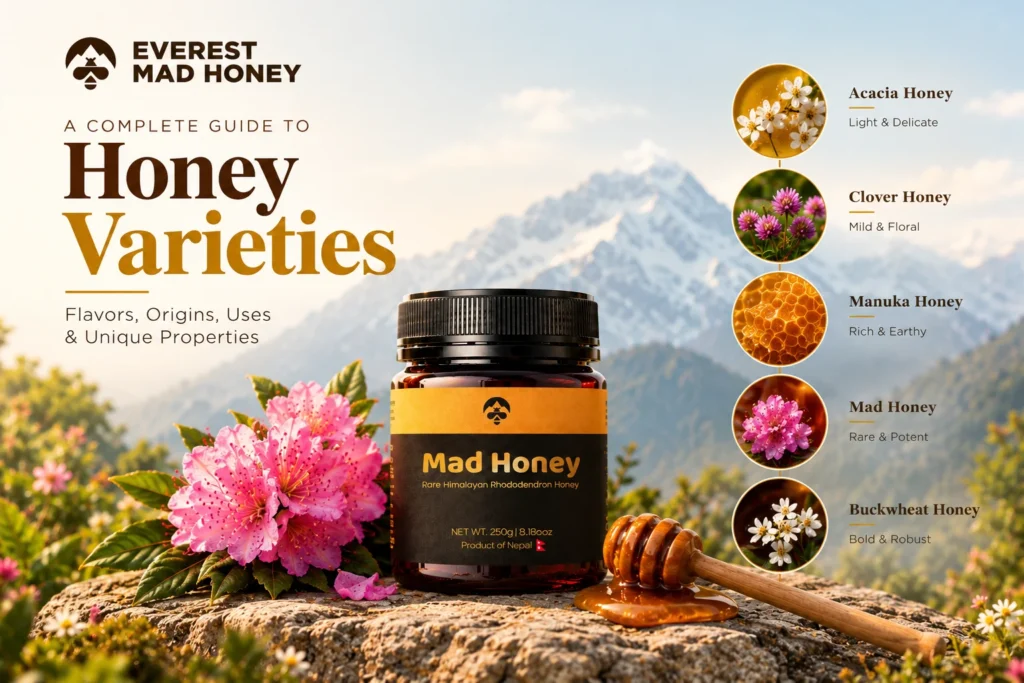
With over 300 types of honey produced worldwide, choosing the right one can feel overwhelming. From light and mild clover honey to dark and earthy buckwheat, from New Zealand’s famed manuka to Nepal’s rare and extraordinary mad honey — every variety carries a distinct flavor, color, and set of properties shaped by the flowers bees visit and the landscape they inhabit.
This guide breaks down the most popular and notable honey varieties available today — their floral origins, flavor profiles, nutritional differences, and best uses. Whether you’re a first-time buyer trying to understand the different types of honey on grocery shelves, or a connoisseur hunting for something rare and bioactive, you’ll find what you need here.
How Honey Is Classified: Understanding the Different Types of Honey
Before diving into individual varieties, it helps to understand how the different types of honey are actually categorized. Not all honey is the same — even jars that look identical on the shelf can differ dramatically in origin, processing, and composition.
Honey from bees is classified in three main ways:
By Floral Source
Monofloral honey comes primarily from the nectar of a single plant species. When bees forage predominantly from one flower — clover fields, orange groves, or buckwheat plantations — the resulting honey carries that plant’s distinctive flavor, color, and aroma. Examples include clover honey, manuka honey, and acacia honey.
Polyfloral honey (also called multifloral or wildflower honey) comes from multiple nectar sources. Because bees visit whatever flowers are available, the flavor and appearance of polyfloral honey changes by season, year, and even hive location. This makes every batch unique.
By Processing Method
- Raw honey — Extracted from the hive and minimally strained, never heated above natural hive temperatures. Retains all enzymes, pollen, and beneficial compounds.
- Pasteurized honey — Heated to 70°C (158°F) or higher to kill yeast cells, slow crystallization, and create a smooth, uniform product. This process destroys many heat-sensitive nutrients.
- Filtered honey — Passed through fine filters to remove pollen, air bubbles, and particles. Creates a clear appearance but removes pollen that helps identify the honey’s origin.
- Ultrafiltered honey — Heavily processed to remove virtually all pollen. Often used in commercial blends. Some experts argue this shouldn’t be called honey at all.
By Physical Form
- Liquid honey — The most common form, extracted from the comb by centrifuge.
- Comb honey — Sold in its original beeswax comb, completely unprocessed.
- Creamed (whipped) honey — Controlled crystallization creates a smooth, spreadable texture.
- Chunk honey — Pieces of honeycomb suspended in liquid honey.
What Type of Sugar Is Honey?
One of the most common questions people ask is: what type of sugar is honey, exactly? Unlike table sugar, which is pure sucrose (a disaccharide), honey is a complex mixture of natural sugars, water, and trace compounds.
Honey’s Sugar Composition
Here’s the approximate breakdown of what’s inside every jar of honey:
| Component | Percentage | Type |
|---|---|---|
| Fructose | 38–40% | Monosaccharide (simple sugar) |
| Glucose | 27–31% | Monosaccharide (simple sugar) |
| Water | 17–20% | — |
| Maltose & Sucrose | 1–5% | Disaccharides |
| Other compounds | 2–5% | Enzymes, amino acids, vitamins, minerals, antioxidants, organic acids |
The key difference from table sugar: honey’s primary sugars — fructose and glucose — are monosaccharides (already in their simplest form), while table sugar is sucrose, a disaccharide that your body must first break down. This is one reason honey has a lower glycemic index (GI of 45–64) compared to white sugar (GI of 65).
The fructose-to-glucose ratio also varies between different honey varieties, which affects both sweetness and crystallization speed:
- High-fructose honeys (acacia, tupelo, sage) — Stay liquid longer, taste sweeter, lower GI
- High-glucose honeys (clover, alfalfa, dandelion) — Crystallize faster, slightly less sweet
Calorie comparison: Honey contains about 334 calories per 100g versus sugar’s 400 calories per 100g. However, because honey is denser, a tablespoon of honey (28g) actually contains more calories than a tablespoon of sugar (16g). The nutritional advantage of honey lies not in calorie reduction but in its additional bioactive compounds — antioxidants, enzymes, and trace minerals that table sugar simply doesn’t have.
Common Honey Varieties: The Types You’ll Find Everywhere
These are the honey varieties you’re most likely to encounter at grocery stores, farmers’ markets, and specialty shops around the world. Each one is defined by the primary flower its bees foraged from.
Clover Honey
Color: Pale gold to light amber | Origin: Canada, US, New Zealand, Sweden | Crystallization: Moderate to fast
Flavor: Mild, clean sweetness with subtle floral notes and a hint of vanilla-cinnamon warmth.
Clover honey is the world’s most widely produced and consumed variety. It’s the “default” honey most people picture — light, sweet, and versatile. Its mild flavor makes it ideal for everyday use: sweetening tea, drizzling on pancakes, baking, and cooking where you want sweetness without an overpowering honey flavor. Because clover is abundantly cultivated, this honey is consistently available and affordable. However, its lighter color means it generally contains fewer antioxidants than darker varieties.
Wildflower Honey
Color: Light to dark amber (varies by season and region) | Origin: Produced worldwide | Crystallization: Variable
Flavor: Complex, robust, and floral — different every batch.
Wildflower (polyfloral) honey is sourced from multiple flower species, making each harvest unique. A spring batch might taste light and citrusy, while an autumn batch from the same region could be darker and more earthy. This unpredictability is part of its charm. The multi-floral nature means wildflower honey often contains a broader diversity of pollen and plant compounds than single-source varieties, potentially offering a wider range of antioxidant benefits.
Acacia Honey
Color: Very pale, almost water-white | Origin: Eastern Europe (Hungary, Romania), North America | Crystallization: Very slow (high fructose content)
Flavor: Delicate, mild, clean sweetness with vanilla undertones.
Prized for its exceptionally light color and mild taste, acacia honey is one of the most popular gourmet varieties. Its high fructose-to-glucose ratio means it stays liquid for months — sometimes years — without crystallizing. Perfect for drizzling over cheese, fresh fruit, or yogurt where you want sweetness without color or strong flavor.
Orange Blossom Honey
Color: Light golden | Origin: Florida, California, Texas, Spain, Israel, Mexico | Crystallization: Moderate
Flavor: Bright citrus and floral notes, sweet without being cloying.
Harvested from citrus groves in bloom, orange blossom honey carries a subtle but unmistakable citrus perfume. It’s a favorite for baking — particularly in scones, biscuits, and desserts — and pairs beautifully with tea. The best orange blossom honey comes raw and unprocessed; some commercial versions add artificial citrus flavoring, so check labels carefully.
Buckwheat Honey
Color: Very dark amber to nearly black | Origin: United States, Canada, France, Japan, Netherlands | Crystallization: Moderate
Flavor: Bold, malty, earthy, with notes of molasses, dark chocolate, and caramel.
Buckwheat honey is the polar opposite of clover — dark, intense, and almost savory. Research has shown it contains significantly more antioxidants than lighter honeys, making it one of the most nutritionally dense varieties available. Its strong flavor makes it a natural substitute for molasses or dark corn syrup in baking. It’s also been studied as a cough suppressant, with some research suggesting it’s as effective as common over-the-counter remedies.
Alfalfa Honey
Color: Nearly white to pale gold | Origin: Western United States, Canada | Crystallization: Fast (high glucose)
Flavor: Delicate, clean, mildly sweet with subtle herbal-grassy notes and a hint of mint and vanilla.
One of the lightest honeys both in color and flavor, alfalfa honey is excellent for baking, dressings, and smoothies where you want honey’s moisture and binding properties without a strong taste. It crystallizes quickly into a smooth, creamy texture that many people actually prefer.
Eucalyptus Honey
Color: Medium amber, sometimes with a greenish tint | Origin: Australia, California, Mediterranean | Crystallization: Moderate
Flavor: Bold, woody, slightly medicinal with menthol undertones.
The flavor of eucalyptus honey mirrors the tree itself — herbaceous, mentholated, and aromatic. It has been traditionally used to soothe respiratory discomfort, and its distinctive taste makes it an excellent addition to herbal teas and warm beverages during cold season.
Lavender Honey
Color: Clear to light amber | Origin: France (Provence), Spain, Italy, England | Crystallization: Moderate
Flavor: Sweet, floral, slightly herbal with delicate woody notes.
A Mediterranean specialty, lavender honey is as fragrant as the fields it comes from. It pairs exceptionally well with cheese — particularly feta, goat cheese, and blue cheese — and adds a sophisticated floral note to desserts. Genuine lavender honey should taste distinctly different from regular honey infused with lavender essential oil.
Linden (Basswood) Honey
Color: Light gold with a slight green tint | Origin: Europe (Germany, Poland, Hungary), Eastern United States, China | Crystallization: Moderate to fast
Flavor: Fresh, mildly sweet, with subtle mint and herbal notes, slightly woodsy.
Linden honey has a clean, refreshing quality that’s different from most other varieties. It’s been traditionally valued for its soothing properties and is a popular choice in herbal and wellness teas. Some describe a lingering cool aftertaste, almost like a very mild menthol.
Clover Honey vs Wildflower Honey: A Detailed Comparison
The clover honey vs wildflower honey debate is one of the most common among honey buyers. Both are widely available, reasonably priced, and delicious — but they serve different purposes.
| Factor | Clover Honey | Wildflower Honey |
|---|---|---|
| Source | Primarily clover blossoms (monofloral) | Multiple wildflower species (polyfloral) |
| Flavor | Mild, consistent, lightly sweet | Complex, varies by batch and season |
| Color | Pale gold — consistently light | Light to dark amber — varies |
| Consistency | Uniform taste batch to batch | Every harvest is slightly different |
| Best for | Baking, sweetening tea, everyday use | Charcuterie, gourmet cooking, tasting |
| Antioxidants | Moderate (lighter color = fewer) | Potentially higher and more diverse |
| Price | Budget-friendly, widely available | Slightly higher, varies by source |
| Crystallization | Crystallizes relatively quickly | Variable — depends on floral mix |
The bottom line: Choose clover honey when you want a predictable, mild sweetener that won’t overpower other flavors. Choose wildflower honey when you want something with character — a more complex flavor profile that tells a story of its landscape and season.
For maximum health benefits from either, always opt for the raw, unfiltered version. Pasteurized commercial blends of both varieties lose much of their nutritional value during processing.
Clover Honey vs Raw Honey: What’s the Real Difference?
The clover honey vs raw honey comparison is a bit of a false dichotomy — because clover honey can be raw. The real question people are asking is: what’s the difference between processed clover honey (the most common type on grocery shelves) and raw, unprocessed honey?
Understanding the Distinction
“Clover honey” describes the floral source — it comes from clover nectar. “Raw honey” describes the processing method — it hasn’t been pasteurized or heavily filtered. These are two separate categories, and a jar of honey can be both (raw clover honey) or neither (pasteurized wildflower honey).
Here’s what actually matters:
| Factor | Processed Clover Honey | Raw Honey (any source) |
|---|---|---|
| Processing | Pasteurized (heated to 70°C+), often filtered | Never heated above hive temperature (~35°C), lightly strained |
| Enzymes | Reduced or destroyed by heat | Fully intact — diastase, invertase, glucose oxidase |
| Pollen | Often filtered out | Retained — allows origin tracing |
| Antioxidants | Reduced by pasteurization | Fully preserved |
| Appearance | Clear, smooth, golden — slow to crystallize | May look cloudy, crystallize faster |
| Shelf appeal | Looks “prettier” — uniform and clear | Less uniform — but that’s a sign of quality |
| Nutritional value | Lower — processing removes beneficial compounds | Higher — full spectrum of natural compounds |
Key takeaway: If you’re buying honey for its health benefits, the processing method matters more than the floral source. Raw clover honey is nutritionally superior to pasteurized wildflower honey. Always look for “raw” on the label, regardless of the variety.
That said, floral source still influences the specific compounds present. A raw buckwheat honey will have more antioxidants than raw clover simply because darker honeys are naturally richer in those compounds.
Premium & Rare Honey Varieties
Beyond the common varieties, there exists a world of rare and extraordinary honeys — each one defined by unique geography, extreme harvesting conditions, or exceptional bioactive properties. These are the honey varieties that collectors seek and connoisseurs prize.
Mad Honey (Himalayan Cliff Honey)
Color: Dark reddish-amber | Origin: Nepal (Himalayan mountains), Turkey (Black Sea region) | Price: $99–$139+ per jar
Flavor: Bittersweet, slightly pungent, with earthy medicinal undertones. What makes it unique: Contains grayanotoxin — a naturally occurring compound from rhododendron nectar.
Mad honey is arguably the most extraordinary type of honey in the world. Produced by Apis laboriosa — the world’s largest honey bee — from rhododendron flowers growing at altitudes above 2,500 meters in the Himalayan mountains, it contains grayanotoxin, a naturally occurring bioactive compound found nowhere else in the honey world.
Harvested by Gurung honey hunters who scale sheer cliff faces using handmade rope ladders — a tradition stretching back thousands of years — mad honey is consumed in small doses (1–2 teaspoons) and has been used traditionally for relaxation, mood elevation, and general wellness.
Authentic mad honey is rare, seasonal, and expensive due to the extreme difficulty and danger of harvesting. The limited production means genuine product commands premium prices, and buyers need to be cautious about imitations.
Shop authentic Himalayan mad honey from Everest Mad Honey — lab-tested, ethically sourced, with a 30-day money-back guarantee.
Manuka Honey
Color: Medium to dark amber | Origin: New Zealand, parts of Australia | Price: $30–$300+ depending on UMF rating
Flavor: Rich, earthy, herbal with a slightly bitter aftertaste. What makes it unique: Contains methylglyoxal (MGO) — a potent antibacterial compound.
Manuka honey has become the most commercially successful premium honey in the world, valued for its scientifically documented antibacterial properties. The UMF (Unique Manuka Factor) rating system measures the concentration of its key compounds — the higher the UMF, the stronger the antibacterial activity, and the higher the price.
Medical-grade manuka honey is used clinically for wound care, and research has demonstrated effectiveness against bacteria including MRSA. However, the manuka market has also attracted significant adulteration — by some estimates, more “manuka honey” is sold globally each year than is actually produced in New Zealand.
Sidr Honey
Color: Dark golden | Origin: Yemen (Hadramaut Valley), Saudi Arabia, Pakistan | Price: $80–$200+ per jar
Flavor: Rich, aromatic, with butterscotch and caramel undertones. What makes it unique: Harvested from ancient Sidr (jujube) trees; considered sacred in Islamic tradition.
Sidr honey from Yemen’s Hadramaut Valley is one of the rarest and most expensive honeys in the world. The Sidr trees bloom only once per year, and production has been further limited by conflict in Yemen. Authentic Yemeni Sidr commands extraordinary prices in Gulf countries, where it has been used for centuries as both a food and a traditional remedy.
Tupelo Honey
Color: Light golden with a subtle green hue | Origin: Florida Panhandle and coastal Georgia | Price: $25–$50+ per jar
Flavor: Buttery, fruity, with hints of cinnamon and a lingering floral finish. What makes it unique: Extremely high fructose content means it almost never crystallizes.
Tupelo honey comes from the Ogeechee tupelo tree, which blooms for only 2–3 weeks each spring in the river swamps of the southeastern United States. Its exceptionally high fructose-to-glucose ratio gives it two remarkable properties: a rich, complex flavor and an almost complete resistance to crystallization. Genuine tupelo honey can stay liquid for years.
Sourwood Honey
Color: Light amber | Origin: Appalachian Mountains (United States) | Price: $20–$40+ per jar
Flavor: Buttery smooth, with anise, light caramel, and subtle spice notes.
Widely regarded as one of America’s finest honeys, sourwood honey is produced from the bell-shaped blooms of sourwood trees in the Appalachian region. Its distinctive buttery, almost tangy flavor sets it apart from almost every other American variety.
Tualang Honey
Color: Dark amber | Origin: Malaysia and Sumatra (from giant honey bee colonies) | Price: $40–$80+ per jar
Flavor: Complex, strong, slightly smoky.
Harvested from the massive Tualang trees of the Malaysian and Sumatran rainforests, this honey is produced by Apis dorsata (the giant honey bee). Research from Monash University and Malaysian institutions has identified tualang honey as having notable antibacterial, antioxidant, and anti-inflammatory properties.
Leatherwood Honey
Color: Golden amber | Origin: Tasmania, Australia | Price: $25–$50+ per jar
Flavor: Rich, spicy, intensely floral — unlike any other honey.
Tasmania’s leatherwood honey is a truly unique variety with an almost perfumed quality. The leatherwood tree (Eucryphia lucida) grows only in the ancient Tasmanian rainforests, and the honey it produces has a distinctive spicy-floral intensity that divides opinion — people tend to either love it or find it overwhelming.
Honey Varieties by Region: A World Tour
Honey from bees reflects the landscape they inhabit. Every region of the world produces distinctive varieties shaped by local flora, climate, and beekeeping traditions. Here’s a look at the most notable honey-producing regions and their signature products.
North America
The United States alone produces over 300 types of honey. Key American varieties include tupelo (Florida), sourwood (Appalachian Mountains), orange blossom (Florida, California), buckwheat (New York, Midwest), sage (California), clover (Dakotas, Midwest), mesquite (Southwest), and fireweed (Pacific Northwest, Alaska). Canada is known for its clover, buckwheat, and fireweed honeys.
New Zealand & Australia
New Zealand is home to manuka and kanuka honey, along with unique varieties like rata, rewarewa, and beech honeydew. Australia produces eucalyptus varieties (blue gum, iron bark), leatherwood (Tasmania), and macadamia honey.
Europe
The Mediterranean region produces prized thyme honey (Greece), lavender honey (France, Spain), and chestnut honey (Italy, France). Central and Northern Europe contribute linden/basswood honey (Germany, Poland), heather honey (Scotland, Norway), and various forest/honeydew honeys (Germany, Austria, Slovenia).
South & Southeast Asia
Nepal produces the world’s only genuine mad honey — harvested from Himalayan cliff hives. India produces large quantities of multi-floral, mustard, and litchi honey. Malaysia’s tualang honey from giant bee colonies is gaining global recognition. Japan produces small-batch cherry blossom and buckwheat honeys.
Middle East & North Africa
Yemen’s Sidr honey from the Hadramaut Valley is among the world’s most expensive. Saudi Arabia, Oman, and Pakistan also produce Sidr varieties. Turkey is a major producer of both pine honeydew honey and rhododendron (mad) honey from the Black Sea region. Egypt produces fragrant citrus and clover honeys.
South America
Argentina is one of the world’s largest honey exporters, producing primarily clover and eucalyptus varieties. Brazil produces unique stingless bee honey and various tropical fruit blossom honeys. Chile contributes ulmo honey, a rare variety with vanilla and floral notes.
Africa
Ethiopia is Africa’s largest honey producer, with a rich tradition of wildflower honey production used in the traditional drink tej (honey wine). South Africa produces fynbos honey from the Cape region’s unique floral kingdom.
Honeydew Honey vs Blossom Honey
Most people think all honey from bees comes from flower nectar — but that’s not always true. Honeydew honey (also called forest honey) comes from an entirely different source, and understanding this distinction opens up a whole new category of honey varieties.
What Is Honeydew Honey?
Blossom honey is made when bees collect nectar directly from flowers. This accounts for the vast majority of honey produced worldwide.
Honeydew honey is made when bees collect honeydew — a sweet, sticky substance excreted by aphids and other sap-sucking insects that feed on trees. Instead of visiting flowers, bees gather this honeydew from bark, leaves, and stems. They do this primarily when floral nectar is scarce.
Honeydew honey is typically labeled as “forest honey,” “pine honey,” “oak honey,” or “fir honey,” depending on the dominant tree species in the region.
Key Differences
| Factor | Blossom Honey | Honeydew (Forest) Honey |
|---|---|---|
| Source | Flower nectar | Tree sap (via aphid secretions) |
| Color | Light to medium amber | Dark amber to nearly black |
| Sweetness | Sweeter | Less sweet, more malty and resinous |
| Minerals | Lower mineral content | Higher mineral and amino acid content |
| Sugar types | Higher glucose and sucrose | Higher in oligosaccharides |
| Price | Generally affordable | Premium — scarcer production |
| Popular regions | Worldwide | Germany, Greece, Turkey, New Zealand (beech) |
Honeydew honey is particularly popular in Germany, Greece, and Central Europe, where it’s often considered superior to blossom honey for its higher mineral content, more complex flavor, and stronger antibacterial properties.
How to Choose the Right Honey for Your Needs
With so many types of honey available, choosing the right one depends on what you’re using it for. Here’s a practical guide:
For Everyday Sweetening
Go with clover or acacia honey. Both have mild flavors that sweeten without overpowering coffee, tea, oatmeal, or yogurt. Acacia stays liquid longer if crystallization bothers you.
For Baking & Cooking
Wildflower, clover, or orange blossom work well in most recipes. For darker baked goods (gingerbread, dark bread, BBQ sauces), buckwheat honey adds incredible depth — it’s a natural substitute for molasses.
For Health & Wellness
Choose raw honey — whatever the floral source, raw is what matters for retaining enzymes and antioxidants. For specific properties: manuka for antibacterial potency, buckwheat for antioxidants, mad honey for its unique grayanotoxin-based traditional uses.
For Cheese Pairing & Entertaining
Lavender, chestnut, or wildflower honey pair beautifully with cheese boards. The more complex the honey, the better it complements strong cheeses like blue, aged cheddar, or manchego.
For a Unique Experience
If you’re looking for something beyond ordinary honey, explore the rare varieties: mad honey from Nepal for its one-of-a-kind bioactive properties, Sidr honey for its legendary Middle Eastern heritage, or leatherwood honey for its intensely aromatic flavor.
Quick Tip — The Color Rule: As a general rule across all honey varieties, darker honeys contain more antioxidants and minerals than lighter ones. If nutritional density is your priority, reach for the darker jar.
Frequently Asked Questions About Types of Honey
How many types of honey are there?
There are over 300 types of honey sold in the United States alone, according to the National Honey Board. Globally, the number is even higher. Honey varieties are distinguished by floral source, processing method, physical form, and geographic origin.
What is the healthiest type of honey?
Raw, unprocessed honey of any variety retains the most health-beneficial compounds. Among specific types, manuka honey has the strongest scientific backing for antibacterial properties, buckwheat honey is exceptionally high in antioxidants, and mad honey contains unique grayanotoxin compounds used traditionally for centuries. As a rule, darker honeys contain more antioxidants than lighter ones.
What type of sugar is honey?
Honey is primarily composed of two simple sugars (monosaccharides): fructose (38–40%) and glucose (27–31%), plus small amounts of sucrose, maltose, water (17–20%), and trace compounds. Unlike table sugar (pure sucrose), honey’s sugars are already in their simplest form, and it has a lower glycemic index (45–64 vs. 65 for white sugar).
Is clover honey better than wildflower honey?
Neither is objectively better — they serve different purposes. Clover honey is mild and consistent, ideal for everyday sweetening and baking. Wildflower honey has a more complex, variable flavor, better for gourmet use and cheese pairing. Wildflower may contain a wider diversity of antioxidants due to its multi-floral sources.
What is the rarest type of honey in the world?
Some of the rarest honeys include Himalayan mad honey (harvested from cliff-side hives at extreme altitudes), Sidr honey from Yemen’s Hadramaut Valley, Elvish honey from deep caves in Turkey, high-UMF manuka honey from New Zealand, and Hawaiian Kiawe honey. These are rare due to limited geography, dangerous harvesting, or tiny production volumes.
What is the difference between raw honey and regular honey?
Raw honey is extracted, lightly strained, and bottled without pasteurization — retaining all natural enzymes, pollen, and antioxidants. Regular (processed) honey is heated to prevent crystallization, creating a smooth, uniform appearance but destroying many heat-sensitive nutrients. If you’re buying honey for health benefits, always choose raw.
Does the color of honey matter?
Yes. As a general rule, darker honeys contain more antioxidants, minerals, and nutritionally active compounds than lighter varieties. Buckwheat, chestnut, and manuka are among the darkest and most nutrient-dense. However, some light honeys (like acacia and tupelo) have other desirable properties, such as slower crystallization and milder flavor.
Why does honey crystallize?
Crystallization is a natural process where glucose molecules in honey solidify. Honeys with higher glucose content (clover, alfalfa, dandelion) crystallize faster, while high-fructose honeys (acacia, tupelo, sage) stay liquid much longer. Crystallization doesn’t mean the honey has gone bad — in fact, it’s a sign of a genuine, unprocessed product. To re-liquefy, gently warm the jar in warm (not hot) water.
Final Thoughts: Exploring the World of Honey
With over 300 varieties available in the United States alone, the world of honey extends far beyond the plastic bear on your grocery store shelf. Each type of honey carries a unique flavor profile, nutritional composition, and set of best uses — shaped by the flowers the bees visit, the region where it’s produced, and how it’s processed after harvest.
Whether you’re drawn to the everyday versatility of clover honey, the complex depth of buckwheat honey, the scientifically-backed benefits of manuka honey, or the adventurous allure of Himalayan mad honey, there’s a variety perfectly suited to your palate and purpose.
Here are a few principles to guide your exploration:
- Choose raw over processed whenever possible — raw honey retains the enzymes, pollen, and antioxidants that pasteurization destroys.
- Match the honey to the task — mild honeys for baking and sweetening, robust honeys for glazes and cheese pairings, specialty honeys for targeted wellness.
- Buy from trusted sources — whether it’s a local beekeeper at the farmers’ market or a reputable specialty retailer, knowing your honey’s origin ensures authenticity and quality.
- Store it properly — a cool, dry place with a tightly sealed lid. Crystallization is natural and doesn’t mean your honey has gone bad.
The journey through different types of honey is one of the most delicious explorations in the natural food world. Start with what you know, branch out to something new, and let your taste buds discover why honey has been treasured by civilizations for thousands of years.
Ready to Explore Premium & Rare Honey Varieties?
Discover authentic Himalayan mad honey, high-grade manuka honey, and other rare varieties at Everest Mad Honey. Every jar is ethically sourced, lab-tested for purity, and shipped worldwide.