
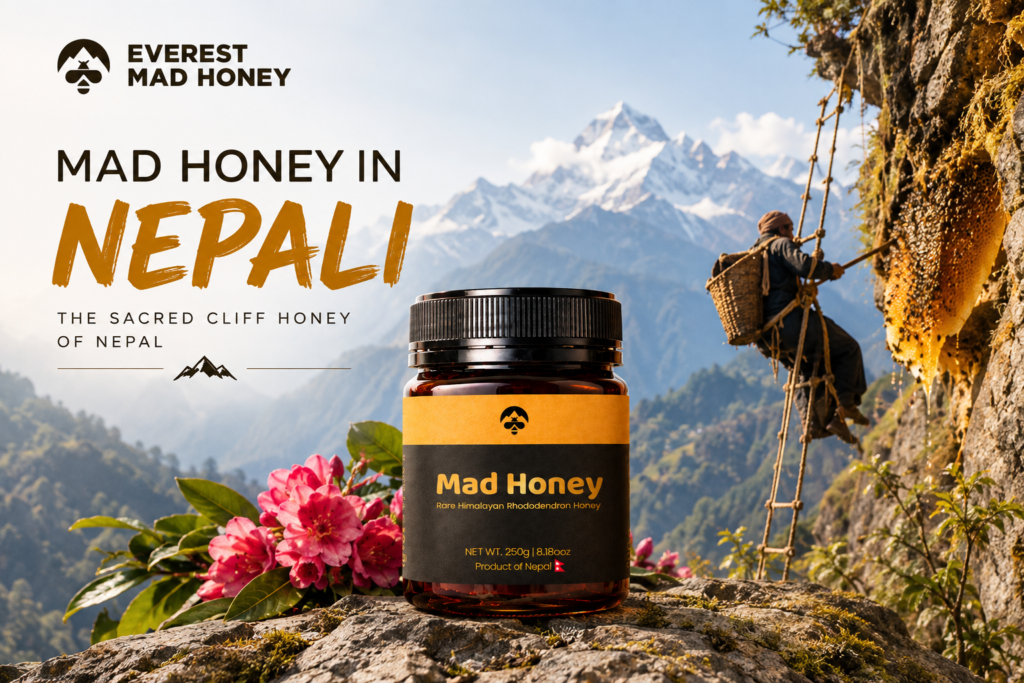
Introduction: The Honey That Nepal Calls Its Own
Mad honey in Nepali is not just a product — it is a living piece of Himalayan heritage. Known locally as Pagal Maha, Bhir Maha, or Baula Maha, this rare, dark, reddish honey has been harvested from the sheer cliff faces of Nepal’s mountains for centuries by indigenous Gurung honey hunters who risk their lives to collect it using nothing but handmade rope ladders, bamboo tools, and raw courage.
If you have been searching for mad honey Nepal, mad honey from Nepal, or wondering what is mad honey from Nepal, you have come to the right place. This is the most comprehensive guide to Nepal’s sacred cliff honey available anywhere online — covering everything from the Nepali names and their meanings, to the geography, the bees, the hunters, the science, the culture, and how to buy authentic Nepal mad honey that you can trust.
Nepal is the world’s primary source of the most potent and sought-after mad honey. While Turkey’s Black Sea coast also produces a version called deli bal, it is Nepali mad honey — harvested from wild Apis laboriosa cliff hives at altitudes above 2,500 metres — that is universally regarded as the gold standard.
Whether you are in the United Kingdom, the United States, or anywhere else in the world, this guide will give you everything you need to understand and appreciate this extraordinary product — and to find a genuine, lab-tested source you can buy from with confidence.
Mad honey goes by several names in the Nepali language, each revealing something different about the honey’s character, origin, or cultural significance.
The most commonly used Nepali name is Bhir Maha. Bhir means steep cliff in Nepali, and Maha (sometimes written Mauri ko Maha) means honey. The name is a direct description of where the honey comes from — the sheer cliff faces of the Himalayas where Apis laboriosa builds its enormous exposed honeycombs. This is the name most frequently used by the Gurung communities who harvest it.
Some sources also write it as Bhir Mauri ko Maha, where Mauri specifically refers to bees — literally translating to “honey of the cliff bees.”
The name Baula Maha is the most direct Nepali translation of “mad honey.” Baula means mad, crazy, or intoxicated in Nepali, referring to the disorienting effects the honey can produce when consumed in larger amounts. This name reflects the honey’s reputation for its grayanotoxin-driven psychoactive properties.
Pagal Maha is another widely used name, particularly in popular and commercial contexts. Pagal is the Hindi-Nepali word for mad or crazy — the same root as the English term “mad honey.” In Nepal’s Lamjung district, the village of Ghale Gaun, famous for its honey-hunting tradition, refers to it locally as Pagal Mah.
In some Nepali communities, mad honey is respectfully called Jhari Madhu, which translates to “forest honey.” This name emphasises the honey’s wild, natural origin rather than its intoxicating properties — reflecting a cultural perspective that sees the honey as a gift from the forest rather than something to be sensationalised.
The diversity of Nepali names for mad honey reveals something important: this is not a novelty product that appeared on the international market recently. It is a substance with deep linguistic, cultural, and historical roots in Nepali society — woven into the vocabulary across multiple communities, regions, and generations. Understanding mad honey in Nepali starts with understanding that these names carry centuries of meaning.
Mad honey from Nepal is produced in some of the most remote, inaccessible terrain on the planet. The specific combination of altitude, climate, flora, and wild bee species required to produce genuine mad honey exists only in a handful of Himalayan districts.
Solukhumbu — Located in northeastern Nepal, home to Mount Everest, this district is one of the primary sources of the world’s most potent mad honey. The Kulung Rai communities here continue the cliff honey hunting tradition using handmade rope ladders and bamboo poles at elevations above 3,000 metres.
Lamjung — In central Nepal, the villages around Lamjung district — particularly Ghale Gaun and the surrounding Gurung settlements — are among the most documented mad honey harvesting sites in the world. Al Jazeera, Reuters, and AFP have all covered the honey hunters of Lamjung in recent years, bringing global attention to this endangered tradition.
Kaski — Adjacent to Lamjung, the Kaski district (which includes the gateway city of Pokhara) hosts Gurung communities that have practised cliff honey hunting for centuries. Photographer Andrew Newey spent two weeks documenting the autumn honey hunt in Kaski’s remote hilltop villages.
Myagdi and Gorkha — Additional districts in the Annapurna and Manaslu regions where Gurung and Magar communities harvest mad honey from wild cliff hives.
Altitude is not just a detail — it is central to what makes Nepal mad honey what it is. The wild Rhododendron species that produce grayanotoxin-rich nectar grow at elevations between 2,500 and 4,000 metres. At these altitudes, the plants produce higher concentrations of grayanotoxins as a natural defence mechanism — and the bees that forage on them at these heights produce correspondingly more potent honey.
This is why Nepal mad honey from high-altitude spring harvests is consistently regarded as the most potent in the world.
Nepal is home to over 30 species of Rhododendron, and the Rhododendron is the country’s national flower — locally called Lali Gurans (लालीगुराँस). The specific species most associated with mad honey production include high-altitude varieties that bloom in dense swathes across Himalayan hillsides, creating a near-monofloral foraging environment for the bees. Because the Rhododendron density is so high in these regions, the bees have limited access to other nectar sources, resulting in honey with unusually concentrated grayanotoxin levels.
No discussion of mad honey in Nepal is complete without understanding the extraordinary bee that produces it.
Apis laboriosa — the Himalayan giant honey bee — is the largest honey bee species on Earth. Individual adults can measure up to 3 centimetres (1.2 inches) long, significantly larger than the common Western honey bee (Apis mellifera). The Latin name laboriosa means “hardworking” — an apt description for a species that thrives in some of the most extreme conditions any bee has ever adapted to.
These bees are found across the mountains of Nepal, Bhutan, India, Myanmar, Laos, Vietnam, and China’s Yunnan province. However, Nepal’s Himalayan cliffs remain their most iconic habitat and the primary source of commercially available mad honey.
Unlike domesticated honeybees that live in managed wooden hives, Apis laboriosa builds enormous, single-comb nests attached directly to the south-western faces of vertical cliffs. These open-air colonies can measure over a metre and a half wide — some of the largest individual honeycomb structures in the natural world. A single nest can hold as much as 60 kilograms (130 pounds) of honey.
The bees choose cliff faces at altitudes between 2,500 and 3,200 metres, typically near water sources. They show a strong preference for south-west-facing overhangs that provide shelter from rain and direct midday sun.
This is the critical fact that makes Nepal mad honey so rare and valuable: Apis laboriosa cannot be domesticated. Unlike Turkish mad honey, which comes from managed hives of Apis mellifera, Nepalese mad honey can only be harvested from wild cliff colonies. Every jar of authentic Nepal mad honey was collected by hand from a wild hive on a vertical cliff face — there is simply no other way to obtain it.
This fundamental constraint is what drives the price, the danger, and the authenticity of genuine mad honey from Nepal.
The story of Nepal mad honey is inseparable from the story of the people who harvest it. The Gurung (also called Tamu) are an indigenous ethnic group believed to have migrated from Tibet to central Nepal around the 6th century. For centuries, they have been the primary custodians of the cliff honey hunting tradition.
Every honey hunt begins not with climbing but with prayer. Before any hunter touches a rope, the community performs a Puja — a sacred ceremony to appease the forest spirits and the “Cliff God” (Bhir-Durgu). A ritual sacrifice is offered, typically a chicken, goat, or sheep, accompanied by grains and incense. The lead hunter prays for safety, forgiveness from the bees, and a successful harvest.
For the Gurung, the cliffs are not just rock — they are the domain of powerful spirits. The honey hunt is as much a spiritual act as it is a practical one.
A typical expedition involves a team of 10 to 15 experienced hunters. The process is a masterclass in teamwork and physical courage:
Bee stings, blood, and physical exhaustion are unavoidable. A fall from these heights would be fatal.
Mad honey is harvested twice a year in Nepal. The spring harvest (April to June) is considered the most important — this is when the Rhododendron flowers are in full bloom and the honey contains the highest concentration of grayanotoxins. The autumn harvest (October to November) typically yields honey with a milder potency.
The number of experienced honey hunters is declining rapidly. As younger Gurung generations move toward cities and modern employment, the intricate knowledge required — which cliffs hold nests, how to read the bees, how to build and trust the ladder — is being lost. Photographer Andrew Newey, who documented the tradition in Nepal’s Kaski district, wrote that “both the number of bees and traditional honey hunters are in rapid decline.”
Buying authentic mad honey from brands that work directly with these communities — like Everest Mad Honey — is one of the most tangible ways to help preserve this tradition.
Understanding the science behind mad honey from Nepal is essential for anyone considering buying or consuming it.
Grayanotoxins are a family of naturally occurring diterpenoid compounds produced by certain plants in the Ericaceae family — most notably specific Rhododendron species. They are classified as neurotoxins, meaning they affect the nervous system. The key variants are grayanotoxin I and III, which research has identified as the principal compounds responsible for mad honey’s effects.
These compounds are present in the leaves, flowers, nectar, and pollen of grayanotoxin-producing Rhododendrons. Not every Rhododendron species produces them — only two to three out of approximately 700 species worldwide contain significant concentrations in their nectar.
When Apis laboriosa bees forage on Rhododendron nectar, they collect grayanotoxins along with the sugars. During the natural process of converting nectar into honey inside the hive, these compounds are not neutralised or filtered out — they pass through largely intact into the finished honey.
Because Nepal’s high-altitude Rhododendron forests create a near-monofloral foraging environment (the bees have limited access to non-Rhododendron nectar sources), the resulting honey contains unusually concentrated grayanotoxin levels compared to honey produced in areas where the bees forage on a wider variety of flowers.
The grayanotoxin concentration in any given batch of Nepal mad honey varies based on several factors:
This natural variability is precisely why batch-level lab testing is essential for any brand selling authentic Nepal mad honey.
Mad honey is far more than a food product in Nepal. It is woven into the spiritual, medicinal, social, and economic fabric of the mountain communities that produce it.
For the Gurung, honey hunting is as spiritual as it is physical. The cliffs are not merely geological features — they are the domain of forest gods and spirits. The Puja ceremony performed before each hunt is a genuine expression of belief, not a tourist performance. As one Gurung elder told a WWF researcher: “We climb for the spirits.”
The knowledge of which cliffs hold nests, when the bees are calm enough to approach, and how to build and trust a rope ladder at fatal heights is transmitted orally within families and villages. Nothing is written down. When an experienced hunter retires or passes away without training a successor, that specific knowledge — accumulated over a lifetime — is lost permanently.
In Nepali folk medicine, mad honey has been used for generations to address a range of ailments. Communities have traditionally consumed small, measured doses for hypertension management, digestive discomfort (including gastritis and peptic ulcers), joint pain, and as a natural aphrodisiac. These uses are well-documented in ethnographic literature, though modern clinical evidence for specific therapeutic claims remains limited.
It is important to note that traditional Nepali use has always been characterised by restraint — small doses, typically on an empty stomach, consumed with respect and caution. The Gurung do not treat mad honey casually.
For many remote Himalayan communities, the twice-yearly honey harvest represents a significant income supplement. Honey that once sold locally for around $3.50 per litre now commands $20 or more at the village level — and far more once it reaches international markets. The proceeds are typically shared among the hunting team.
However, as bee populations decline and harvests shrink, this economic lifeline is fraying. Many community members have had to shift toward subsistence agriculture — growing rice, corn, millet, and wheat — to compensate for declining honey income.
The honey harvest in many Gurung communities is not just a task but a festival. It coincides with spring and autumn celebrations, bringing villages together in shared effort and shared reward. The ritual, the danger, the community feast afterwards — all of it reinforces the social bonds that hold these remote mountain settlements together.
Both Nepal and Turkey produce mad honey, but there are fundamental differences that explain why Nepal mad honey is considered the global benchmark.
| Factor | Nepal Mad Honey | Turkish Deli Bal |
|---|---|---|
| Bee Species | Apis laboriosa (wild, cannot be domesticated) | Apis mellifera (managed hives) |
| Harvest Method | Wild cliff hunting — handmade rope ladders on vertical cliffs | Managed apiaries in mountain regions |
| Altitude | 2,500–4,000 metres | Lower elevation mountain forests |
| Rhododendron Species | High-altitude Himalayan varieties (more concentrated nectar) | R. ponticum and R. luteum |
| Typical Potency | Higher grayanotoxin concentration | Moderate to lower concentration |
| Foraging Exclusivity | Near-monofloral (mostly Rhododendron) | Mixed foraging dilutes concentration |
| Supply | Extremely limited, seasonal only | More readily available |
| Cultural Context | Sacred Gurung tradition, spiritual ceremonies | Regional folk tradition, less ceremonial |
| Price Range (per 100g) | $60–$180 | $25–$80 |
| Local Name | Bhir Maha, Baula Maha, Pagal Maha | Deli Bal |
The potency difference is not a marketing claim — it is a consequence of biology and geography. Nepal’s high-altitude Rhododendron forests create conditions where Apis laboriosa forages almost exclusively on grayanotoxin-rich nectar. In Turkey, the managed bees forage on a wider variety of flowers, diluting the grayanotoxin concentration in the finished honey.
This does not mean Turkish deli bal is inferior as a product — it simply means it is a different experience. For first-time users, Turkish mad honey’s milder profile can be more forgiving. For experienced users seeking the full Himalayan experience, Nepal mad honey is what they are looking for.
When buying, always check that your product is sourced from Nepal if potency is a priority. Everest Mad Honey sources exclusively from Nepal’s Himalayan regions — never blended with Turkish or other origins.
The story of mad honey in Nepal is increasingly shadowed by an urgent conservation crisis. The very bees that produce this remarkable honey are disappearing — and the consequences extend far beyond the honey industry.
According to researchers at the International Centre for Integrated Mountain Development (ICIMOD), data from Nepal’s Kaski and Lamjung districts shows a significant decrease in both the number of Apis laboriosa colonies per cliff and the total number of cliffs being nested by bees. Some reports cite an annual decline of up to 70% in honeybee populations on Himalayan cliffs.
Villagers in the Lamjung district have observed the change first-hand. “Earlier we would find wild bees in abundance around the village, but they are slowly disappearing,” one Gurung community member told researchers.
Researchers at ICIMOD and Nepal’s Tribhuvan University have identified multiple converging factors:
Efforts are underway to protect both the bees and the communities that depend on them. Nepal’s Wild Honey Trade Guidelines now set fair trade rules and export standards. The Himalayan Bees and Livelihoods Project, run jointly by ICIMOD and Tribhuvan University, works to connect traditional knowledge with modern conservation tools. Some local village councils are implementing permit systems to limit tourism-related disturbance at nesting sites.
Supporting brands that source ethically and pay fair prices to harvesting communities creates an economic incentive for sustainable practices. When hunters are paid fairly, they are less likely to overharvest — and more likely to invest in protecting the cliffs and bee populations for future seasons. This is why choosing a responsible source for your mad honey from Nepal matters.
With the surge in global interest, the mad honey market is flooded with diluted, mislabelled, and outright fake products. Here is how to ensure you are getting the real thing.
1. Lab testing with batch traceability. Any brand selling genuine Nepal mad honey should provide independent lab results for grayanotoxin concentration, tied to the specific batch you are purchasing. Without this, you are buying blind.
2. Specific sourcing region. Authentic sellers can name the district (Solukhumbu, Lamjung, Gorkha), the altitude band, and the harvesting community. Generic claims like “Himalayan honey” are not sufficient.
3. Appearance. Real Nepal mad honey is dark reddish-brown — significantly darker than regular golden honey. It is thick, viscous, and has a distinctive slightly gritty texture.
4. Taste. A sharp, earthy, bitter-sweet flavour with a noticeable tingling or burning sensation in the back of the throat. If it tastes like ordinary honey, it is ordinary honey.
5. Realistic pricing. Authentic Nepalese mad honey retails between $60–$180 per 100g internationally. If a deal seems too good to be true, it almost certainly is.
6. Seasonal limitation. Genuine suppliers have limited stock that sells out between harvest seasons. A brand claiming unlimited year-round supply is likely not selling authentic cliff honey.
Everest Mad Honey delivers everything a buyer should expect from an authentic Nepal mad honey supplier — and several things most competitors do not.
Authentic Himalayan sourcing. Every jar is wild-harvested from Apis laboriosa cliff hives in Nepal’s high-altitude Himalayan regions by experienced Gurung honey-hunting communities. This is genuine Bhir Maha — cliff honey in its purest form.
Independent lab testing. Each batch is tested for grayanotoxin concentration with results tied to traceable batch seal codes. No vague claims — verifiable data you can check before you buy.
The most competitive pricing in the market. Authentic Nepal mad honey is expensive to produce. But Everest Mad Honey works directly with harvesting communities — cutting out middlemen — to offer lab-tested, genuine product at prices that are significantly more accessible than most competitors.
Free insured worldwide shipping. No hidden fees. No surprise customs charges at checkout. Whether you are in London, New York, Dubai, or Sydney, your order ships free with full insurance to over 180 countries. Delivery in 12–14 business days.
No additives, no processing, no dilution. Pure, raw cliff honey — exactly as it was collected from the hive. Nothing added, nothing removed.
Clear dosage guidance. Every order includes responsible serving instructions and safety information. Everest Mad Honey educates its customers rather than encouraging reckless consumption.
→ Shop Everest Mad Honey — Lab-Tested, Free Worldwide Shipping
Mad honey has several names in Nepali: Bhir Maha (भीर मह) meaning cliff honey, Baula Maha (बौला मह) meaning mad honey, Pagal Maha (पागल मह) meaning intoxicating honey, and Jhari Madhu (झरी मधु) meaning forest honey. Bhir Maha is the most commonly used name among the Gurung communities who harvest it.
Authentic Nepal mad honey comes from the high-altitude Himalayan districts of Solukhumbu, Lamjung, Kaski, Gorkha, and Myagdi — where wild Rhododendron forests grow between 2,500 and 4,000 metres. It is harvested from the cliff hives of Apis laboriosa, the world’s largest honey bee.
Nepal mad honey is produced by wild Apis laboriosa bees that cannot be domesticated, foraging almost exclusively on high-altitude Rhododendron nectar. This creates a higher concentration of grayanotoxins compared to Turkish mad honey, which comes from managed hives of Apis mellifera foraging on a wider variety of flowers.
Yes. Mad honey is legal in the United States, the United Kingdom, and most countries worldwide. It is classified as a food product, not a controlled substance. Grayanotoxin is not on the scheduled drug lists of any major jurisdiction. Always verify your local import regulations before ordering.
Yes. Everest Mad Honey ships authentic, lab-tested Nepal mad honey to the United Kingdom with free insured delivery — no hidden customs charges.
Yes. Mad honey is legal in all 50 US states. Everest Mad Honey offers free insured shipping to the entire United States.
Authentic Nepalese mad honey typically retails between $60–$180 per 100g internationally. Prices reflect the extreme difficulty and danger of cliff harvesting, limited seasonal supply, fair compensation to hunting communities, and independent lab testing costs.
It has a sharp, earthy, bitter-sweet flavour with a distinctive tingling or mild burning sensation at the back of the throat. The colour is a deep reddish-brown — much darker than regular honey.
Yes. Bee populations are declining due to overharvesting, climate change, deforestation, and infrastructure development. The number of experienced Gurung honey hunters is also falling as younger generations move to cities. Supporting ethical brands that pay fair prices to harvesting communities helps sustain both the tradition and the bee populations.
Mad honey in Nepali is called Bhir Maha, Baula Maha, Pagal Maha, or Jhari Madhu — and each name carries centuries of meaning. This is not a novelty product that appeared on the internet recently. It is a living piece of Himalayan heritage, harvested at the risk of human life from some of the most extreme terrain on Earth, by communities whose spiritual and cultural identity is inseparable from the practice.
Nepal is the world’s primary source of the most potent and authentic mad honey. The combination of wild Apis laboriosa bees, high-altitude Rhododendron forests, and centuries of Gurung harvesting expertise makes Nepal mad honey unlike anything else available anywhere.
But with global demand rising and bee populations falling, the choices you make as a buyer matter. Every jar you purchase either supports or undermines the communities and ecosystems that make this product possible.
Choose a brand that:
Everest Mad Honey delivers on every point — authentic, lab-tested, competitively priced, with free insured worldwide shipping to the United States, the United Kingdom, and over 180 countries.
→ Experience Authentic Nepal Mad Honey — Shop Everest Mad Honey Today
This guide was researched and written to provide the most comprehensive resource on “mad honey in Nepali” and “mad honey from Nepal” available online. All claims are supported by the sources cited below.
Authentic Himalayan Mad Honey, ethically harvested in Solukhumbu, Nepal. Premium quality with fast delivery across the UK.
FDA Regulatory Sourcing & Legal Disclaimer: The statements, active biochemistry assessments, and traditional medicinal metrics presented inside this archive have not been fully cataloged by the United Kingdom Food and Drug Administration. Everest Mad Honey is not manufactured to treat, diagnose, mitigate, or systematically prevent clinical conditions. Mindful dosage limits must be strictly integrated into individual consumer protocols.
