
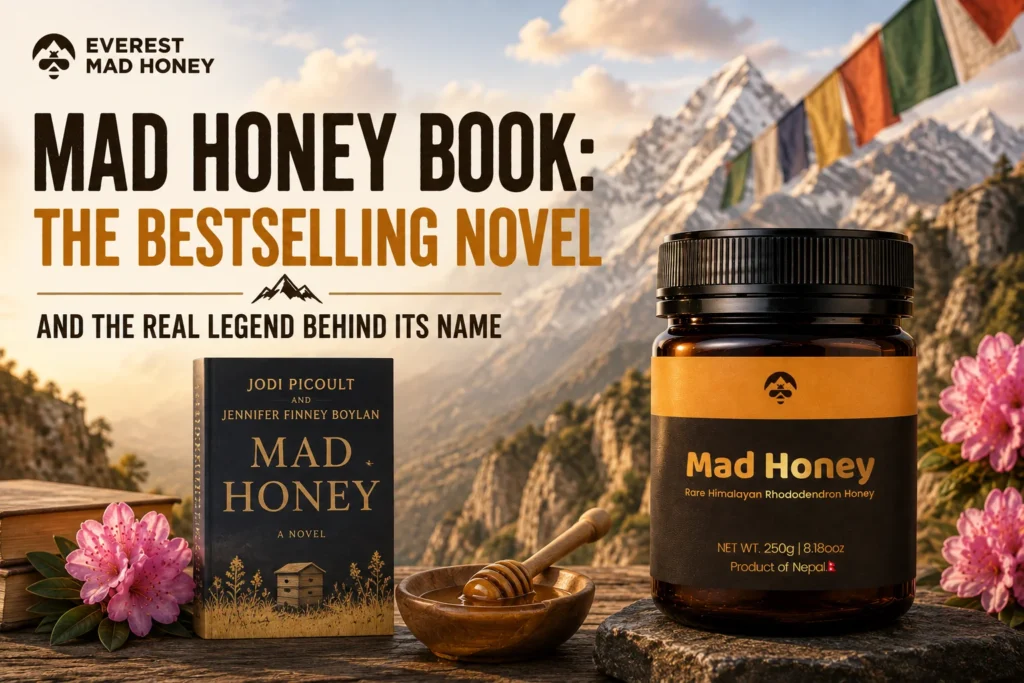
If You’re Searching for “Mad Honey Book,” You’ve Found Two Stories
There are two things people usually mean when they search for the “mad honey book.” Most are looking for the bestselling 2022 novel Mad Honey by Jodi Picoult and Jennifer Finney Boylan. A smaller number are curious about something else entirely: the real, centuries-old honey the book takes its name from — an actual wild honey with a genuinely strange history of its own. This guide covers both.
Mad Honey is a novel co-written by Jodi Picoult, the #1 New York Times bestselling author of nearly thirty books including My Sister’s Keeper and Small Great Things, and Jennifer Finney Boylan, a bestselling author, longtime New York Times contributing opinion writer, and English professor at Barnard College of Columbia University. Released in 2022, it became a Good Morning America Book Club pick and a New York Times bestseller.
What the book is about: The story follows Olivia McAfee, a beekeeper who left an abusive marriage to raise her son Asher back in her small New Hampshire hometown. Years later, Asher is a popular high school senior dating a girl named Lily, who moved to town seeking her own fresh start. When Lily is found dead and Asher is charged with her murder, the novel unfolds across two intertwining timelines — one moving forward through the aftermath, the other moving backward through Lily’s story — gradually revealing the truth behind what happened.
Why it stands out: Picoult and Boylan each wrote alternating chapters from Olivia’s and Lily’s perspectives, blending courtroom drama with family secrets. The novel explores themes of domestic abuse, identity, and acceptance, and its handling of Lily’s storyline drew particular attention for the way it approaches gender identity within a mainstream suspense novel. Critics highlighted how the two authors’ distinct voices come together into a single, cohesive narrative.
A note on the title itself: Olivia’s family business is beekeeping, and honey imagery runs through the novel as both a literal plot element and a symbol — something that looks sweet and familiar on the surface but carries a hidden, toxic danger underneath. That symbolism is exactly why Picoult and Boylan borrowed the name “mad honey” for the title: it’s a real substance with that same unsettling duality.
This is the part that surprises a lot of readers: mad honey isn’t a literary invention. It’s a real, rare type of honey that has existed for thousands of years, produced by bees that feed on the nectar of certain wild rhododendron species. The honey naturally contains grayanotoxins — compounds that give it a distinctive, sometimes disorienting effect when consumed in larger amounts, which is exactly where its name and its reputation for “madness” come from.
Today, authentic mad honey is most associated with two regions: the Black Sea coast of Turkey, and the high-altitude cliffs of Nepal’s Himalayas, where it’s harvested by Apis laboriosa, the giant Himalayan honeybee, in one of the most dangerous traditional harvesting practices in the world.
Mad honey’s reputation isn’t a modern internet legend — it’s documented in some of the oldest surviving military histories in the world.
The first written account comes from 401 BCE. The Greek general and historian Xenophon recorded in his work Anabasis that soldiers from his retreating army ate wild honeycombs near the Black Sea city of Trabzon and were quickly overcome — vomiting, unable to stand, and behaving as though badly intoxicated. According to his account, none of the affected soldiers died, and most recovered within a few days.
The most famous account comes from 67 BCE. During the Third Mithridatic War, forces loyal to King Mithridates VI of Pontus reportedly left containers of mad honey along a route where Roman soldiers under the general Pompey were advancing. The Romans ate the honey, became incapacitated by its effects, and were then ambushed while unable to effectively defend themselves — a case modern researchers have described as a documented instance of grayanotoxin poisoning used as a deliberate military tactic.
Both accounts are still studied today, including in a 2023 peer-reviewed medical history analysis that reexamined the Pompey episode through a modern toxicological lens.
The novel uses mad honey as a symbol of hidden danger beneath a sweet surface — and there’s a kernel of real science behind that symbolism. Grayanotoxin, taken in excess or without care, can genuinely cause unpleasant and, in significant overdoses, serious effects. That’s precisely why authentic producers emphasize lab testing and careful, measured use rather than treating it casually.
That said, the ancient historical accounts above are notable for a reason: in both the Xenophon and Pompey episodes, the affected individuals recovered — this isn’t a substance associated with the kind of instant, catastrophic outcome sometimes implied by dramatized retellings online. If you’re curious about safe, informed use of real mad honey, that’s a separate and more detailed topic than this article covers.
Read our full Mad Honey Dosage & Safety Guide →
Is the Mad Honey book based on a true story? The novel’s plot — the murder mystery, courtroom drama, and characters — is fictional. What is real is the honey itself: mad honey genuinely exists, and its symbolic use in the title draws on thousands of years of real history.
Who wrote the Mad Honey book? It was co-written by Jodi Picoult and Jennifer Finney Boylan, published in 2022, with each author writing alternating chapters from different characters’ perspectives.
What does “mad honey” mean in real life? It refers to a rare wild honey, produced mainly in Nepal and Turkey, that contains natural grayanotoxins from rhododendron nectar — a real substance, not just a literary device.
Is real mad honey the same as what’s described in the novel? The novel references genuine mad honey’s toxic reputation as a narrative symbol rather than a detailed factual account of the honey itself. The real product is a niche, wild-harvested specialty food with a documented ancient history, distinct from its fictional portrayal.
Where can I learn more about or try real mad honey? Everest Mad Honey sources authentic, lab-tested Himalayan mad honey directly from Nepal, with batch traceability for every jar.
(publish with rel=”nofollow”)
Everest Mad Honey — everestmadhoney.com
Authentic Himalayan Mad Honey, ethically harvested in Solukhumbu, Nepal. Premium quality with fast delivery across the UK.
FDA Regulatory Sourcing & Legal Disclaimer: The statements, active biochemistry assessments, and traditional medicinal metrics presented inside this archive have not been fully cataloged by the United Kingdom Food and Drug Administration. Everest Mad Honey is not manufactured to treat, diagnose, mitigate, or systematically prevent clinical conditions. Mindful dosage limits must be strictly integrated into individual consumer protocols.
Authentic Himalayan Mad Honey, ethically harvested in Solukhumbu, Nepal. Premium quality with fast delivery across the UK.
FDA Regulatory Sourcing & Legal Disclaimer: The statements, active biochemistry assessments, and traditional medicinal metrics presented inside this archive have not been fully cataloged by the United Kingdom Food and Drug Administration. Everest Mad Honey is not manufactured to treat, diagnose, mitigate, or systematically prevent clinical conditions. Mindful dosage limits must be strictly integrated into individual consumer protocols.
