
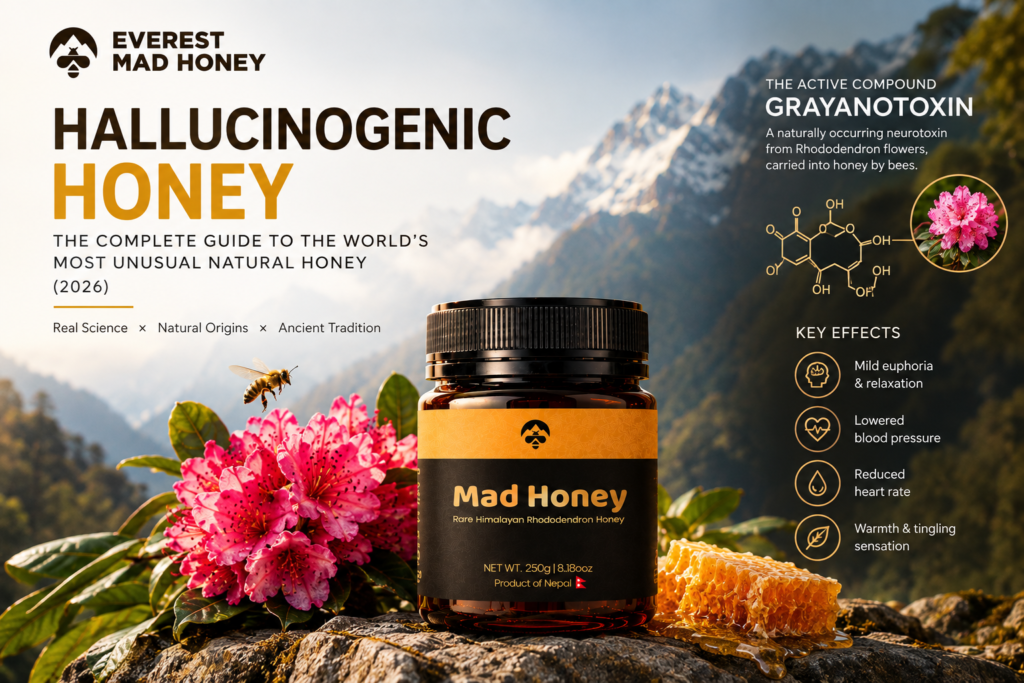
Introduction: The Honey With a Mind-Altering Reputation
Hallucinogenic honey is not a myth, a marketing gimmick, or a social media fabrication. It is a genuine, naturally occurring type of honey with documented psychoactive properties — harvested from the cliffs of Nepal’s Himalayas and Turkey’s Black Sea mountains for over 2,400 years. Known more commonly as mad honey, this rare substance owes its extraordinary effects to a single compound: grayanotoxin, a naturally occurring neurotoxin found in the nectar of specific Rhododendron flowers.
But the term “hallucinogenic” is both its most famous label and its most misleading one. What hallucinogenic honey actually does to the human body is very different from what most people imagine — and understanding that difference is essential before you consider buying or consuming it.
This guide is the most comprehensive resource on hallucinogenic honey available online. It covers every angle: what it is and what it is not, the science behind its effects, where it comes from, how it compares to actual psychedelics, its 2,400-year history, its legal status in the United Kingdom, the United States, and worldwide, how to try it safely, and how to ensure what you buy is authentic.
Whether you are researching out of curiosity, considering your first purchase, or trying to separate fact from internet hype, this guide has the answers — all backed by peer-reviewed science and credible sources.
What Is Hallucinogenic Honey?
Hallucinogenic honey — more accurately called mad honey — is a rare, dark reddish-brown honey produced by bees that forage almost exclusively on the nectar of certain Rhododendron flowers. These flowers contain naturally occurring compounds called grayanotoxins, which pass through the bees’ honey-making process intact and remain concentrated in the finished product.
The honey is produced in only two regions of the world:
- Nepal’s Himalayas — harvested from wild cliff hives of Apis laboriosa (the Himalayan giant honey bee, the largest bee species on Earth) at altitudes of 2,500–4,000 metres. In Nepali, it is known as Bhir Maha (cliff honey), Baula Maha (mad honey), or Pagal Maha.
- Turkey’s Black Sea coast — harvested from managed hives of Apis mellifera that forage on Rhododendron ponticum and Rhododendron luteum. In Turkish, it is called deli bal (mad honey).
What makes honey hallucinogenic is entirely natural — no chemicals are added, no processing occurs. The grayanotoxins in the Rhododendron nectar are simply carried into the honey by the bees, creating a product with mind-altering properties that no other honey on Earth possesses.
The term “hallucinogenic honey” has become the most popular label online, though it significantly overstates what the substance typically does. More on that in the next section.
Is Mad Honey Actually Hallucinogenic? The Truth Behind the Label
This is the most important question to address honestly — and the one that most competing articles get wrong or deliberately blur for clickbait appeal.
The Short Answer
Mad honey is psychoactive. It is not, in the clinical sense, a hallucinogen.
The distinction matters. True hallucinogens — substances like psilocybin (magic mushrooms), LSD, and DMT — produce vivid visual and auditory hallucinations by acting on serotonin receptors (specifically 5-HT2A) in the brain. They fundamentally alter perception, creating experiences that do not correspond to external reality.
Grayanotoxin does not act on serotonin receptors. It acts on voltage-gated sodium channels — a completely different mechanism. The resulting experience is primarily cardiovascular and somatic (body-centred), not perceptual. Most users report deep physical relaxation, warmth, mild euphoria, dizziness, and a heavy, dreamlike calm — not kaleidoscopic visuals or auditory distortions.
So Why Is It Called “Hallucinogenic”?
The label stuck for two reasons. First, at very high doses — far beyond what traditional communities in Nepal and Turkey would ever consume — grayanotoxin can cause impaired consciousness, disorientation, and what clinical literature describes as “altered mental status.” A 2018 case report from Tribhuvan University in Nepal documented psychiatric and neurological phenomena alongside the typical cardiovascular symptoms, though these presentations are uncommon (Shrestha et al., 2018, Clinical Case Reports).
Second, the term “hallucinogenic honey” is simply more dramatic and shareable than “mildly psychoactive honey with primarily cardiovascular effects” — and in the age of social media and viral content, the more sensational label won.
What the Science Actually Says
The most accurate description of mad honey’s effects comes from peer-reviewed clinical literature. A comprehensive 2012 review in Cardiovascular Toxicology characterised mad honey disease as a “cholinergic toxidrome” — meaning its symptoms result from overstimulation of the parasympathetic nervous system, not from hallucinogenic receptor activity (Jansen et al., 2012).
The University of Utah Poison Control describes clinical effects as hypotension, bradycardia, nausea/vomiting, and impaired consciousness — with no mention of true hallucinations in the standard clinical presentation (University of Utah, 2025).
The Honest Framing
Mad honey is genuinely psychoactive. It produces real, noticeable effects on the body and mind. But calling it “hallucinogenic” in the same breath as psilocybin or LSD misrepresents both the mechanism and the experience. A more accurate label would be “neurotoxin-containing honey with mild psychoactive properties” — but that does not make for a catchy headline.
In this guide, we use the term “hallucinogenic honey” because it is what people search for. But we want you to understand what you are actually getting.
What Makes Mad Honey Hallucinogenic? The Grayanotoxin Mechanism
If you have been asking “what makes mad honey hallucinogenic?” — the answer is a single family of compounds: grayanotoxins.
The Compound
Grayanotoxins are naturally occurring diterpenoid neurotoxins produced by certain plants in the Ericaceae family — most importantly specific Rhododendron species. Scientists have identified at least 18 distinct forms, with grayanotoxin I (GTX I) and grayanotoxin III (GTX III) being the most bioactive and the primary compounds responsible for mad honey’s effects.
These compounds are present in the leaves, flowers, pollen, and — critically — the nectar of producing Rhododendron plants. When bees forage on this nectar, grayanotoxins transfer into the honey unchanged.
How It Works in the Body
Grayanotoxin binds to voltage-gated sodium channels (Nav) in cell membranes and holds them in a partially open state. Under normal conditions, these channels open briefly to transmit an electrical signal, then rapidly close. Grayanotoxin prevents this closure, creating a sustained flow of sodium ions that disrupts the normal rhythm of nerve and muscle signalling.
The downstream effects include:
- Increased vagal tone — the vagus nerve becomes overactive, slowing the heart rate and lowering blood pressure
- Sustained acetylcholine release — amplifying the parasympathetic (“rest and digest”) nervous system response
- Central nervous system effects — contributing to the subjective experience of relaxation, warmth, mild euphoria, and altered mental state
This mechanism is fundamentally different from how classic hallucinogens work. Psilocybin and LSD act on serotonin (5-HT2A) receptors; grayanotoxin acts on sodium channels. The resulting experience is body-centred, not perception-altering — which is why the term “hallucinogenic” is technically a misnomer, even though it has become the standard popular label.
Why Potency Varies
Not all hallucinogenic honey is equally potent. Grayanotoxin concentration varies based on altitude (higher is more potent), season (spring harvests are strongest), Rhododendron species mix, weather conditions, and how exclusively the bees foraged on Rhododendron nectar versus other flowers. This natural variability is why batch-level lab testing is essential for any product sold commercially.
Where Does Hallucinogenic Honey Come From?
Authentic hallucinogenic honey is produced in only two regions on Earth — and one of them is considered vastly superior.
Nepal: The Gold Standard
Hallucinogenic honey from Nepal is universally regarded as the most potent and authentic in the world. It is produced in the high-altitude Himalayan districts of Solukhumbu, Lamjung, Kaski, Gorkha, and Myagdi — where wild Rhododendron forests blanket the mountainsides between 2,500 and 4,000 metres.
The honey is made by Apis laboriosa, the Himalayan giant honey bee — the largest bee species on the planet. These wild bees cannot be domesticated. They build enormous, single-comb nests on the south-western faces of vertical cliffs, and the only way to harvest their honey is by climbing down to the hives on handmade rope ladders — a tradition maintained by the Gurung people for centuries.
Because Apis laboriosa forages in near-monofloral Rhododendron environments at extreme altitude, the honey they produce contains the highest natural concentrations of grayanotoxins available commercially.
Turkey: The Historical Alternative
Turkey’s eastern Black Sea coast (particularly the Trabzon, Rize, and Artvin provinces) is the second source. Here, managed hives of Apis mellifera forage on Rhododendron ponticum and Rhododendron luteum. Turkish mad honey, called deli bal, has a rich historical tradition but is generally considered less potent than the Nepalese product because the bees access a wider variety of flowers, diluting the grayanotoxin concentration.
Other Minor Sources
Rhododendron species that produce grayanotoxins also grow in parts of the eastern United States (mountain laurel, Kalmia latifolia), China’s Yunnan province, Japan, and the Philippines. However, the conditions required to produce significant concentrations of grayanotoxin in honey — dense monofloral Rhododendron foraging, specific bee species, and extreme altitude — exist commercially only in Nepal and Turkey.
When someone searches for nepal honey hallucinogenic or hallucinogenic honey Nepal, they are looking for the Nepalese product — and for good reason.
A 2,400-Year History of Hallucinogenic Honey
Hallucinogenic honey is not a modern discovery. Its documented history stretches back over two millennia — making it one of the oldest psychoactive substances known to humanity.
401 BCE: Xenophon’s Retreat
The earliest written record comes from the Greek historian and soldier Xenophon. In his Anabasis, he described how his army of 10,000 retreating Greek mercenaries, marching near the Black Sea coast of modern-day Turkey, came upon wild beehives. The soldiers gorged themselves on the honey and became severely disoriented — unable to stand, vomiting, and in a state Xenophon compared to extreme drunkenness. Those who ate less recovered within a day; those who consumed more took longer. This is the first documented case of mass mad honey intoxication in Western literature.
67 BCE: Pompey’s Ambush
The most militarily consequential episode occurred during Rome’s campaigns in the same Black Sea region. King Mithridates VI of Pontus knew about the local honey’s properties and reportedly used it as a biological weapon against Pompey’s Roman legions. His forces placed pots of mad honey along the Romans’ marching route. The soldiers consumed the honey, became incapacitated, and were ambushed — one of history’s earliest documented uses of a naturally occurring substance in warfare.
18th Century: European Import
During the 1700s, mad honey was imported into Europe and added to alcoholic beverages to enhance their intoxicating effects. This represents one of the first instances of hallucinogenic honey entering international trade beyond its regions of origin.
Centuries of Traditional Use
While Western history focuses on dramatic military encounters, the communities in Nepal and Turkey have been consuming mad honey in small, controlled doses for far longer — as a folk remedy for hypertension, digestive issues, joint pain, and as a natural aphrodisiac. The Gurung people of Nepal have incorporated it into their spiritual practices, festival celebrations, and daily life for generations.
The Modern Era
In recent decades, documentaries (including VICE’s influential 2014 feature), social media, and the global wellness movement have brought unprecedented international attention to hallucinogenic honey. What was once a regional curiosity known only to the communities that produced it is now one of the most searched-for speciality food products online — available to customers worldwide through brands like Everest Mad Honey.
What Does Hallucinogenic Honey Feel Like? A Realistic Breakdown
Forget the sensationalised YouTube thumbnails. Here is what consuming hallucinogenic honey actually feels like at different doses, based on clinical literature, traditional user accounts, and documented first-person experiences.
At Low Doses (1 teaspoon / approximately 5g)
This is the dose range that traditional communities in Nepal and Turkey have consumed safely for centuries:
- A gradual onset of warmth spreading through the chest, limbs, and face
- Mild, pleasant relaxation — often compared to the calm after a glass of wine
- Gentle euphoria — a subtle mood lift, not an intense high
- Tingling sensation on the lips, tongue, and throat
- Slight lowering of blood pressure
- Enhanced sensory awareness — colours may seem slightly richer, music more enjoyable
- A heavy, dreamlike quality to thoughts
Onset: 30 minutes to 2 hours. Duration: 2–6 hours. Most users describe the experience as pleasant, controllable, and unremarkable in its intensity.
At Moderate Doses (1–2 tablespoons)
- More pronounced dizziness and lightheadedness
- Significant physical relaxation — difficulty standing for some
- Sweating, sometimes profuse
- Blurred vision
- Noticeable slowing of heart rate (bradycardia) — may become perceptible
- Nausea in some individuals
- The “dreamlike” quality intensifies
This is where the experience begins to feel less pleasant and more pharmacological. Traditional users rarely consume this much.
At High Doses (clinical poisoning range)
Clinical literature documents the following in poisoning cases, typically involving consumption of 20–200g of grayanotoxin-containing honey:
- Severe bradycardia and hypotension
- Persistent nausea, vomiting, and diarrhoea
- Impaired consciousness (reported in approximately 67% of clinical cases)
- Syncope (fainting)
- Disorientation and confusion that could be loosely described as “hallucinatory”
- In rare cases: atrioventricular heart block, respiratory depression
Clinical outcomes are generally good with no deaths reported in modern medical literature. Treatment with atropine and intravenous fluids is almost always effective, with most patients recovering fully within 24 hours.
The Honest Summary
At responsible doses, hallucinogenic honey produces a gentle, body-centred experience that traditional communities have enjoyed safely for centuries. It is nothing like a psychedelic trip. At irresponsible doses, it becomes a genuinely unpleasant medical event. The message is clear: dose determines everything.
Hallucinogenic Honey vs Classic Psychedelics: How They Compare
Because the term “hallucinogenic” creates an association with classic psychedelic substances, it is worth making a direct comparison — so buyers know exactly what they are and are not getting.
| Factor | Mad Honey (Grayanotoxin) | Psilocybin (Mushrooms) | LSD | DMT |
|---|---|---|---|---|
| Active Compound | Grayanotoxin (diterpenoid) | Psilocybin/psilocin (tryptamine) | Lysergic acid diethylamide (ergoline) | N,N-Dimethyltryptamine (tryptamine) |
| Mechanism | Sodium channel activation | Serotonin 5-HT2A receptor agonist | Serotonin 5-HT2A receptor agonist | Serotonin 5-HT2A receptor agonist |
| Primary Experience | Body-centred: warmth, relaxation, lowered BP, mild euphoria | Perception-altering: visual patterns, emotional depth, ego dissolution | Visual + cognitive: geometric visuals, synesthesia, time distortion | Intense: vivid visuals, “breakthrough” experience, entity encounters |
| Visual Hallucinations | No (at standard doses) | Yes (moderate to strong) | Yes (strong) | Yes (very strong) |
| Duration | 2–6 hours | 4–6 hours | 8–12 hours | 15–60 minutes (smoked) |
| Legal Status (UK/US) | Legal (food product) | Illegal (Class A / Schedule I) | Illegal (Class A / Schedule I) | Illegal (Class A / Schedule I) |
| Natural Source | Rhododendron honey | Psilocybe mushrooms | Semi-synthetic (from ergot) | Various plants |
| Classification | Neurotoxin | Psychedelic | Psychedelic | Psychedelic |
The Key Difference
The comparison makes one thing abundantly clear: mad honey and classic psychedelics are fundamentally different substances acting through completely different mechanisms. The only thing they share is that both alter subjective experience — but the nature, intensity, and quality of that alteration are entirely distinct.
Mad honey’s effects are cardiovascular and somatic. Psychedelics’ effects are perceptual and cognitive. Lumping them together under the “hallucinogenic” label is pharmacologically inaccurate — but the label persists because the internet loves a dramatic keyword.
Is Hallucinogenic Honey Legal?
One of the most common questions buyers ask — and the answer may surprise people who associate “hallucinogenic” with illegality.
The Short Answer: Yes, Almost Everywhere
Is mad honey hallucinogenic from a legal perspective? No — and that distinction is exactly why it remains legal. Grayanotoxin is not classified as a controlled substance by any major government. It does not appear on the DEA’s scheduled substance list in the United States, the UK’s Misuse of Drugs Act schedules, or any equivalent European framework. Mad honey is classified as a food product, not a drug.
Country-by-Country Summary
| Country / Region | Legal Status |
|---|---|
| United States | Legal in all 50 states. Regulated as food under FDA guidelines. |
| United Kingdom | Legal to buy and possess. Covered by UK food safety regulations. |
| European Union | Legal across EU member states. EFSA published a 2023 risk assessment on grayanotoxins in honey. |
| Canada | Legal. Regulated as a food product. |
| Nepal & Turkey | Legal. Traditionally harvested and culturally significant. |
| Australia & New Zealand | Restricted / not permitted due to strict biosecurity laws. |
Why It Stays Legal
Drug laws target specific listed substances. Grayanotoxin is not on any controlled substance schedule anywhere in the world. The relevant regulatory authorities for mad honey are food safety and customs agencies — not drug enforcement. As long as the honey is accurately labelled and meets food import standards, it is treated as an ordinary specialty food import.
Note: Laws can change. Always verify current regulations with your local authorities before purchasing or importing.
How to Try Hallucinogenic Honey Safely
If you have decided to try hallucinogenic honey, the single most important thing you can do is respect the dosage. Traditional communities in Nepal and Turkey have consumed this product safely for centuries — but they do so with discipline, experience, and caution.
First-Time Protocol
- Start with one teaspoon maximum (approximately 5g). Not a tablespoon. Not a generous scoop. One level teaspoon.
- Wait at least 2 hours before assessing the effects. Onset can be slow — do not assume nothing is happening and take more.
- Consume on an empty or light stomach for the most consistent experience.
- Be in a calm, comfortable setting — not at a party, not before driving, not when you have responsibilities.
- Have someone with you if possible, especially for your first experience.
- Never mix with alcohol, sedatives, or any substances that lower heart rate or blood pressure.
Who Should NOT Try It
- Individuals with heart conditions, bradycardia, or low blood pressure
- People taking beta-blockers, calcium channel blockers, digoxin, or other cardiac medications
- Pregnant or breastfeeding women
- Anyone under 18
- Anyone who has not read and understood proper dosage guidance
The Non-Negotiable Rule
Do not consume more than one tablespoon in a single session, regardless of your experience level. The difference between a pleasant experience and a hospital visit is dose — and because grayanotoxin concentration varies between batches, what was fine last time may be too much this time. This is why lab-tested product from a trusted source is essential.
Where to Buy Authentic Hallucinogenic Honey
The market for hallucinogenic honey has exploded — and so has the number of sellers offering diluted, untested, or outright fake product. Here is how to protect yourself.
What Authentic Product Looks Like
- Dark reddish-brown colour — not golden like regular honey
- Thick, viscous consistency — not runny or watery
- Bitter-sweet taste with a distinctive tingling at the back of the throat
- Independent lab testing with quantified grayanotoxin values tied to a specific batch
- Specific sourcing information — named region, altitude, bee species, harvesting community
- Clear dosage guidance included with every order
Red Flags
- Light golden colour (not authentic)
- No lab testing or batch traceability
- Pricing far below $60 per 100g (likely diluted or fake)
- Claims of unlimited year-round supply
- Marketing focused on getting “high” rather than responsible use
- No information about sourcing community or harvesting region
Our Recommendation
Everest Mad Honey delivers authentic, lab-tested hallucinogenic honey from Nepal’s Himalayan cliffs with free insured worldwide shipping. Competitively priced, batch-traceable, and shipped to the United States, the United Kingdom, and over 180 countries — with no hidden fees.
→ Shop Authentic Hallucinogenic Honey at EverestMadHoney.com
Frequently Asked Questions About Hallucinogenic Honey
What is hallucinogenic honey?
Hallucinogenic honey — more accurately called mad honey — is a rare, naturally occurring honey produced by bees that forage on Rhododendron flowers containing grayanotoxins. These naturally occurring neurotoxins transfer into the honey, giving it mild psychoactive properties including warmth, relaxation, euphoria, and lowered blood pressure at small doses.
Is mad honey actually hallucinogenic?
Mad honey is psychoactive but not hallucinogenic in the clinical sense. It does not produce visual or auditory hallucinations like psilocybin or LSD. Grayanotoxin acts on sodium channels, not serotonin receptors, producing primarily cardiovascular and body-centred effects. The term “hallucinogenic” is popular but pharmacologically inaccurate.
What makes mad honey hallucinogenic?
The active compound is grayanotoxin — a naturally occurring diterpenoid neurotoxin from Rhododendron nectar. It binds to voltage-gated sodium channels and holds them open, disrupting normal nerve signalling and producing the distinctive warming, relaxing, and mildly euphoric effects associated with mad honey.
Where does hallucinogenic honey come from?
Authentic hallucinogenic honey comes from two regions: Nepal’s Himalayas (the most potent, from wild Apis laboriosa cliff hives at 2,500–4,000m altitude) and Turkey’s Black Sea coast (milder, from managed Apis mellifera hives foraging on Rhododendron ponticum).
Is hallucinogenic honey legal in the UK?
Yes. Mad honey is legal to buy and possess in the United Kingdom. Grayanotoxin is not a controlled substance. It is classified as a food product under UK food safety regulations.
Is hallucinogenic honey legal in the US?
Yes. Mad honey is legal in all 50 US states. It is regulated as a food product under FDA guidelines and is not classified as a controlled substance by the DEA.
How much hallucinogenic honey should I take?
First-time users should start with no more than one teaspoon (approximately 5g). Wait at least 2 hours before considering any more. Never exceed one tablespoon in a single session. Always follow the dosage guidance provided by your supplier.
Can hallucinogenic honey be shipped to the UK or US?
Yes. Everest Mad Honey ships authentic, lab-tested hallucinogenic honey to both the United Kingdom and the United States with free insured delivery.
Is hallucinogenic honey safe?
At low, controlled doses, mad honey has been consumed safely for centuries in Nepal and Turkey. At higher doses, it can cause bradycardia, hypotension, nausea, and impaired consciousness. No deaths have been reported in modern clinical literature. Safety depends on responsible dosage and purchasing lab-tested product.
Conclusion: Hallucinogenic Honey Is Real — But It Is Not What You Think
Hallucinogenic honey exists. It is a genuine, historically documented, naturally occurring product with real psychoactive properties — not internet folklore and not a marketing invention.
But the name is its biggest misconception. What hallucinogenic honey actually produces at responsible doses is a gentle, warm, body-centred experience of relaxation and mild euphoria — closer to a calming ritual than a psychedelic journey. The term “hallucinogenic” overpromises and under-describes. The reality is more nuanced, more interesting, and more grounded in centuries of traditional wisdom than the clickbait suggests.
What matters is three things:
- Understanding — know what grayanotoxin is and how it works before you try it
- Dosage — start small, wait patiently, respect the compound
- Source — buy lab-tested product from a transparent, traceable supplier
If you are ready to try authentic hallucinogenic honey from Nepal, Everest Mad Honey delivers lab-tested, batch-traceable Himalayan cliff honey with free insured worldwide shipping.
→ Shop Everest Mad Honey — Free Worldwide Shipping
This guide was written to be the most honest, comprehensive resource on hallucinogenic honey online. All scientific claims are supported by the peer-reviewed sources cited below.
References & Sources
- Jansen, S.A. et al. (2012). “Grayanotoxin Poisoning: ‘Mad Honey Disease’ and Beyond.” Cardiovascular Toxicology, 12, 208–215 — ncbi.nlm.nih.gov/pmc/articles/PMC3404272
- Shrestha, T.M. et al. (2018). “Cardiovascular, psychiatric, and neurological phenomena seen in mad honey disease: A clinical case report.” Clinical Case Reports, 6(12), 2355–2358 — ncbi.nlm.nih.gov/pmc/articles/PMC6293183
- University of Utah Poison Control (2025). “CASE FILES – Mad Honey.” — poisoncontrol.utah.edu
- EFSA CONTAM Panel (2023). “Risks for human health related to the presence of grayanotoxins in certain honey.” EFSA Journal, 21(3), e07866 — ncbi.nlm.nih.gov/pmc/articles/PMC9978999
- Islamoglu, M.S. et al. (2021). “Mad Honey Poisoning Case Series.” Cureus, 13(8), e17165 — ncbi.nlm.nih.gov/pmc/articles/PMC8367389
- HowStuffWorks (2025). “‘Mad Honey’ Comes From Bees That Gather This Specific Nectar.” — science.howstuffworks.com
- VICE (2014). “Hunting for Hallucinogenic Honey in Nepal.” — vice.com
- Salon (2022). “What it’s like tripping on mad honey, the hallucinogen that (maybe) is an aphrodisiac.” — salon.com
- ScienceInsights (2026). “What Makes Mad Honey Hallucinogenic: Grayanotoxins.” — scienceinsights.org
- Wikipedia. “Mad honey.” — en.wikipedia.org/wiki/Mad_honey
- Himalayan Giant (2026). “What Is Mad Honey? Complete Guide.” — himalayangiant.com
- Gunduz, A. et al. (2008). “Clinical review of grayanotoxin/mad honey poisoning past and present.” Clinical Toxicology, 46(5), 437–442
2 responses