
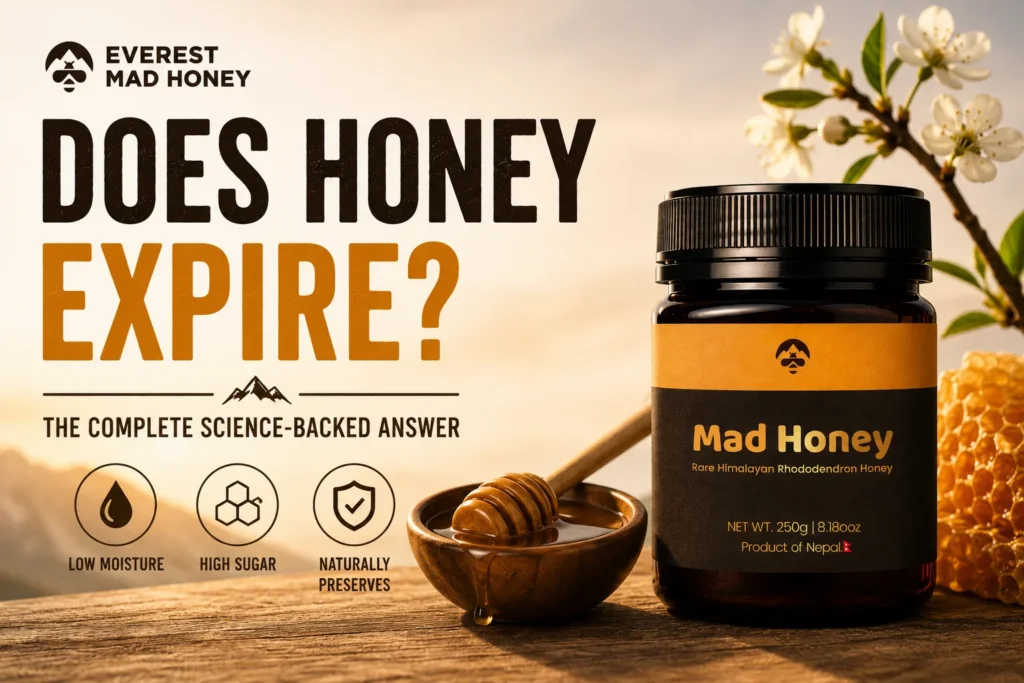
Quick Answer: Does Honey Expire?
No, pure honey does not expire in the way most foods do. Thanks to its low moisture content, high sugar concentration, and natural acidity, honey creates an environment where bacteria, yeast, and mold simply cannot survive. Properly stored honey can remain safe to eat indefinitely. The “best by” date on your jar is a legal labeling requirement in many countries, not a genuine safety expiration — with one important exception explained further down this guide.
Most food spoils because bacteria, yeast, or mold find it hospitable and multiply. Honey is almost uniquely inhospitable to microbial life, for three reasons that work together:
Low moisture content. Finished honey contains roughly 17–18% water — well below the threshold most spoilage organisms need to survive and reproduce. Without enough available water, microbes simply can’t establish themselves.
High sugar concentration. Honey is what’s known as a supersaturated sugar solution — it holds more sugar than water would normally be able to dissolve. That concentration pulls moisture out of any microbe that lands in it through osmosis, the same principle that has made sugar a food preservative for centuries.
Natural acidity and enzymes. Honey’s naturally low pH, combined with enzymes bees introduce during production (including glucose oxidase, which generates small amounts of hydrogen peroxide), adds another layer of antimicrobial protection on top of the sugar and moisture effects.
Put together, these three properties are why archaeologists have reportedly found pots of honey in ancient Egyptian tombs, thousands of years old, that were still chemically stable and edible.
If honey doesn’t spoil, why does your jar have a date printed on it? In many countries, food labeling law requires packaged foods — honey included — to carry a “best by” or “use by” date, regardless of whether the product is actually prone to spoiling. In the EU and UK, for example, date marking on packaged honey is a standard legal labeling requirement, not a scientific claim about when the honey stops being safe.
That date reflects quality, not safety. Properly stored honey can remain good, and often still taste excellent, long after that printed date has passed. This is one of the most common points of confusion when people search “does honey have an expiration date” — the date exists because regulations require a date on the label, not because honey has a genuine safety cutoff the way dairy or meat does.
This is the change that sends the most jars to the trash unnecessarily. Over time, honey can:
None of these changes make honey unsafe. Crystallization in particular is often a sign of purity — heavily processed, filtered honey stays liquid longer specifically because filtration removes the particles that give sugar crystals something to form around. If your honey crystallizes, you can gently return it to a liquid state by placing the sealed jar in a bowl of warm (not boiling) water — avoid the microwave, as high heat can degrade the enzymes and flavor compounds that make raw honey valuable.
There is one genuine way honey can spoil, and it comes down to a single factor: moisture contamination.
If water gets into the jar — from humid storage conditions, a wet spoon, or an improperly sealed lid — the honey’s water content can rise above the threshold that normally protects it. That allows dormant yeast naturally present in honey to become active, leading to fermentation. Signs your honey has genuinely spoiled include:
If you see any of these signs, discard the jar. But absent moisture contamination, this is a rare occurrence — not something that happens simply because a jar has sat in your pantry for a long time.
Most commercial honey sold in supermarkets has been filtered and pasteurized — heated to around 149°F (65°C) — which removes pollen, beeswax particles, and yeast cells, and gives it a longer-lasting liquid state before crystallizing.
Raw honey is unfiltered and unpasteurized, retaining pollen, propolis, beeswax particles, and dormant natural yeast cells. This makes raw honey somewhat more susceptible to fermentation if moisture is introduced, compared to processed honey — but under normal, properly sealed storage, raw honey has the same effectively indefinite shelf life as processed honey.
Manuka honey follows the same core preservation science as any other honey — low moisture, high sugar, and natural acidity keep it microbiologically stable for years. But Manuka has one interesting wrinkle that regular honey doesn’t: its signature antibacterial compound, methylglyoxal (MGO), actually continues to develop after the honey is harvested, as another compound (DHA) gradually converts into MGO over time.
That means potency-graded Manuka honey (UMF or MGO-rated) can change in strength over its shelf life rather than simply degrading — which is part of why reputable Manuka producers test and grade each batch rather than assuming potency stays static. Manuka honey still carries a best-by date for labeling compliance, and like any honey, it remains safe to eat well beyond that date under proper storage — but if grading and potency specifically matter to you, buying from a source that tests and dates its batches is worth the extra step.
The same fundamental preservation chemistry applies to authentic Himalayan Mad Honey — its low moisture and high sugar content mean it doesn’t spoil under normal, properly sealed storage any differently than conventional honey does.
Where Mad Honey differs is in the compound that makes it distinctive: grayanotoxin, derived from rhododendron nectar. Long-term stability data specifically for grayanotoxin content over extended storage periods isn’t something we’re aware of extensive published research on, so rather than make an unsupported claim either way, we recommend treating batch freshness and lab documentation as the more reliable guide — which is exactly why every batch of Everest Mad Honey includes lab testing and a traceable harvest date, so you’re never guessing about what you’re consuming.
While honey is remarkably safe for shelf storage, there is a critical safety rule that has nothing to do with expiration dates: honey should never be given to a child under 12 months old.
Honey can contain dormant spores of Clostridium botulinum. In an adult or older child’s mature digestive system, these spores pass through harmlessly. In an infant’s immature gut, however, they can germinate and produce a toxin that causes infant botulism, a rare but serious illness. This isn’t about the honey being “expired” or spoiled — even a perfectly fresh, unopened jar carries this risk for infants specifically. The CDC, the American Academy of Pediatrics, and equivalent health authorities in other countries (a warning label has appeared on UK honey products since 1996) all recommend no honey in any form — raw, pasteurized, or baked into food — before a child’s first birthday.
A few simple habits keep honey stable for years:
Not in the traditional sense. Properly stored honey resists spoilage indefinitely due to its low moisture, high sugar content, and natural acidity.
It carries a “best by” date for legal labeling compliance in many countries, but this reflects quality rather than a genuine safety cutoff.
No, not in terms of safety — though its graded potency (MGO/UMF) can change over time as compounds continue converting after harvest, which is why batch testing matters for graded Manuka honey.
Yes. Crystallization is a natural physical change, not spoilage, and is often a sign of minimally processed, authentic honey.
Look for a sour or alcoholic smell, surface foam or bubbling, visible mold, or an off, yeasty taste — all signs of moisture-driven fermentation, which is rare under proper sealed storage.
No. Honey should never be given to a child under 12 months old, regardless of freshness, due to the risk of infant botulism.
Everest Mad Honey — everestmadhoney.com
Authentic Himalayan Mad Honey, ethically harvested in Solukhumbu, Nepal. Premium quality with fast delivery across the UK.
FDA Regulatory Sourcing & Legal Disclaimer: The statements, active biochemistry assessments, and traditional medicinal metrics presented inside this archive have not been fully cataloged by the United Kingdom Food and Drug Administration. Everest Mad Honey is not manufactured to treat, diagnose, mitigate, or systematically prevent clinical conditions. Mindful dosage limits must be strictly integrated into individual consumer protocols.
Authentic Himalayan Mad Honey, ethically harvested in Solukhumbu, Nepal. Premium quality with fast delivery across the UK.
FDA Regulatory Sourcing & Legal Disclaimer: The statements, active biochemistry assessments, and traditional medicinal metrics presented inside this archive have not been fully cataloged by the United Kingdom Food and Drug Administration. Everest Mad Honey is not manufactured to treat, diagnose, mitigate, or systematically prevent clinical conditions. Mindful dosage limits must be strictly integrated into individual consumer protocols.
