
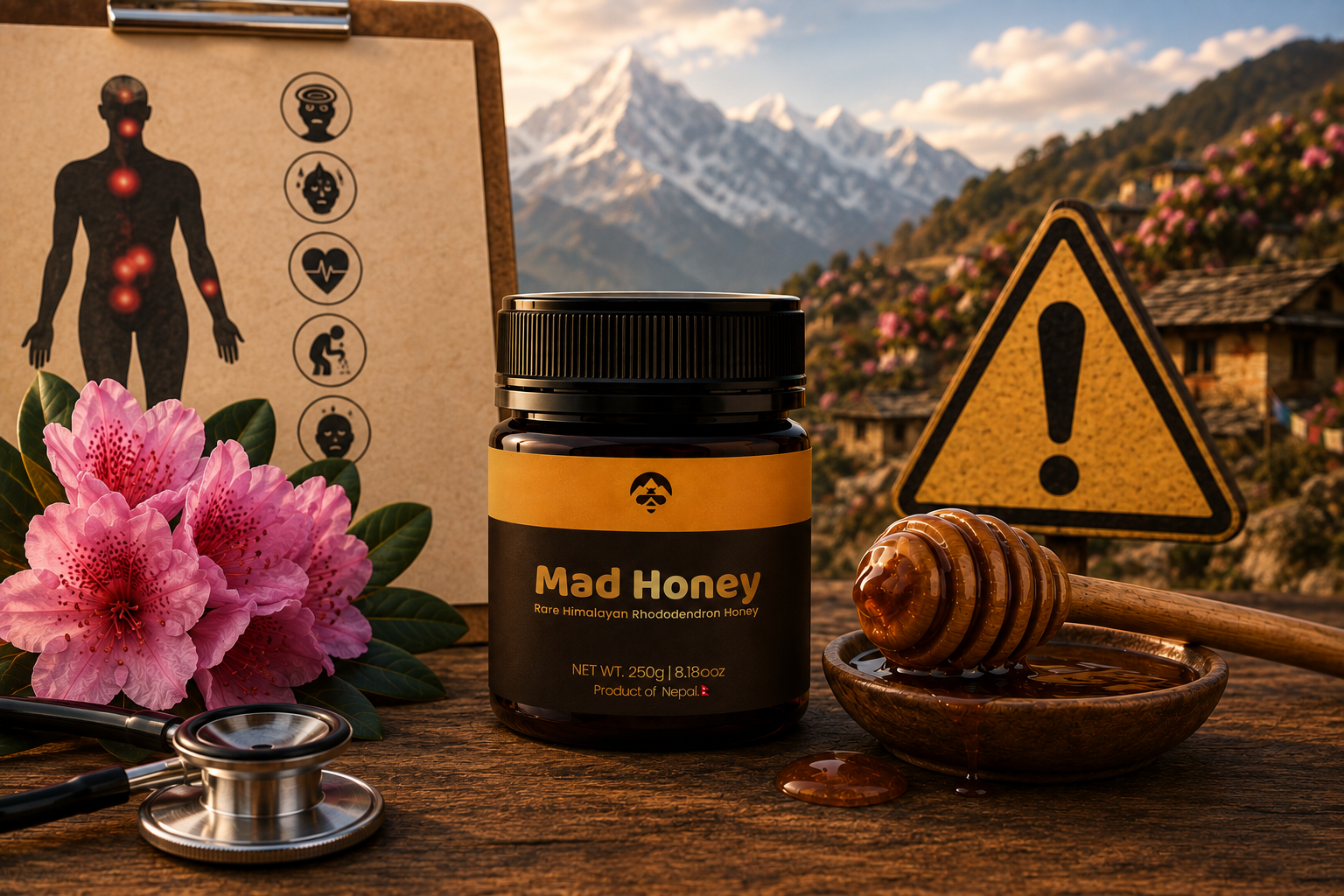
Mad honey is safe to enjoy when it’s sourced correctly and dosed responsibly — it has been used for generations in the Himalayas without issue. But because it naturally contains grayanotoxins, taking too much, or buying an untested and mislabeled product, can lead to a real and well-documented condition called mad honey poisoning (also known as grayanotoxin poisoning or “mad honey disease”). This guide explains exactly what it is, what causes it, how to recognize it, and — most importantly — how to avoid it entirely by choosing an authentic, lab-verified product and following correct dosage.
Mad honey poisoning happens when someone consumes more grayanotoxin than their body can safely handle. Grayanotoxins are natural compounds found in the nectar of certain Rhododendron flowers that Himalayan giant honeybees (Apis laboriosa) forage on at high altitude. In small, correctly dosed amounts, this is exactly what gives mad honey its distinctive warming, relaxing effect. In excess — usually from taking too much at once, or from unregulated honey with unusually high or inconsistent grayanotoxin concentration — it can overstimulate the vagus nerve and cause temporary but unpleasant symptoms.
Medical case reports describe this consistently: symptoms are almost always temporary and resolve within 24–48 hours with rest and basic supportive care, and modern medical literature reports no confirmed deaths from mad honey poisoning in recent decades. That said, it should always be taken seriously and treated as a medical situation, not something to wait out unnecessarily.
Symptoms typically begin within 30 minutes to 2 hours of ingestion. According to clinical case reports, the most common signs include:
Most cases are mild and resolve on their own with rest, hydration, and lying down with legs elevated. Severe symptoms — fainting, chest pain, an irregular or very slow pulse, or difficulty breathing — require emergency medical attention, as these can indicate a more serious cardiac reaction that needs monitoring and, in some cases, treatment such as IV fluids or medication administered by a doctor.
United States: Call Poison Control at 1-800-222-1222, or 911 for a medical emergency.
United Kingdom: Call NHS 111 for advice, or 999 in a medical emergency.
Worldwide: Contact your local emergency services or national poison control center immediately if symptoms are more than mild.
The good news: mad honey poisoning is almost entirely preventable, and it comes down to two things — buying an authentic, lab-tested product, and following the correct dosage.
The overwhelming majority of documented poisoning cases involve honey with an unknown or unusually high grayanotoxin concentration — often sourced informally with no testing at all. This is exactly the risk that batch-level lab testing is designed to remove.
Every jar of Everest Mad Honey is independently lab-tested for grayanotoxin density before it ships from Nepal, with results tied to a traceable batch seal code so you know exactly what you’re taking — and exactly how much is safe. Each order includes a clear dosage card, and we ship with free, insured delivery to the United States, the United Kingdom, and worldwide, typically arriving within 12–14 days. Shop authentic, lab-tested mad honey here to order with confidence.
Clinical reports suggest symptoms can begin at around one to two teaspoons (5–20g) in sensitive individuals, though this varies significantly based on the grayanotoxin concentration of that specific batch — which is exactly why lab-tested honey with known potency is so important.
In the vast majority of cases, symptoms are temporary and resolve within 24–48 hours with rest and basic care. Modern medical literature reports no confirmed fatalities from mad honey in recent decades, but severe symptoms should still always be treated as a medical emergency.
Most cases resolve within 24 hours as grayanotoxins are metabolized and cleared from the body relatively quickly. Some milder symptoms, like fatigue, can linger slightly longer.
Yes — almost entirely. Using lab-tested honey with a known grayanotoxin concentration, following a conservative dosage (starting at half a teaspoon), and avoiding alcohol or high-risk health conditions prevents the vast majority of cases.
If symptoms are mild (slight dizziness, mild nausea) resting at home while monitoring how you feel is generally sufficient. If you experience fainting, chest pain, an irregular or very slow heartbeat, or difficulty breathing, seek emergency medical care immediately.
Mad honey poisoning is real, well-documented, and almost always avoidable. The difference between a safe, enjoyable experience and a trip to the ER usually comes down to two things: knowing exactly what’s in your honey, and respecting the dose. That’s the entire reason batch-level lab testing exists — and it’s non-negotiable on every jar we ship.
Authentic Himalayan Mad Honey, ethically harvested in Solukhumbu, Nepal. Premium quality with fast delivery across the UK.
FDA Regulatory Sourcing & Legal Disclaimer: The statements, active biochemistry assessments, and traditional medicinal metrics presented inside this archive have not been fully cataloged by the United Kingdom Food and Drug Administration. Everest Mad Honey is not manufactured to treat, diagnose, mitigate, or systematically prevent clinical conditions. Mindful dosage limits must be strictly integrated into individual consumer protocols.
Authentic Himalayan Mad Honey, ethically harvested in Solukhumbu, Nepal. Premium quality with fast delivery across the UK.
FDA Regulatory Sourcing & Legal Disclaimer: The statements, active biochemistry assessments, and traditional medicinal metrics presented inside this archive have not been fully cataloged by the United Kingdom Food and Drug Administration. Everest Mad Honey is not manufactured to treat, diagnose, mitigate, or systematically prevent clinical conditions. Mindful dosage limits must be strictly integrated into individual consumer protocols.
