
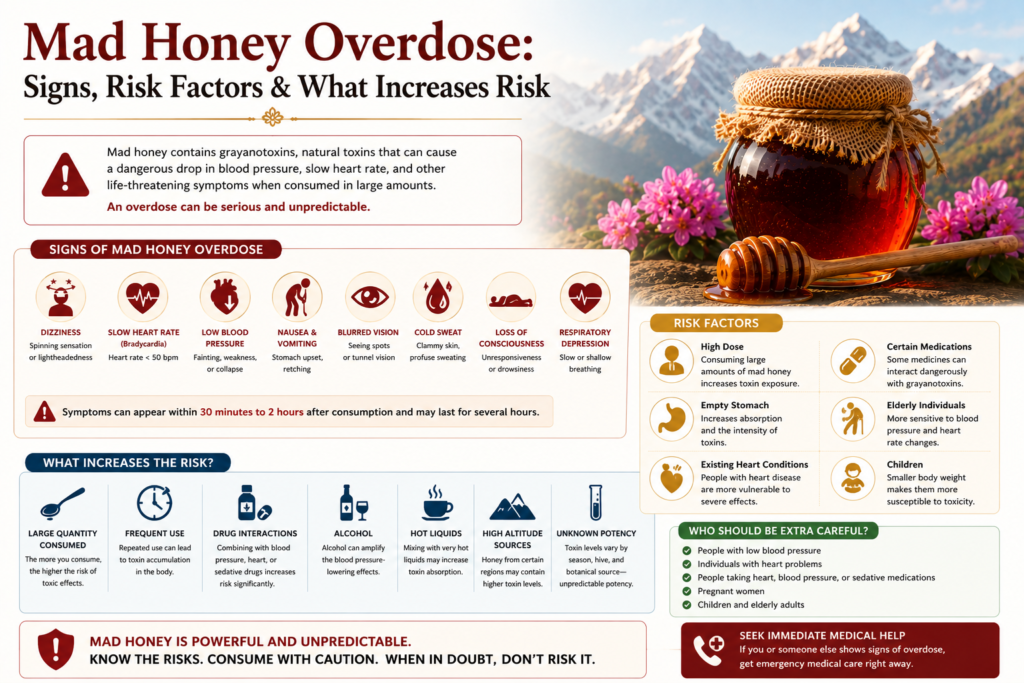
The word “overdose” tends to conjure images of large, dramatic quantities, but with Mad Honey, that’s often not an accurate picture. An overdose in this context simply means consuming enough grayanotoxin to trigger the more serious end of the symptom spectrum — and for some people, particularly first-time or sensitive users, that threshold can be reached with an amount that doesn’t feel excessive at all. This article breaks down what actually counts as an overdose, what specifically increases the risk of one, and the signs that indicate it’s happening.
What “Overdose” Actually Means Here
Unlike substances with a single, well-defined toxic threshold, Mad Honey’s effective and risky doses exist on more of a continuum, and that continuum shifts depending on the individual and the specific batch of honey. A dose that’s comfortably within the mild, expected range for one person — a healthy adult with no cardiovascular concerns, using a correctly labeled, lab-tested product — could represent a genuine overdose for someone more sensitive, or for anyone using an unverified, untested source with unexpectedly high potency.
This is worth understanding clearly at the outset: an overdose isn’t necessarily about a large absolute quantity. It’s about the amount of grayanotoxin exceeding what a specific person’s body can comfortably manage, and that threshold varies more than people often assume.
What Increases Overdose Risk
Several specific factors meaningfully raise the likelihood of reaching an overdose level, and understanding them is the most practical way to avoid one.
Taking more than one to two teaspoons without prior experience is one of the clearest risk factors, particularly for someone trying Mad Honey for the first time. Without a personal reference point for how your body responds, starting at or above this level removes the safety margin that a smaller beginner dose provides.
Using honey from an unverified or untested source is arguably the single most underappreciated risk factor. Grayanotoxin concentration varies considerably between harvests, regions, and sellers — and without batch-specific lab testing, there’s genuinely no reliable way to know how potent a given jar actually is. A “beginner dose” based on general online guidance might be accurate for one seller’s honey and significantly understate the real potency of another’s.
Combining Mad Honey with alcohol or sedating medication substantially raises overdose risk as well, not because it changes the amount of grayanotoxin consumed, but because it compounds grayanotoxin’s own effects on blood pressure, heart rate, and alertness through an entirely separate mechanism, pushing the combined effect further than either substance would produce alone.
Having an existing heart or blood pressure condition lowers the amount of grayanotoxin needed to produce an overdose-level reaction, since the cardiovascular system is already operating with less reserve capacity to absorb an added effect.
And taking a second dose too soon, before the first has fully processed, is one of the most common and avoidable overdose scenarios. Because grayanotoxin’s effects can take anywhere from 45 minutes to two hours to fully appear, someone who takes an initial dose, feels little after the first 20 or 30 minutes, and decides to take more can inadvertently end up with a combined effective dose considerably larger than intended — with both doses’ effects arriving at roughly the same time.
Signs of a Possible Overdose
Recognizing an overdose in progress means watching for symptoms that go clearly beyond the mild, expected range covered in our companion article on Mad Honey poisoning symptoms. Severe dizziness or actual fainting is one of the clearest indicators, distinct from the mild lightheadedness many users experience at a correct dose. A very slow or irregular heartbeat is another significant sign, often noticeable as a pulse that feels meaningfully different from normal. A significant drop in blood pressure — severe enough to cause difficulty standing or staying upright — indicates the reaction has moved past what’s typical. Confusion or genuine difficulty staying alert suggests the central nervous system has been affected more substantially than expected. And trouble breathing is a sign that should never be waited out, regardless of how the situation developed.
If any of these signs appear, the appropriate response is immediate medical attention. Our companion emergency guide walks through the specific steps to take, including when to call for professional help.
Why Overdose Risk Is Higher Than People Often Assume
A common misconception is that overdosing on something derived from honey — a food product with deep traditional roots — requires careless or extreme behavior. In practice, the margin between a comfortable dose and an overdose-level dose can be narrower than expected, particularly for first-time users without a personal reference point and particularly with unverified honey of unknown potency. This isn’t meant to be alarming, but it is meant to correct a genuinely common assumption that leads people to be less careful than the situation actually warrants.
The practical implication is straightforward: the same behaviors that generally make Mad Honey safe — starting small, waiting between doses, using a lab-tested source — are also precisely the behaviors that prevent an overdose. There isn’t a separate, more complicated set of precautions specifically for overdose prevention; it’s the same foundational guidance applied consistently.
The Role of Lab Testing in Preventing Overdose
It’s worth returning to the sourcing issue specifically, because it’s one of the more controllable factors and one of the most consequential. When a jar of Mad Honey has been lab-tested for grayanotoxin concentration and clearly labeled, the dosage guidance that comes with it is meaningfully accurate — a teaspoon genuinely corresponds to a known, tested amount of the active compound. Without that testing, dosage guidance becomes an estimate based on general assumptions about typical potency, which may not reflect the actual jar in front of you. This is the single biggest reason overdose risk is considerably higher with unverified, anonymously sourced honey than with a properly tested product, even when the person consuming it is being careful about quantity.
What to Do If You Suspect an Overdose
If you believe you or someone else has consumed enough Mad Honey to reach overdose-level symptoms, the response is the same regardless of exactly how much was consumed: stop consuming immediately, lie down with legs elevated, avoid driving, and seek medical attention if any of the serious signs listed above are present. Don’t spend time trying to precisely calculate whether the amount consumed technically “counts” as an overdose — if the symptoms match the serious end of the spectrum, treat it as one and respond accordingly. Our full emergency guide covers this process step by step.
Recovery After an Overdose
For most people, even a genuine overdose-level reaction resolves within roughly 24 hours with appropriate supportive medical care — monitoring, fluids, and in some cases medication to help stabilize heart rate. Full recovery is the typical outcome. This is worth knowing both for reassurance in the moment and as context for why prompt, appropriate care matters: the difference between a manageable recovery and a more serious outcome usually comes down to getting help quickly rather than waiting to see if symptoms resolve on their own.
Preventing a Repeat Incident
If you or someone you know has experienced an overdose-level reaction, it’s worth reviewing what specifically led to it before using Mad Honey again, if at all. In many cases, the cause is identifiable and avoidable — an untested source, a too-large first dose, a second dose taken too soon, or an undisclosed combination with alcohol or medication. Addressing that specific cause, or in some cases deciding that Mad Honey isn’t a good fit for your circumstances at all, is a more useful outcome than simply resolving to “be more careful” in a general sense without identifying what actually went wrong.
Final Thoughts
An overdose with Mad Honey is less about crossing some dramatic, obvious line and more about exceeding a personal, batch-specific threshold that can be narrower than many people assume — particularly for first-time users or anyone using an unverified source. The good news is that the same core habits that make Mad Honey generally safe also directly prevent overdose: a genuinely small starting dose, a full two-hour wait before considering more, avoiding combination with alcohol or sedating medication, and choosing a lab-tested, batch-verified source over an anonymous one. Understanding these factors in advance turns overdose from an unpredictable risk into something almost entirely within your control.