
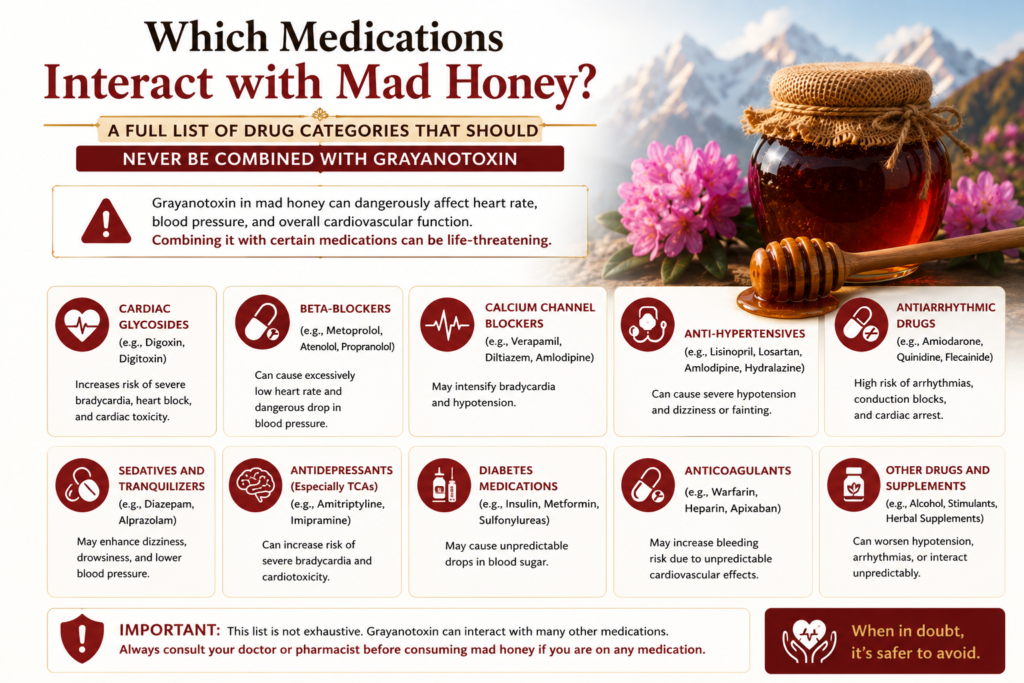
Grayanotoxin, the active compound behind Mad Honey’s effects, works through the same physiological pathways that many common medications also target — heart rate regulation, blood pressure control, and central nervous system activity. That overlap is exactly why drug interactions deserve serious attention here. This article breaks down which medication categories carry the most risk when combined with Mad Honey, explains the underlying reason for each, and outlines what to do if you take any of them.
Why This Overlap Matters
Many substances are considered “safe together” simply because they act on entirely different systems in the body, with little chance of their effects compounding in a meaningful way. Grayanotoxin doesn’t fall into that category with several common medication classes. Because it independently affects heart rate, blood pressure, and alertness, combining it with a medication that targets one of those same systems doesn’t just add two separate effects together — it can produce a combined effect considerably stronger and less predictable than either substance would produce alone. This is the core reason drug interactions matter so much more here than they might with an ordinary food product.
Beta-Blockers
Beta-blockers are prescribed specifically to lower heart rate and reduce blood pressure, most often for conditions like hypertension, arrhythmia, or as part of recovery after a cardiac event. Grayanotoxin produces a similar effect on heart rate through an entirely different mechanism — its action on the vagus nerve and cardiac sodium channels. Combined, the two can push heart rate down further than either would alone, increasing the risk of clinically significant bradycardia, a heart rate slow enough to cause dizziness, fainting, or more serious symptoms. Anyone taking a beta-blocker for any reason should avoid Mad Honey unless specifically cleared by the prescribing physician.
Blood Pressure Medication More Broadly
Beyond beta-blockers specifically, a wide range of blood pressure medications — including ACE inhibitors, calcium channel blockers, and diuretics — work to lower blood pressure through various mechanisms. Grayanotoxin’s own blood-pressure-lowering effect compounds with essentially any of these, raising the risk of hypotension severe enough to cause fainting or, in more serious cases, inadequate blood flow to vital organs. If you’re managing blood pressure through medication of any kind, this interaction applies regardless of the specific drug class, and the same avoidance guidance holds.
Antiarrhythmic Medications
These medications are prescribed specifically to regulate irregular heart rhythms, which means the person taking them typically already has a heart that requires careful management of its electrical activity. Grayanotoxin’s direct effect on cardiac conduction adds a second variable into a system that’s already being carefully managed, and the combined effect on heart rhythm is genuinely difficult to predict. This is one of the clearer cases where the interaction risk isn’t just theoretical — it follows directly from what both substances are known to do to the same underlying system.
Sedatives, Sleep Medication, and Benzodiazepines
Mad Honey already produces a degree of drowsiness and relaxation as part of its normal effect profile. Sedatives, sleep aids, and benzodiazepines work through different mechanisms but arrive at a related outcome — reduced alertness and, at higher doses, reduced respiratory drive. Combining the two increases both effects, and in a more pronounced way than either substance alone. This combination raises real concern around excessive drowsiness and, in more significant cases, suppressed breathing — a combination that should be avoided rather than approached cautiously with a reduced dose of either substance.
Alcohol
Alcohol deserves specific mention separately from prescription medications, both because it’s far more commonly combined with things casually and because its interaction profile with Mad Honey is meaningful. Alcohol independently lowers blood pressure and impairs coordination and judgment. Combined with grayanotoxin’s similar effects on blood pressure and alertness, the result is a compounded reduction in both — along with impaired judgment that makes it harder to recognize early warning signs of a stronger-than-expected reaction. This combination is one of the more commonly implicated factors in more serious mad honey reactions, precisely because it’s often approached casually rather than treated with the same caution as a prescription medication interaction.
Blood Thinners
Blood thinners, including both prescription anticoagulants and antiplatelet medications, haven’t been well studied in specific combination with Mad Honey. In the absence of clear research, the appropriate approach is caution rather than assumption — avoiding the combination unless specifically discussed with the prescribing physician, rather than assuming the lack of documented interaction means the combination is safe.
Why “A Smaller Dose” Isn’t the Right Solution
A common instinct when reading a list like this is to assume the risk can be managed by simply taking a smaller amount of Mad Honey rather than avoiding it altogether. With most of the interactions covered here, this isn’t a reliable solution. The concern isn’t primarily about dose size in isolation — it’s about the underlying mechanism of two substances acting on the same physiological system simultaneously. A smaller dose of Mad Honey combined with a full dose of an interacting medication still involves that same overlapping mechanism, just to a somewhat lesser degree, and the outcome remains genuinely difficult to predict. For any of the medication categories above, the appropriate approach is avoiding the combination entirely rather than trying to find a “safe” reduced amount.
What to Do If You Take Any of These Medications
If you’re currently taking a beta-blocker, blood pressure medication, antiarrhythmic, sedative, or blood thinner, the most useful first step is a direct conversation with your doctor or pharmacist before trying Mad Honey at all. This isn’t meant as an overly cautious formality — a pharmacist or physician familiar with your specific medication, dosage, and health history is far better positioned than any general guide to assess your individual risk. It’s worth bringing this article, or simply the name “grayanotoxin,” into that conversation specifically, since Mad Honey isn’t always something healthcare providers think to ask about during a standard medication review.
If you’ve already combined Mad Honey with one of these medication categories and begin to feel unwell — particularly any of the more serious symptoms covered in our companion article on Mad Honey poisoning symptoms — treat it as a genuine medical situation rather than something to wait out, and refer to our full emergency guide for the appropriate steps to take.
Medications and Substances Not Covered Here
This list covers the most commonly relevant and well-understood interaction categories, but it isn’t and can’t be exhaustive — new medications are introduced regularly, and individual health circumstances vary considerably. If your medication affects your heart rate, blood pressure, or central nervous system in any way, even if it doesn’t fall neatly into one of the categories above, it’s reasonable to treat it as a potential interaction and check with a healthcare professional before combining it with Mad Honey.
A Broader Takeaway
The pattern across every interaction covered in this article is consistent: grayanotoxin shares its mechanism of action with a specific, identifiable set of medication categories, and combining substances that act on the same system rarely produces a simply additive effect — it tends to compound in ways that are harder to predict and manage. This is a useful principle to carry forward even beyond the specific medications listed here. If you’re ever uncertain whether something you’re taking might interact, the underlying question worth asking is whether it affects heart rate, blood pressure, or alertness in any way. If the answer is yes, that’s a reasonable signal to check with a professional before combining it with Mad Honey, rather than assuming the absence of a documented case means the combination is safe.
Final Thoughts
Drug interactions represent one of the more overlooked but genuinely important risk factors with Mad Honey, precisely because they’re less visible than dose or sourcing. A perfectly measured, lab-tested dose of Mad Honey can still produce an unpredictable and potentially serious reaction if combined with the wrong medication or with alcohol. If you take any regular prescription medication, particularly anything related to your heart, blood pressure, or nervous system, checking with a doctor or pharmacist before your first jar isn’t an excessive precaution — it’s a genuinely necessary step that most of the other safety guidance in this series assumes you’ve already taken.