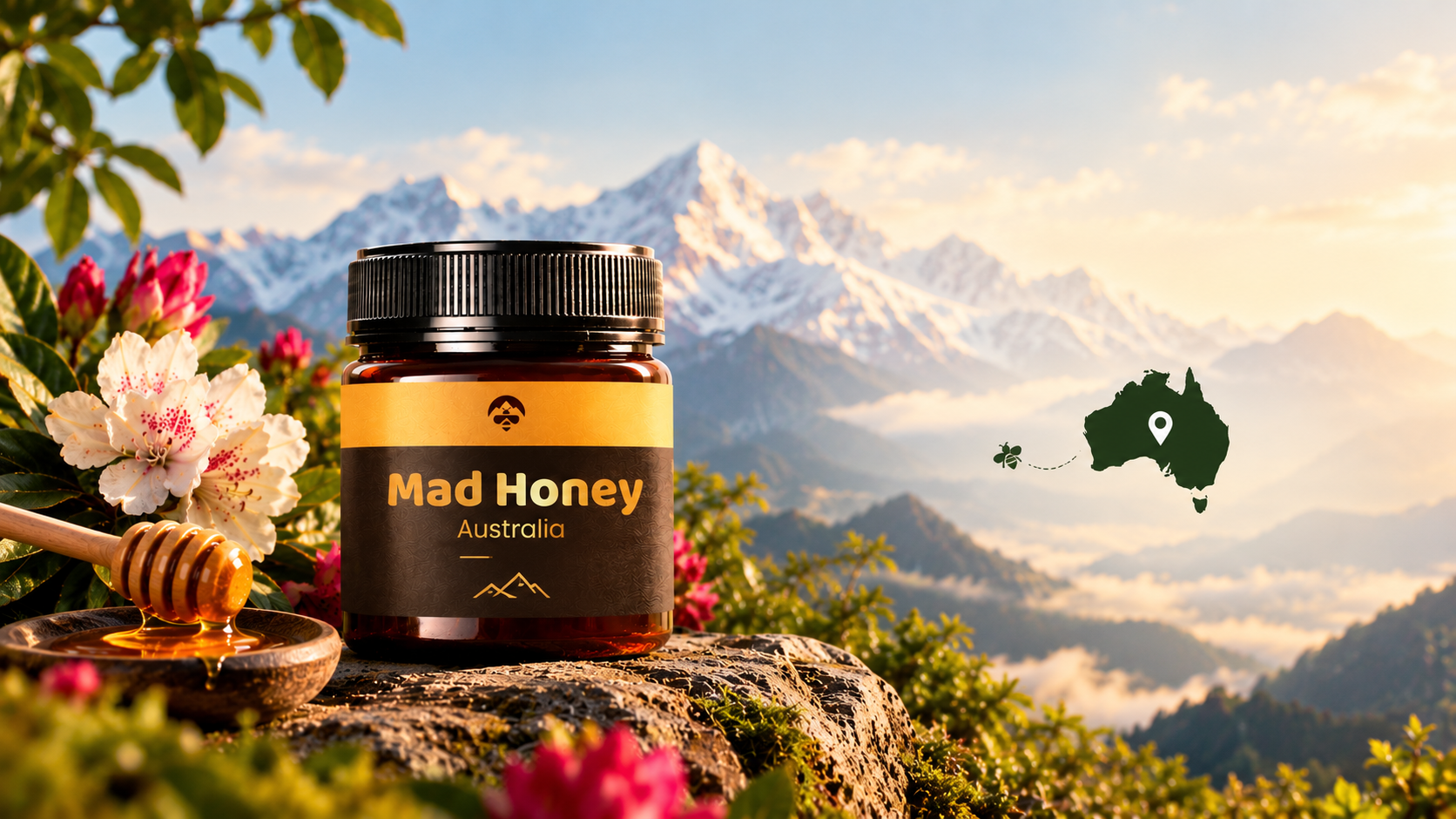
Everything Australian buyers need to know about purchasing, importing, and using mad honey — from legality and customs to dosage and delivery.
Is mad honey legal in Australia?
Yes, mad honey is completely legal in Australia. Grayanotoxin — the active compound in mad honey — is not listed in the Standard for the Uniform Scheduling of Medicines and Poisons (SUSMP) and is not classified as a controlled substance, prohibited import, or restricted drug under any federal or state legislation. Mad honey is treated as a natural food product. It is legal to purchase, possess, and consume in all eight states and territories — NSW, VIC, QLD, WA, SA, TAS, ACT, and the NT. The primary regulatory consideration is biosecurity compliance when importing, not legality.
Will mad honey get stopped at Australian customs?
All imported honey may be inspected by the Department of Agriculture, Fisheries and Forestry (DAFF) under the Biosecurity Act 2015. The key is proper documentation and packaging. Everest Mad Honey ships with full customs declarations, lab test certificates, origin documentation, and biosecurity-compliant packaging — pure honey in sealed food-grade glass jars, free from comb, pollen pellets, or propolis. Our documentation is specifically designed to facilitate smooth Australian customs clearance, and we've successfully shipped to hundreds of Australian customers. In the unlikely event your order is held, our team assists directly — and if it's intercepted, you receive a full replacement or refund.
How long does shipping to Australia take?
Standard delivery to Australia takes 10–15 business days after dispatch from our facility in Nepal. This includes international transit via insured express shipping and any customs processing time. Biosecurity inspection, if triggered, may add 2–3 business days. You'll receive full tracking details via email within 24 hours of dispatch, and our team proactively updates you if there are any delays. We ship to all Australian cities and regional areas — Sydney, Melbourne, Brisbane, Perth, Adelaide, Gold Coast, Canberra, Hobart, Darwin, and everywhere in between.
What does mad honey taste like?
Authentic mad honey tastes distinctly different from regular honey. It has a darker colour, thicker consistency, and a bittersweet, slightly earthy flavour with subtle medicinal undertones. Some describe it as having a mildly pungent aftertaste. The taste is one of the easiest ways to confirm authenticity — if it tastes like regular honey, it probably is regular honey. Most people take it straight from the spoon or dissolved in lukewarm water or herbal tea. Never mix with hot liquids, as high temperatures can degrade the active grayanotoxin compounds.
How much mad honey should I take?
Start with 1 teaspoon (approximately 5 grams) — especially for first-time users. Wait at least 2 hours before considering more. Experienced users typically find their ideal dose between 1–2 teaspoons (5–10 grams). The absolute maximum in any 24-hour period is 3 teaspoons (approximately 15 grams). Take on an empty stomach for best absorption. More is not better — the best experiences come from controlled, responsible doses. If you experience any adverse effects, rest and hydrate. For severe symptoms, call the Poisons Information Centre on 13 11 26 or Emergency Services on 000.
Is mad honey safe?
When consumed responsibly at recommended doses, mad honey has been used safely for thousands of years by communities across Nepal and Turkey. However, it is a bioactive food product and should be treated with respect. Do not exceed 3 teaspoons in 24 hours. Do not use mad honey if you have heart conditions, arrhythmias, low blood pressure, or are taking blood pressure or cardiac medication. It is not suitable for pregnant or breastfeeding women, individuals under 18 or over 75, those taking blood thinners, or anyone with a bee product allergy. Always start with a small dose to understand your body's response.
Why is mad honey so expensive?
Authentic mad honey is one of the rarest honeys in the world. It's wild-harvested by Gurung honey hunters from Apis laboriosa cliff hives in the Himalayan mountains of Nepal — often at altitudes above 2,500 metres on sheer cliff faces. The harvest is physically dangerous, seasonal (typically spring and autumn), and produces limited quantities. Each harvest yields only small amounts of genuine grayanotoxin-containing honey. When you factor in lab testing, proper packaging, customs documentation, and insured international shipping, the pricing reflects the genuine cost and risk involved. Products priced significantly lower (under A$80 for 250g) are almost certainly diluted or fake.
How do I know if my mad honey is authentic?
Look for these key authenticity markers: third-party lab testing for grayanotoxin concentration and purity (ask for certificates); a verified source region — legitimate sellers name the specific region and bee species (Apis laboriosa); dark colour and bitter taste — authentic mad honey is distinctly darker and more bitter than regular honey; proper pricing — genuine product should not be suspiciously cheap; and a money-back guarantee that shows the seller stands behind their product. Everest Mad Honey provides lab reports, named sourcing from Solukhumbu, Nepal, and a 30-day satisfaction guarantee on every order.
Can I buy mad honey locally in Australia?
Mad honey is not commercially produced in Australia — it requires specific rhododendron species (primarily Rhododendron ponticum and related species) that are native to the Himalayan and Black Sea regions, not Australia. Any "mad honey" sold domestically is imported. Buying direct from the source in Nepal eliminates middlemen who mark up prices 2–3× while adding no value. Direct purchasing also gives you full supply chain transparency, fresher product, and direct access to the team that sources and tests the honey. Everest Mad Honey ships direct to all Australian addresses with free insured shipping.
Does mad honey show up on drug tests?
No. Grayanotoxin is not a substance tested for in standard drug screening panels used in Australia — whether workplace drug tests, roadside testing, or sports anti-doping tests. It is not an illicit substance, not a controlled drug, and is not chemically related to any class of prohibited drugs. Mad honey is classified as a natural food product. However, because it can produce mild psychoactive effects (relaxation, mood elevation), it's advisable not to drive or operate heavy machinery after consumption, particularly with higher doses or on your first experience.