
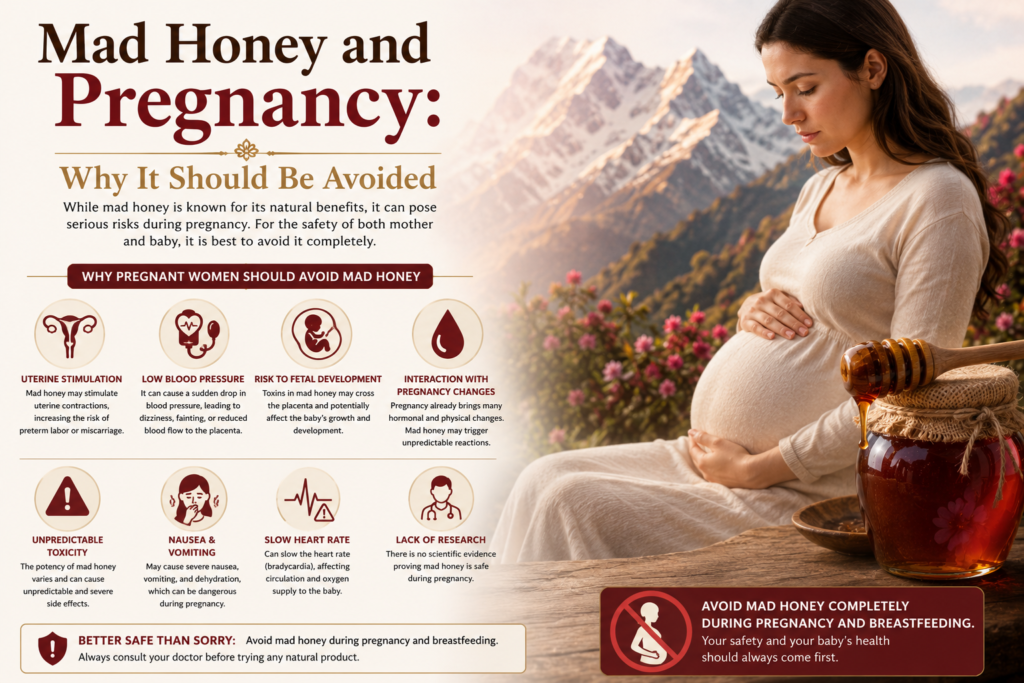
Of all the safety topics covered in this series, this is one of the most straightforward: Mad Honey should not be consumed during pregnancy or while breastfeeding. There’s no dose, brand, or “milder” version of Mad Honey that changes this recommendation. This article explains exactly why, so the guidance makes sense rather than feeling like an arbitrary restriction.
The Short Answer
Mad Honey’s active compound, grayanotoxin, affects blood pressure and heart rate through its action on sodium channels in nerve and muscle tissue, including tissue involved in cardiovascular regulation. During pregnancy, the cardiovascular system is already working differently to support increased blood volume and the needs of the developing baby. Introducing a compound that independently alters blood pressure and heart rhythm adds a real, unnecessary variable to a system that’s already adapting to significant physiological change — and it’s a variable with no established safety profile in this specific context.
Why There’s No “Safe Amount” During Pregnancy
For a healthy, non-pregnant adult, safety with Mad Honey is largely a matter of dose — start small, and the risk is generally low. Pregnancy changes this equation in an important way: there is no established safe threshold, because there is no reliable clinical research on grayanotoxin exposure during pregnancy at any dose. This is different from many other dietary precautions during pregnancy, where research has identified a specific safe limit. With Mad Honey, the absence of that research means the standard, appropriately cautious medical position is complete avoidance rather than a smaller “pregnancy-safe” serving.
This is worth internalizing clearly: the guidance here isn’t “half the normal dose” or “only a small taste.” It’s full avoidance, for the entire duration of pregnancy, regardless of trimester.
What the Underlying Concern Actually Is
To understand why this matters, it helps to look at what grayanotoxin does more specifically. It can lower blood pressure and slow heart rate, effects that are generally mild and temporary in a healthy adult but that interact with a maternal cardiovascular system already managing changes in blood volume, heart rate, and blood pressure regulation to support the pregnancy. There’s also a broader concern that applies to essentially any bioactive compound during pregnancy: substances that cross into maternal circulation can potentially reach the developing baby, and grayanotoxin’s effects on the developing fetal cardiovascular and nervous systems have simply never been studied. In the complete absence of safety data, caution is the only reasonable default — this is the same conservative approach used for many herbal remedies, supplements, and bioactive natural compounds during pregnancy, not something specific to Mad Honey alone.
Breastfeeding Deserves the Same Caution
The recommendation to avoid Mad Honey extends through breastfeeding as well, for closely related reasons. Compounds present in a nursing parent’s system can potentially transfer into breast milk, and while this hasn’t been specifically studied for grayanotoxin, the general principle holds: infants are considerably more sensitive to changes in heart rate and blood pressure than adults are, given their smaller body size and still-developing systems. Without specific research showing safety, the same precautionary avoidance that applies during pregnancy is the appropriate approach during breastfeeding.
A Common Misconception Worth Addressing
Because Mad Honey is a traditional, natural product rather than a synthetic supplement, it’s easy to assume it falls into the same low-concern category as, say, drinking herbal tea. This assumption doesn’t hold up well here. Grayanotoxin is a genuinely bioactive compound with a measurable, direct effect on the cardiovascular system — a category of substance that pregnancy guidelines generally treat with real caution regardless of whether the source is natural or synthetic. The traditional use of Mad Honey in Nepali culture, for what it’s worth, has never included pregnancy as a context for consumption; if anything, traditional practice reinforces rather than contradicts the modern medical recommendation here.
What If You Didn’t Know and Already Consumed It
If you’re pregnant and have already consumed Mad Honey — whether knowingly or without realizing the recommendation — the most useful next step is not panic, but information and communication. Monitor yourself for any of the symptoms covered in our companion article on Mad Honey poisoning symptoms, particularly dizziness, a noticeably slowed heartbeat, or a significant drop in blood pressure. Even if you feel completely fine, it’s worth letting your doctor or midwife know at your next appointment, or sooner if you have any concerns — not because a single incident is necessarily cause for alarm, but because your care provider is best positioned to advise you based on your specific pregnancy and health history. There’s no benefit to withholding this information out of embarrassment; obstetric care providers deal with these kinds of disclosures regularly and are focused on your and your baby’s wellbeing, not on judgment.
What About After Pregnancy and Breastfeeding End?
Once breastfeeding has fully ended, the general safety guidance for Mad Honey that applies to any other healthy adult returns — meaning the standard considerations around dose, personal health, and sourcing become the relevant framework again, rather than the complete avoidance that applies during pregnancy and nursing. If you have any lingering health considerations from pregnancy, such as changes in blood pressure that persisted afterward, it’s worth factoring those into your personal risk assessment the same way you would any other cardiovascular consideration, covered in more depth in our guide on who should avoid Mad Honey.
Talking to Your Care Provider
If you’re pregnant or planning to become pregnant and have questions about Mad Honey specifically, it’s a completely reasonable thing to bring up with your doctor or midwife directly. Most care providers are used to fielding questions about traditional remedies, supplements, and less mainstream foods, and can offer guidance specific to your individual health history rather than only the general recommendation covered here. This is particularly worth doing if you have a personal or family history of cardiovascular issues, since that may be relevant context even beyond the pregnancy-specific concern.
Why This Guidance Exists Even Without a Documented Case
Some readers might reasonably ask whether this recommendation is based on documented harm during pregnancy specifically, given how rarely pregnancy-specific mad honey cases appear in medical literature. The honest answer is that the recommendation exists because of an absence of safety data, not because of a large body of evidence showing harm. This is actually the more responsible position, not a less rigorous one: when a bioactive compound with known cardiovascular effects has never been studied for pregnancy safety, the appropriate medical stance is precaution, not “no evidence of harm means it’s probably fine.” This same logic applies to a wide range of natural compounds and traditional remedies during pregnancy, and Mad Honey is treated no differently.
Final Thoughts
The guidance here is intentionally simple because the underlying reasoning is straightforward: Mad Honey affects blood pressure and heart rate, pregnancy already involves significant cardiovascular changes, and there’s no research establishing a safe threshold for combining the two. Whether you’re currently pregnant, breastfeeding, or planning either in the near future, the clearest and safest choice is complete avoidance — not a smaller dose, not an exception for a “mild” batch, but avoidance until breastfeeding has fully ended. Once that period is over, the general safety principles that apply to any healthy adult become relevant again, and Mad Honey can be considered under the same framework as anyone else.