
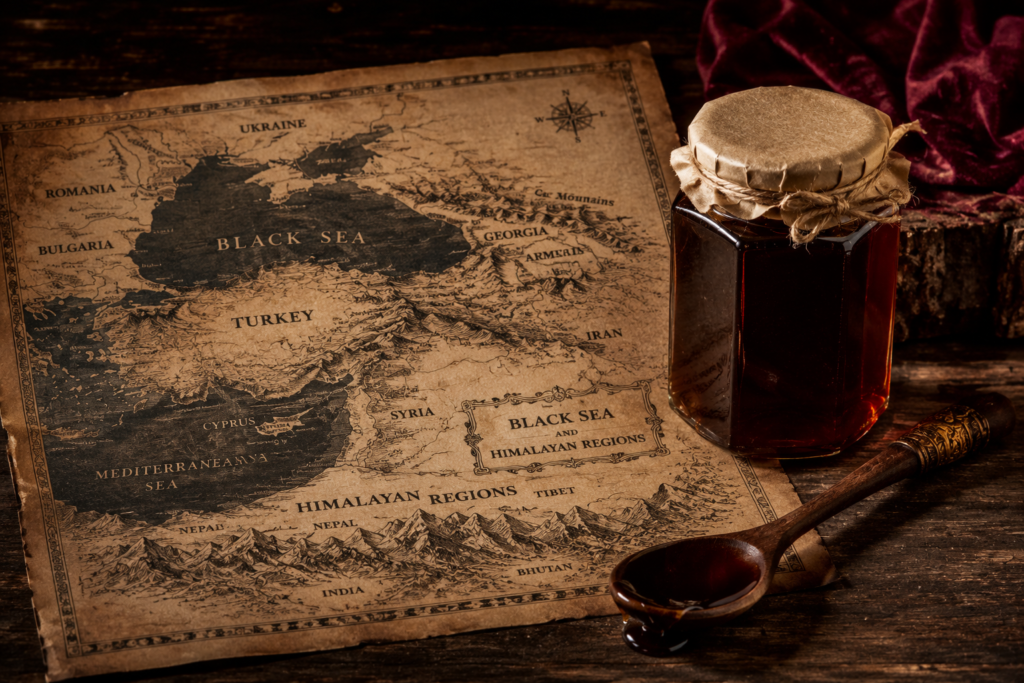
Mad honey’s story spans over two thousand years, moving from a documented military weapon in the ancient world to a generations-old cultural tradition in the Himalayan foothills of Nepal today. Understanding this history explains why mad honey is treated with such respect — and caution — by the communities who have known it longest.
The oldest documented reference to mad honey comes from the Greek historian and soldier Xenophon, writing around 401 BCE. In his account “Anabasis,” Xenophon described Greek soldiers marching through the region of modern-day Turkey who ate wild honey from local hives and became disoriented, weak, and unable to stand — later understood by historians to be grayanotoxin poisoning from honey made near wild rhododendron groves. This is widely considered the first written record of what we now call mad honey.
Centuries after Xenophon’s account, mad honey’s disorienting effects became something armies actively exploited rather than simply stumbled into. Historical accounts describe honey deliberately left along enemy troop routes, with soldiers who consumed it becoming incapacitated shortly before an ambush. One of the most cited instances involves Pontic forces using this tactic against invading Roman soldiers around 67 BCE — a genuinely documented historical use of mad honey as a tool of war, not folklore.
Roman writers, including Pliny the Elder, also referenced the phenomenon of “maddening honey” from the Black Sea region, describing its effects and the caution locals took around it. This period represents the transition of mad honey from an isolated military incident to a recognized, if still poorly understood, natural phenomenon discussed in broader classical writing.
While mad honey’s early recorded history centers on Turkey and the ancient Mediterranean world, an entirely separate — and arguably more central — tradition developed independently in the Himalayan foothills of Nepal. Rather than being used strategically or discovered by outsiders, mad honey harvesting became a generations-old livelihood and cultural practice among Gurung honey-hunting communities, particularly in the Solukhumbu and Lamjung regions. This Nepali tradition wasn’t about exploiting mad honey’s effects against others — it was, and remains, about careful, respectful harvesting and measured traditional use within the community itself.
Historical and anthropological accounts suggest honey hunting using handmade bamboo and rope ladders has been practiced in Nepal for many generations, likely predating reliable written records in the region. Unlike the Turkish military history, which is documented through classical texts, much of the Nepali tradition survives through oral history and continuous, unbroken practice passed down within honey-hunting families rather than external documentation.
Mad honey remained a relatively obscure, regionally known phenomenon for most of the 20th century, known mainly within Nepal and parts of Turkey. Its modern global reputation grew significantly starting in the early 2000s, driven partly by international documentary coverage of Nepali honey hunting and partly by growing global interest in rare, traditional wellness products. This period also brought the first wave of genuine scientific and medical case-study literature, mostly from Turkish hospitals treating grayanotoxin poisoning cases, adding real clinical documentation to what had previously been largely historical and anecdotal.
Understanding mad honey’s history isn’t just interesting trivia — it directly shapes how the product should be approached today. The ancient military history is a clear, documented reminder that mad honey’s effects are genuinely potent, not exaggerated marketing. The parallel Nepali tradition shows generations of careful, measured, respectful use rather than reckless consumption. Both threads point to the same practical conclusion echoed throughout modern guidance: mad honey deserves real respect for its potency, the same respect it’s been given by the cultures who have known it longest.
Few food products carry a documented history stretching back to ancient battlefields while also remaining a living, actively practiced tradition today. Mad honey’s history is genuinely unusual in that respect — equal parts ancient military footnote and unbroken cultural practice, both pointing toward the same lesson about respecting its potency.
Who first wrote about mad honey?
The Greek historian Xenophon, around 401 BCE, describing soldiers affected after eating wild honey in the region of modern-day Turkey — the earliest known written account.
Was mad honey really used as a weapon?
Yes. Historical accounts, most notably around 67 BCE, describe mad honey deliberately left for enemy soldiers to consume before an ambush, a documented military tactic rather than folklore.
Is Nepal’s mad honey tradition connected to the ancient Turkish accounts?
Not directly — they developed independently. The ancient historical record centers on Turkey and the Mediterranean world, while Nepal’s tradition grew separately as a generations-old harvesting practice within Himalayan honey-hunting communities.
Authentic Himalayan Mad Honey, ethically harvested in Solukhumbu, Nepal. Premium quality with fast delivery across the UK.
FDA Regulatory Sourcing & Legal Disclaimer: The statements, active biochemistry assessments, and traditional medicinal metrics presented inside this archive have not been fully cataloged by the United Kingdom Food and Drug Administration. Everest Mad Honey is not manufactured to treat, diagnose, mitigate, or systematically prevent clinical conditions. Mindful dosage limits must be strictly integrated into individual consumer protocols.
Authentic Himalayan Mad Honey, ethically harvested in Solukhumbu, Nepal. Premium quality with fast delivery across the UK.
FDA Regulatory Sourcing & Legal Disclaimer: The statements, active biochemistry assessments, and traditional medicinal metrics presented inside this archive have not been fully cataloged by the United Kingdom Food and Drug Administration. Everest Mad Honey is not manufactured to treat, diagnose, mitigate, or systematically prevent clinical conditions. Mindful dosage limits must be strictly integrated into individual consumer protocols.
