
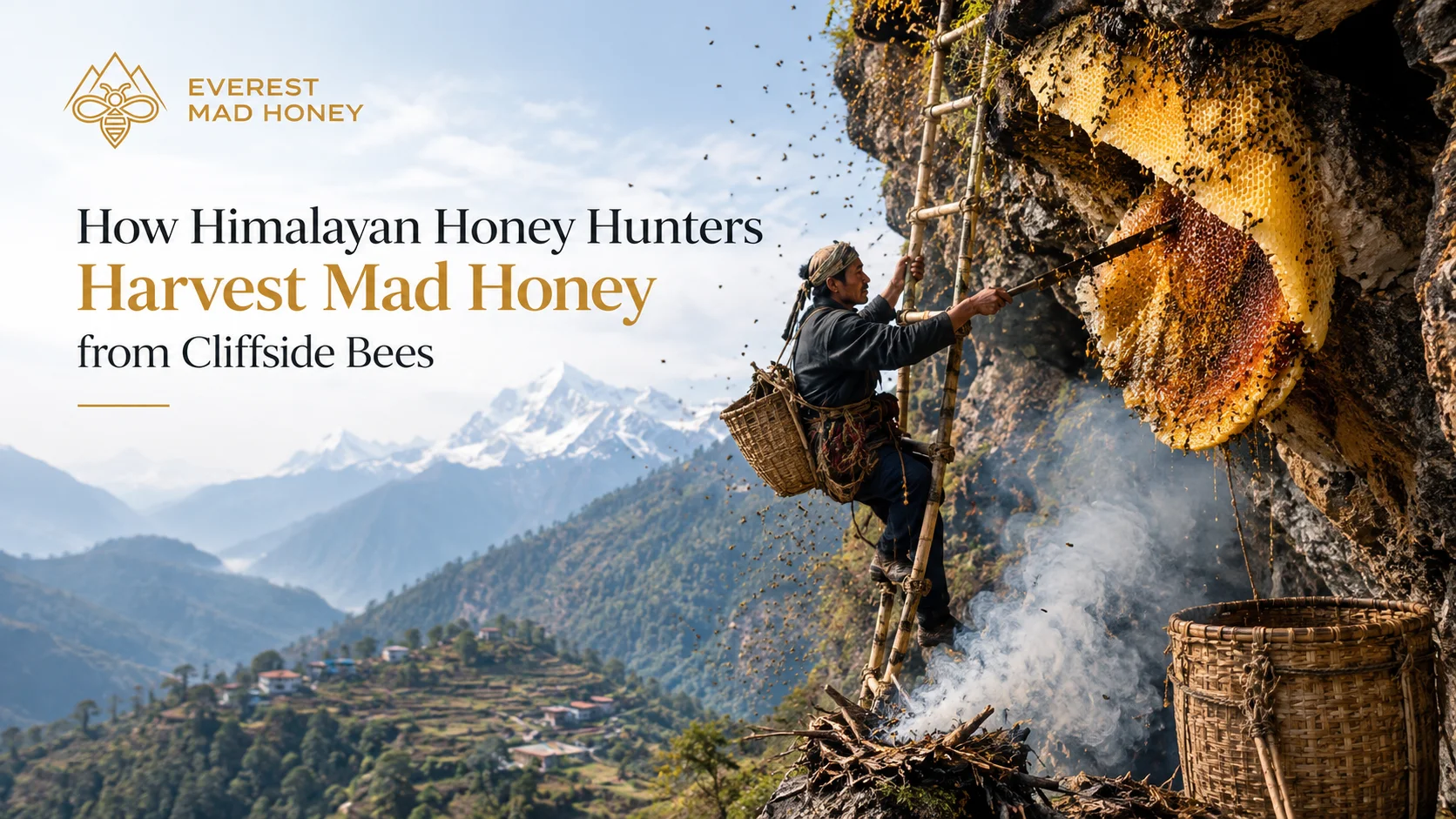
The smoke rises first.
At the foot of a sheer rock wall in the Himalayan foothills, a small fire of damp leaves starts to smoulder. Above it, hundreds of feet up, a living curtain of giant bees ripples across a crescent-shaped comb the size of a door. Then a man steps off the top of the cliff onto a ladder made of bamboo and hand-twisted rope, and starts to climb down.
This is mad honey hunting, one of the oldest and most dangerous food traditions on earth. For generations, the honey hunters of Nepal have risked their lives twice a year to gather a rare, reddish honey from the world’s largest honeybee. Here is how they do it, step by step, and why every jar of authentic Himalayan mad honey carries that story with it.
The star of this story is Apis laboriosa, the Himalayan giant honey bee. It is the largest honeybee species in the world, with adults reaching up to 3 cm long, more than twice the size of a typical garden honeybee.
These bees refuse to live in boxes. They cannot be farmed or kept in hives. Instead, they build huge single combs on sheer, often south-facing cliffs, where predators cannot reach them. They forage in upland meadows as high as 4,100 metres.
In spring, those slopes turn red and pink with rhododendron, Nepal’s national flower. The bees feed heavily on its nectar, and that is where the “mad” in mad honey begins.
Some rhododendron species produce natural compounds called grayanotoxins in their nectar. When the bees turn that nectar into honey, the compounds come with it. The result is a honey that can cause a warm, tingling, light-headed feeling in small amounts, and unpleasant symptoms if you take too much.
Locally it is simply called cliff honey. The rest of the world calls it mad honey. Spring honey, made when rhododendrons are in full bloom, is generally the strongest of the year.
Two indigenous communities are famous for this craft.
In central Nepal, the Gurung people of districts like Lamjung and Kaski have hunted cliff honey for centuries, in villages such as Bhujung and Ghalegaun. In these communities, honey hunters are respected figures, and the hunt is treated as a festival rather than a job.
Further east, in the remote Hongu River valley near Everest, the Kulung people practise their own version. In Kulung belief, a spirit called Rongkemi rules the mountains, forests and bees, and only a hunter chosen by the spirit, traditionally through a dream, may cut the hives. This tradition was captured in the award-winning 2017 documentary The Last Honey Hunter.
The Everest region is close to home for us. Our honey comes from the cliffs of Solukhumbu, the same rugged eastern district, where hunting teams still climb by hand.
[Image 2: Gurung or Kulung village with terraced fields]
Every community has its own rituals, but the core of the harvest has barely changed in hundreds of years.
Nothing happens until the date is right. A village elder or shaman reads the season and sets an auspicious day for the hunt. Some communities hold old beliefs about timing, such as favouring certain days of the week and avoiding particular days of the lunar cycle.
Experienced hunters can tell from a glance at the comb whether it is ready. A comb cut too early holds little honey and harms the colony for nothing.
About a week before the hunt, the village gets to work. Men twist plant fibres into thick ropes and lash them to bamboo rungs, building ladders long enough to hang down a cliff face. Each team carries a small, simple toolkit:
There are no harnesses on the traditional climb. Often there are no bee suits either.
Before anyone climbs, the hunters make offerings to the gods of the cliff. The puja may include flowers, fruit, rice, prayers and sometimes an animal sacrifice. The ritual asks for safe passage and a good harvest, and it reflects a belief shared across these communities: the honey belongs to the mountain first.
A team of roughly ten to twelve men moves into position. At the foot of the cliff, they light a fire of green leaves and grass. The thick smoke drifts upward, confusing the bees’ sense of smell and driving many of them off the comb.
It does not drive all of them away. A cliff colony can hold tens of thousands of angry, oversized bees.
Now the lead hunter goes over the edge. He climbs down the swaying ladder, sometimes 60 to 90 metres (200 to 300 feet) above the ground, until he hangs level with the hive. Bees stream around him. He is stung again and again, often for hours.
Below, helpers call up directions and haul on ropes. On some cliffs, a man climbs a nearby tree simply to relay shouted instructions between the ground and the hunter.
With one hand on the ladder, the hunter uses the bladed pole to slice through the comb. The honey-filled section, heavy and dripping, falls into the basket he has guided beneath it with the second pole. The basket is then lowered to the waiting team.
Careful hunters leave part of the colony intact, so the bees can rebuild and return the next season.
Back in the village, the honey is divided among everyone who took part. The climbers and their helpers traditionally receive the biggest share. Some are kept as a remedy for the family. Locals even give cliff honey to livestock in the belief that it strengthens them.
Hunting happens twice a year:
Visitors can sometimes watch a hunt in Lamjung or Kaski on a guided honey hunting tour of Nepal. Watching is strictly observation only: the climbing is left to the hunters.
The hunters will tell you the cliffs are changing.
Villages that once collected large harvests now bring home a fraction of what they used to. In one Lamjung village, hunters said they could gather around 1,000 litres a season a decade ago. Elsewhere, a single big comb that once held up to 15 litres now yields less than a cup.
The causes are tangled together: shifting weather, more frequent forest fires, deforestation and changing flower cycles. At the same time, many young people are leaving rural villages for work abroad, and fewer are learning to climb. Rising global demand adds pressure too, especially where outside contractors push for bigger harvests.
This matters beyond honey. Researchers have warned that if the Himalayan cliff bees decline, many rhododendron species could decline with them, because the bees are among their key pollinators.
At Everest Mad Honey, we believe the people who risk their lives on the cliffs deserve a fair deal, and the bees deserve a future. That is why we:
When you open a jar, you are tasting a tradition that has survived for centuries. We want to help make sure it survives for centuries more.
Mad honey is not ordinary table honey. The same compounds that make it special also mean you should treat it with care.
Start with a small amount, such as one teaspoon, and wait to see how your body responds. A large review of 1,199 recorded mad honey poisoning cases found that dizziness, nausea and a slowed heart rate were the most common problems, usually from taking too much. Do not use it if you are pregnant, take heart or blood pressure medication, or have a heart condition, and keep it away from children and pets. If in doubt, speak to your doctor first.
Read our full mad honey dosage guide before you try it.
Every jar of Himalayan mad honey begins with a ritual, a rope ladder and a hunter brave enough to climb it. Now you know what it takes to bring it home.
Shop authentic Himalayan mad honey →
Raw, lab-tested and traceable to its harvest batch, with free delivery worldwide, including fast insured shipping across the UK.
How is mad honey harvested?
Honey hunters smoke the bees off the comb with a fire at the base of the cliff. A lead hunter then climbs down a bamboo and rope ladder, cuts the comb with a bladed bamboo pole and lowers it to the ground in a woven basket.
Where does mad honey come from?
Himalayan mad honey comes from the cliffs of Nepal. It is made by the Himalayan giant honey bee (Apis laboriosa) from rhododendron nectar. Main hunting regions include Lamjung, Kaski and the Everest region, including Solukhumbu.
Who are the honey hunters of Nepal?
They are mainly members of indigenous communities, especially the Gurung of central Nepal and the Kulung of the Hongu valley in the east. The skill is passed down through families and villages.
Why is honey hunting so dangerous?
Hunters hang from handmade ladders up to 90 metres above the ground, usually without harnesses, while being stung by thousands of giant bees.
Can the Himalayan giant honey bee be farmed?
No. Apis laboriosa only nests on open cliff faces, which is why its honey must be gathered by hand from the wild.
When is the mad honey hunting season?
Twice a year: the main harvest in spring (around April to June) and a smaller one in autumn (around October to November).
Is mad honey safe to eat?
In small amounts, many people enjoy it, but it contains natural grayanotoxins and too much can cause dizziness, nausea and a slow heart rate. Start small, follow a dosage guide and avoid it if you are pregnant or have a heart condition.
Authentic Himalayan Mad Honey, ethically harvested in Solukhumbu, Nepal. Premium quality with fast delivery across the UK.
FDA Regulatory Sourcing & Legal Disclaimer: The statements, active biochemistry assessments, and traditional medicinal metrics presented inside this archive have not been fully cataloged by the United Kingdom Food and Drug Administration. Everest Mad Honey is not manufactured to treat, diagnose, mitigate, or systematically prevent clinical conditions. Mindful dosage limits must be strictly integrated into individual consumer protocols.
