
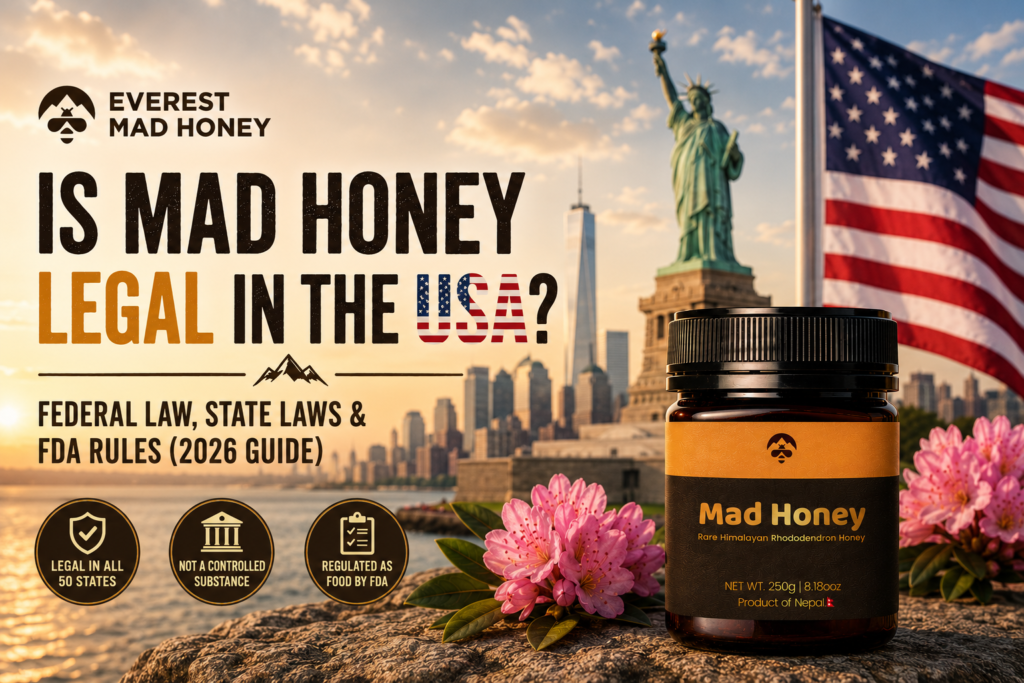
Quick Answer: Is Mad Honey Legal in the USA?
Yes. Mad honey is legal to buy, possess, and consume in all 50 US states. It is not scheduled as a controlled substance by the DEA, and no state currently prohibits it by name. It’s regulated the same way any imported specialty food is — through FDA food-safety and import law, not drug law.
That’s the short version. The fuller picture — how the FDA actually treats it, what “legal” doesn’t mean, and why state-specific searches like “is mad honey legal in Texas” or “is mad honey legal in California” keep coming up — is worth understanding before you order.
What Is Mad Honey?
Mad honey is a rare, raw honey produced by Apis laboriosa, the giant Himalayan honeybee, from the nectar of high-altitude rhododendron species in Nepal. It’s hand-harvested from wild cliff-face hives by traditional honey-hunting communities, rather than farmed in managed apiaries, which is part of why authentic supply is genuinely limited. That nectar naturally contains grayanotoxins — the compound responsible for mad honey’s distinctive character — at levels that don’t occur in ordinary honey.
Is Mad Honey a Controlled Substance in the US?
No. The DEA maintains Schedules I through V under the Controlled Substances Act, and grayanotoxin does not appear on any of them. There has been no DEA scheduling action against mad honey, historically or currently. This is the single most important fact for anyone asking “is mad honey legal” in the US: it is regulated as a food, not classified as a drug.
How the FDA Actually Treats Mad Honey
This is where the nuance lives, and where a lot of vague online answers stop short.
The FDA regulates mad honey as a conventional food, the same broad category as any other specialty honey. There is no federal statute that names or bans mad honey. But two things matter here that a simple “yes it’s legal” doesn’t capture:
- Adulterated food provisions can apply. Under Section 402(a)(1) of the Federal Food, Drug, and Cosmetic Act, a food can be considered adulterated if it contains a poisonous or harmful substance at levels that could injure health. Because grayanotoxin is a naturally occurring toxin, this is the legal mechanism the FDA could rely on if a product’s toxin levels were found to pose a genuine health risk — which is exactly why lab-tested, quality-controlled sourcing matters for any seller and buyer.
- No FDA-established grayanotoxin threshold currently exists. Neither the FDA nor USDA has published a specific numeric safety limit for grayanotoxin in honey. That regulatory gap places more weight on supplier transparency and batch testing than on any government-set number.
- Import shipments follow standard FDA food-import rules. Imported food, including mad honey, is generally required to have FDA Prior Notice filed before the shipment arrives, and US Customs and Border Protection can inspect, hold, or refuse entry to any food shipment on labeling or safety grounds — the same as with any other imported food product.
None of this makes mad honey illegal. It means the responsibility for staying compliant sits with accurate labeling, honest marketing, and batch-level quality testing — not with the product being banned.
The One Thing That Actually Creates Legal Risk: Medical Claims
If there’s a single compliance trap in this space, it’s this: marketing mad honey with disease-treatment or medical claims can legally reclassify it as an unapproved drug, regardless of how it’s actually sold. A seller claiming their honey “cures hypertension” or “treats diabetes” is making a drug claim under FD&C Act provisions — and that shifts regulatory exposure significantly, even though the honey itself remains a legal food product. Reputable sellers describe mad honey’s traditional use and character without making medical guarantees, which is what keeps a product squarely in food regulation rather than drug regulation.
Mad Honey Legal States: Does It Vary by State?
This is one of the most searched versions of this question — “is mad honey legal in Texas,” “is mad honey legal in California” — and the answer is consistent: no US state currently bans mad honey by name. There is no state-level prohibition identified in Texas, California, Florida, Washington, or any other state as of 2026.
What does vary by state is general food-safety enforcement. Every state has its own food-safety statutes that prohibit selling adulterated products, and states with particularly active food-safety enforcement — California and Florida among them — apply those general rules to any food product, mad honey included, if a specific product is found to pose a genuine safety issue. This is a baseline food-safety standard, not a mad-honey-specific restriction, and it’s the same standard any honey, supplement, or specialty food seller operates under.
Does Mad Honey Show Up on a Drug Test?
A closely related high-volume question worth addressing directly: no. Grayanotoxin is not included in standard 5-panel or 12-panel workplace drug screenings, which test for substances regulated under the Controlled Substances Act. Because grayanotoxin is chemically unrelated to THC, opioids, or stimulants, it will not trigger a positive result on a standard employer drug test. It can be identified through specialized clinical testing like GC-MS if a medical provider specifically screens for it, but that’s not part of routine testing.
What This Means If You’re Buying Mad Honey in the USA
Since the legal question is settled, the more useful question for buyers is what separates a compliant, trustworthy seller from one that isn’t:
- Look for batch-specific lab testing, not a generic “lab-tested” claim reused across every listing.
- Check for accurate origin labeling — a named harvest region in Nepal, not vague “wild Himalayan” marketing language.
- Avoid sellers making medical claims. This is a red flag for regulatory risk, not a sign of a more “powerful” product.
- Expect standard FDA import handling. A shipment declared and labeled accurately as honey moves through customs the same way any other specialty food import does.
- Insured, trackable shipping is a sign of a supplier confident in their documentation, since they have nothing to hide about origin or content.
Everest Mad Honey ships lab-tested, batch-traceable Himalayan mad honey to all 50 US states with free, fully insured delivery in 12–14 business days — sourced directly from Solukhumbu, Nepal, with documentation that follows standard FDA food-import practice.
Buy Mad Honey — Free US Delivery →
Frequently Asked Questions
Is mad honey legal in the USA?
Yes. It’s legal to buy, possess, and consume in all 50 states. It is not a controlled substance under DEA scheduling.
Is mad honey legal in Texas?
Yes. There is no Texas state law banning mad honey. It’s treated as a specialty food product, the same as anywhere else in the US.
Is mad honey legal in California?
Yes. California has no ban on mad honey specifically, though like any state it enforces general food-safety standards against adulterated products.
Does mad honey show up on a drug test?
No. Grayanotoxin isn’t included in standard workplace drug panels, since it’s not a DEA-controlled substance and is chemically unrelated to commonly screened drugs.
Can I legally import mad honey from Nepal into the US?
Yes, for personal use. Shipments follow standard FDA food-import requirements, including Prior Notice filing, the same as any other imported specialty food.
Is mad honey FDA-approved?
No, and it doesn’t need to be — the FDA doesn’t “approve” conventional foods the way it approves drugs. It regulates mad honey under general food-safety law.
A Note on This Guide
This article summarizes publicly available information on US federal and state regulation of mad honey for general informational purposes and is not legal advice. Regulations can be updated, and any state’s enforcement approach can change. Buyers or sellers with specific compliance questions should consult the FDA (fda.gov) or a qualified attorney for current requirements.
Sources & References
(publish with rel=”nofollow”)
- U.S. Food and Drug Administration — Federal Food, Drug, and Cosmetic Act, Section 402: Adulterated Food. fda.gov
- U.S. Food and Drug Administration — Prior Notice of Imported Food requirements. fda.gov
- Drug Enforcement Administration — Controlled Substances Act, Schedules I–V. dea.gov
- Wikipedia — Mad honey: origin, composition, and historical use. en.wikipedia.org
Everest Mad Honey — everestmadhoney.com