
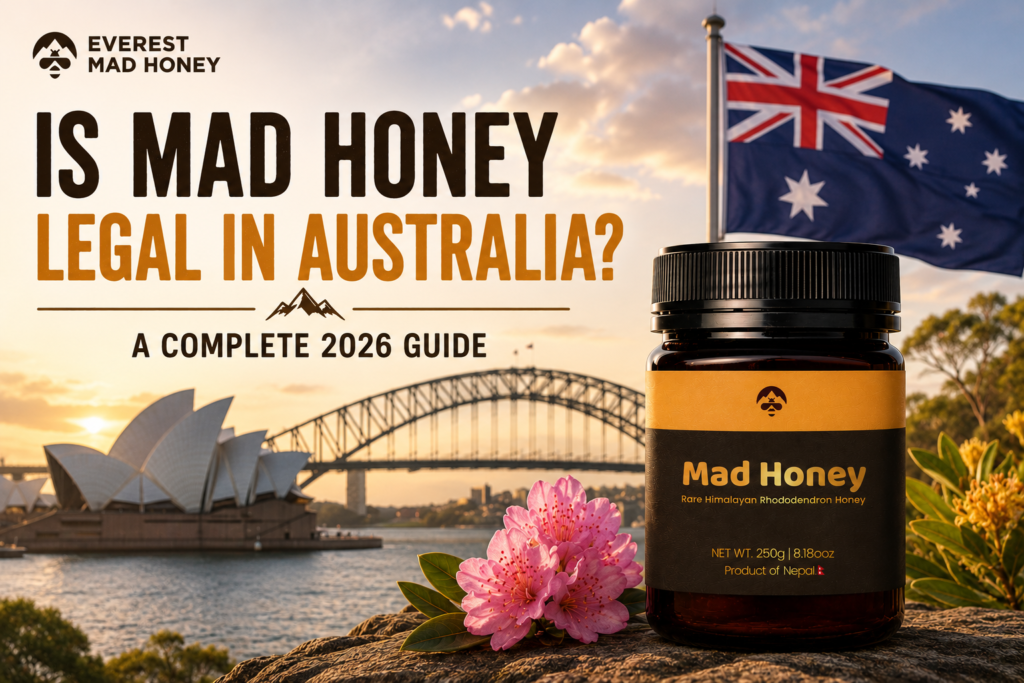
Quick Answer: Is Mad Honey Legal in Australia?
Mad honey is not a controlled substance in Australia. It doesn’t appear on any drug schedule, and there’s no law against possessing or consuming it. But that’s not the full picture — and if you’ve searched “is mad honey legal in Australia” hoping for a simple yes, the honest answer is more nuanced than that.
The real barrier isn’t drug law. It’s biosecurity law. Australia has some of the strictest biosecurity regulations for honey and bee products of any country in the world, and those rules apply to all honey — mad honey included, regardless of its grayanotoxin content. Understanding this distinction is essential before you order.
What Is Mad Honey?
Mad honey is a rare, wild-harvested honey produced by Apis laboriosa, the giant Himalayan honeybee, from the nectar of high-altitude rhododendron species in Nepal. It’s collected by hand from cliff-face hives — not managed apiaries — which is part of why it’s raw, unfiltered, and seasonally limited. That same raw, unprocessed character is exactly what makes it fall into Australia’s highest biosecurity risk category, which we’ll explain below.
Why Australia Treats Honey Differently Than Most Countries
Australia’s approach to imported honey has nothing to do with grayanotoxin or psychoactive effects. It’s governed by the Biosecurity Act 2015, administered by the Department of Agriculture, Fisheries and Forestry (DAFF), and the concern is entirely about protecting Australia’s bee population from foreign pests and diseases like American foulbrood and Varroa mite — threats that can travel in raw honey and beeswax.
Under this framework, honey is officially classified as a “surveillance food,” meaning a percentage of consignments are referred for laboratory testing and visual/label assessment before they’re allowed to enter the country. Even honey from New Zealand, which has comparable biosecurity standards to Australia’s own, is subject to this same surveillance-level testing.
This is the key fact every prospective Australian buyer needs to understand: mad honey’s legal status as a food is not in question — its ability to physically clear Australian customs is.
Personal Import: What Actually Happens at the Border
If you’re an individual in Australia ordering mad honey for personal use, here’s what the biosecurity process generally involves:
- Mandatory declaration. All honey products must be declared, whether arriving by post, courier, or in your luggage. Undeclared honey is treated as a biosecurity breach, not a minor customs oversight.
- Biosecurity inspection. Every honey shipment is subject to inspection by a biosecurity officer to confirm it’s free from contamination before it’s released.
- Higher risk for raw, unprocessed honey. Commercially packaged, heat-treated honey clears more easily than raw, unfiltered honey — and mad honey, by its authentic nature, is raw. This puts it in a more scrutinized category than a standard supermarket honey import.
- Non-compliant shipments are destroyed or returned at the importer’s expense. This isn’t a fine-and-release system — goods that don’t meet import conditions are treated, exported, or destroyed.
It Gets More Complicated State by State
Even honey that clears federal biosecurity checks can run into additional state-level restrictions once it’s inside Australia:
- Western Australia maintains a higher quarantine status for bees and bee products than the rest of the country, with tighter entry conditions.
- South Australia restricts honey and most bee products entering the state from other states or countries entirely, enforced by Primary Industries and Regions SA (PIRSA), unless specific permit and treatment conditions are met.
- Tasmania has actively prosecuted biosecurity breaches involving raw honey — in one widely reported case, a major national retailer was prosecuted and fined for stocking raw honeycomb honey that hadn’t cleared the state’s import authority, illustrating that these rules are genuinely enforced, not just theoretical.
For a product like mad honey, which is inherently raw and wild-harvested, this layered federal-plus-state system is the real obstacle — not any question of legality in the drug-law sense.
What This Means If You’re Trying to Buy Mad Honey in Australia
Being upfront about this is more useful to you than a generic “yes it’s legal” answer that ignores how customs actually works:
- Small, personal-use orders are the realistic path. Bulk or repeat commercial-scale orders face far more scrutiny and require formal import permits through Australia’s BICON (Biosecurity Import Conditions) system.
- Declare it honestly. Attempting to under-declare or mislabel a honey shipment is the fastest way to have it seized, and can carry penalties beyond just losing the product.
- Expect the possibility of inspection delays. Even fully compliant shipments can take longer to clear than orders to countries with lighter biosecurity regimes.
- Commercial resale requires far more. A business wanting to import and resell mad honey in Australia would need registered-establishment documentation and to meet DAFF’s specific import conditions for the product category — a materially bigger undertaking than an individual personal order.
Buying Mad Honey From a Source That Takes This Seriously
Because of Australia’s biosecurity framework, working with a supplier who ships internationally with accurate labeling, transparent origin documentation, and proper customs declarations matters more here than almost anywhere else. A shipment that’s vaguely labeled or missing origin information is far more likely to be delayed or destroyed at the Australian border than one that’s declared clearly and accurately as honey from Nepal.
Everest Mad Honey ships internationally with full tracking and accurate customs documentation for every order. If you’re in Australia and want to order, we recommend reaching out to our team first so we can advise on current shipping conditions for your state before you place your order — this small step significantly reduces the chance of delays at the border.
Contact Us About Ordering to Australia → Browse Mad Honey →
Frequently Asked Questions
Is mad honey illegal in Australia?
No. Mad honey is not a controlled substance and there’s no law against possessing or consuming it in Australia. The practical challenge is biosecurity clearance for raw honey imports, not drug legality.
Can I bring mad honey into Australia in my luggage?
It must be declared on your Incoming Passenger Card and will be inspected by a biosecurity officer on arrival, the same as any other honey product. Raw, unprocessed honey faces closer scrutiny than commercially processed honey.
Can I order mad honey online to Australia?
Yes, personal orders are generally possible, but shipments are subject to biosecurity inspection and can be delayed, treated, or destroyed if they don’t meet import conditions. Accurate labeling and declaration significantly improve the chances of a smooth delivery.
Why is honey treated so strictly in Australia compared to other countries?
Australia’s geographic isolation means its bee populations have avoided many pests and diseases common elsewhere. Strict biosecurity law exists to keep it that way, and it applies to all imported honey, not specifically to mad honey.
Does Western Australia have different rules than the rest of the country?
Yes. Western Australia maintains a higher quarantine status for bee products, and South Australia separately restricts honey entering from other states or countries. Rules can differ depending on which state you’re ordering to.
A Note on This Guide
This article summarizes publicly available Australian biosecurity guidance for general informational purposes and is not legal or customs advice. Import conditions can change, and biosecurity requirements can vary by state and by shipment. Buyers should check current guidance through Australia’s BICON system or the Department of Agriculture, Fisheries and Forestry before ordering.
Sources & References
(publish with rel=”nofollow”)
- Department of Agriculture, Fisheries and Forestry (DAFF) — Bringing or mailing goods to Australia: honey import conditions. agriculture.gov.au
- Department of Agriculture, Fisheries and Forestry (DAFF) — Honey import conditions and surveillance food testing. agriculture.gov.au
- Primary Industries and Regions SA (PIRSA) — Moving bees and apiary commodities into South Australia. pir.sa.gov.au
- Parliament of Australia — Senate Rural and Regional Affairs Committee report on beekeeping biosecurity issues. aph.gov.au
- The Mercury (Hobart) — Coles prosecuted for importing prohibited raw honey product into Tasmania. pressreader.com
Everest Mad Honey — everestmadhoney.com