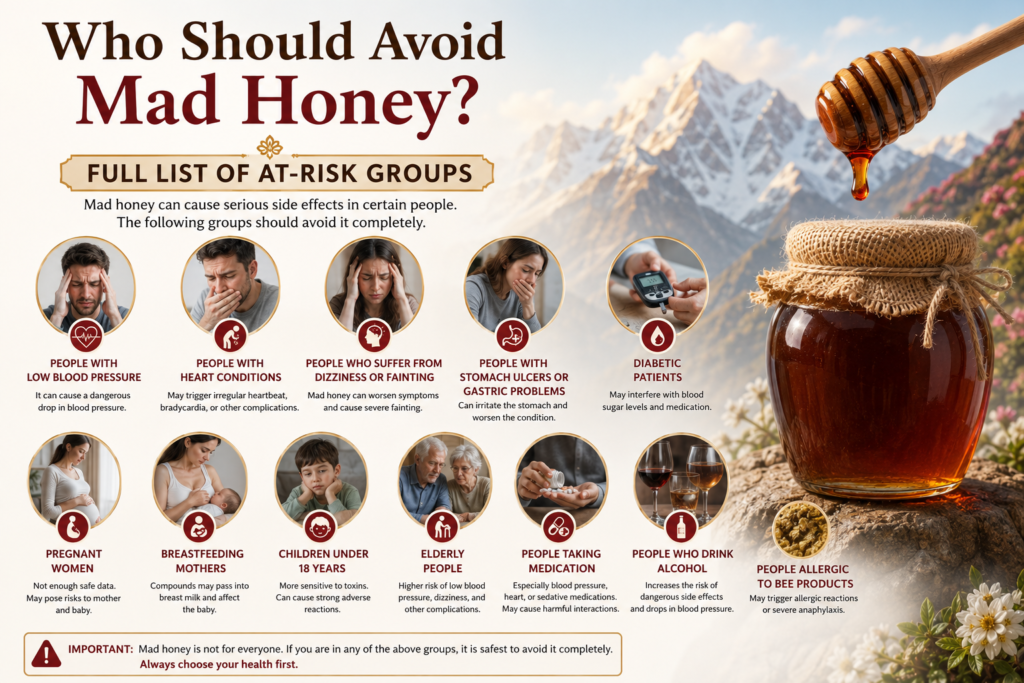
Mad Honey is generally well tolerated by healthy adults who use it at the correct dose from a lab-tested source. But “generally well tolerated” isn’t the same as “safe for everyone,” and being honest about where you personally fall is one of the most important safety decisions you can make before your first jar. This article goes through each at-risk group in detail, explaining not just who should avoid Mad Honey, but why, so the reasoning is clear rather than just a list of rules.
Why Some Groups Face Meaningfully Higher Risk
Mad Honey’s active compound, grayanotoxin, works by binding to sodium channels in nerve and muscle cells, including those involved in regulating heart rate and blood pressure. In a healthy adult with no underlying conditions, a correctly measured dose produces a mild, generally comfortable effect on these systems. But for certain groups, the same mechanism interacts with an already-compromised or more sensitive baseline, which can turn a normally mild effect into something considerably more significant. Understanding this mechanism is what makes the following list make sense — it isn’t an arbitrary set of restrictions, but a direct consequence of how grayanotoxin actually works in the body.
Pregnant or Breastfeeding Individuals
This is one of the clearest and least ambiguous recommendations in this entire list: Mad Honey should not be consumed during pregnancy or while breastfeeding, regardless of dose. There is no reliable clinical safety data on grayanotoxin exposure during pregnancy, and in the absence of that data, the standard and appropriately conservative medical approach is complete avoidance rather than a reduced dose. Because grayanotoxin can affect blood pressure and heart rate, introducing it during pregnancy adds an unstudied variable to a cardiovascular system that is already working differently to support the pregnancy. The same caution applies to breastfeeding, since compounds like grayanotoxin can potentially transfer into breast milk, and infants are especially sensitive to changes in heart rate and blood pressure. Our dedicated article on Mad Honey and pregnancy covers this topic in full detail.
Heart Patients
Of every group on this list, people with existing heart conditions face the highest risk, and it isn’t close. Grayanotoxin directly affects the heart’s electrical activity through its effect on the vagus nerve and sodium channels in cardiac tissue, which can slow heart rate and lower blood pressure even in a healthy heart. In someone managing arrhythmia, a history of heart attack or heart failure, low resting heart rate, or any other diagnosed cardiovascular condition, this same mechanism can push an already-managed system past what it can safely compensate for. It’s worth noting that many heart conditions are well controlled day to day through medication, which can create a false sense that the condition “doesn’t really affect” daily life — but that control often depends on a stable baseline that grayanotoxin can disrupt. Our dedicated guide on Mad Honey and heart patients goes into this mechanism and the specific warning signs in much greater depth.
People on Certain Medications
Mad Honey can interact meaningfully with several categories of common medication, sometimes in ways that amplify their effects beyond what either substance would produce alone. Beta-blockers and other blood pressure medications are a particular concern, since both they and grayanotoxin independently lower heart rate or blood pressure — combined, the effect can become considerably stronger than expected. Antiarrhythmic medications carry similar risk, given that grayanotoxin already has a direct effect on heart rhythm. Sedatives, sleep medications, and benzodiazepines increase drowsiness and, in combination with grayanotoxin, can suppress alertness and breathing more than either would alone. Blood thinners haven’t been well studied in combination with Mad Honey and should be avoided without direct medical guidance. If you take any regular prescription medication, our companion article on Mad Honey drug interactions provides a full breakdown by category, and it’s worth checking with a doctor or pharmacist regardless.
Children and Teenagers
Grayanotoxin sensitivity is closely tied to body weight, which means a dose that would be considered mild for an adult can represent a proportionally much larger exposure for a child or teenager. Mad Honey is formulated and dosed with adult use in mind, and it should never be given to minors under any circumstances, including as a home remedy for sleep or relaxation.
Elderly Individuals
Age brings a number of physiological changes that increase sensitivity to Mad Honey’s effects — slower metabolism, more variable blood pressure regulation, and a higher likelihood of taking one or more medications that could interact with grayanotoxin. Older adults who want to try Mad Honey should start with an especially conservative dose, ideally after discussing it with a doctor, particularly if any cardiovascular medication is involved.
People With Low Blood Pressure
Because grayanotoxin can further lower blood pressure, anyone with existing hypotension — whether diagnosed or simply a known personal tendency toward low blood pressure and lightheadedness — faces an elevated risk of dizziness, fainting, or a more pronounced reaction than a typical user would experience at the same dose.
Anyone Planning to Drive, Swim, or Operate Machinery
This is less about a specific health condition and more about timing. Mad Honey’s relaxing, sometimes drowsy effect genuinely impairs alertness and reaction time in a way that makes driving, swimming, working at height, or operating machinery unsafe for several hours after consumption. This applies to every user, regardless of health status, and should be planned around the same way you’d plan around any substance that affects coordination and alertness.
People With Known Allergies
Anyone with a known allergy to honey, other bee products, or rhododendron pollen specifically should approach Mad Honey with particular caution or avoid it altogether, given the direct link between the honey and rhododendron nectar.
What If You’re Not Sure Which Category You Fall Into
If you’re uncertain whether a health condition, medication, or life circumstance puts you at elevated risk, the safest default is to treat the uncertainty as a reason to check with a doctor first rather than proceeding on the assumption that you’re likely fine. This is particularly true for anyone managing a chronic condition, taking regular medication of any kind, or who is pregnant or trying to conceive.
It’s also worth taking the time to understand what an adverse reaction actually looks like, even if you don’t fall into any of the groups above. Our companion article on Mad Honey poisoning symptoms walks through the full range, from mild and expected effects to the specific warning signs that indicate a genuine medical situation — useful knowledge for anyone using Mad Honey, but especially valuable if you’re in one of the higher-risk categories described here.
Why This List Matters More Than It Might Seem
It can be tempting to skim a list like this and assume it mostly applies to other people. But the reality is that a meaningful share of adults fall into at least one of these categories — whether it’s a blood pressure medication taken for years without much thought, a family history that hasn’t yet become a diagnosed condition, or simply being at an age where cardiovascular sensitivity has quietly increased. Taking a few minutes to honestly check your own situation against this list is a small amount of effort that meaningfully reduces the already-low risk associated with Mad Honey down to something close to negligible.
Final Thoughts
None of the groups covered in this article are being singled out arbitrarily — each one reflects a specific, understood interaction between grayanotoxin and a particular physiological state or medication category. For the large majority of healthy adults outside these groups, Mad Honey used at a correct, measured dose from a lab-tested source remains a generally safe traditional product. The goal of this list isn’t to create fear around Mad Honey, but to make sure the relatively small number of people who genuinely should avoid it have clear, specific information to recognize themselves in it.