
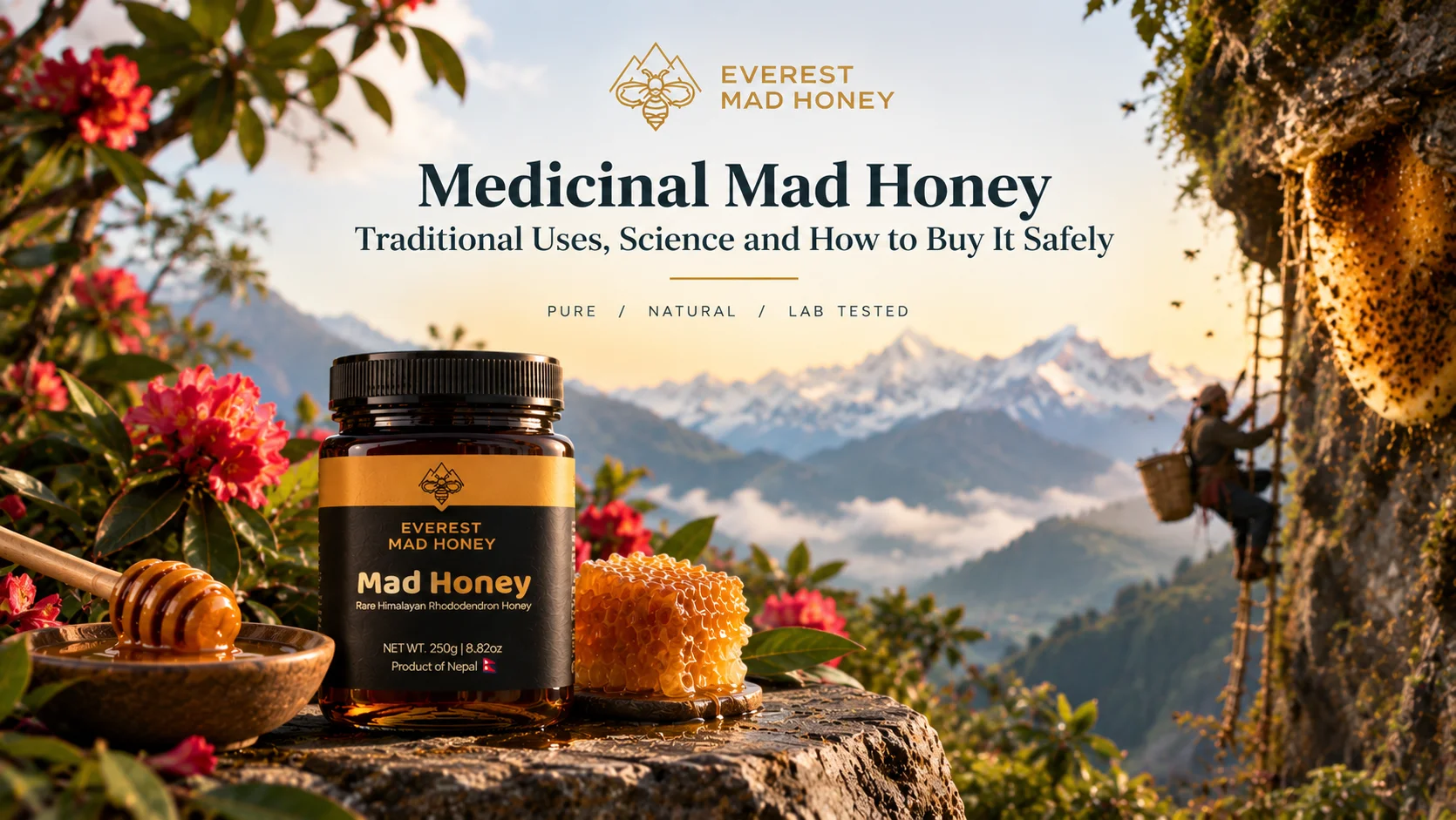
Medicinal mad honey is rhododendron honey from Nepal or Turkey that people have used for centuries as a folk remedy, mainly for blood pressure, stomach problems and sexual health. Its strength comes from grayanotoxins, natural compounds that make a tiny spoonful noticeable and a large one dangerous. Modern research is still at an early stage, so treat it as a traditional food with real effects, not a proven medicine.
This guide explains what medicinal mad honey is, the main mad honey medicinal uses and what studies say about each, how to take it safely, and how to buy real, lab-tested mad honey in the USA.
Medicinal mad honey is the name sellers and buyers use for raw honey made from the nectar of certain rhododendron flowers. The nectar carries grayanotoxins into the honey. These compounds give it a red-amber colour, a bitter, slightly spicy finish, and effects that ordinary honey doesn’t have.
It comes from two places:
People have known about it for a long time. In 401 BC the Greek writer Xenophon described soldiers near today’s Trabzon who ate wild honeycomb, “lost their senses” and vomited, then recovered the next day. By the 18th century, Europe imported it as miel fou, “crazy honey”.
| Medicinal mad honey | Regular honey | |
|---|---|---|
| Nectar source | Wild rhododendron | Clover, wildflowers, citrus and others |
| Active compound | Grayanotoxins | None of note |
| Taste | Bitter, earthy, slight throat tingle | Sweet |
| Serving | Half to one teaspoon, once | Spoonfuls, freely |
| Who should avoid it | Many groups (see safety section) | Infants under 12 months |
Mad honey has a long list of traditional uses, but almost all the research so far is in the lab or in animals, not in human clinical trials. A 2018 review in RSC Advances gathered the folk uses below. Here is what each one rests on.
| Traditional use | Where it is used | What the research shows |
|---|---|---|
| High blood pressure | Turkey, Nepal | Grayanotoxins do lower blood pressure, which is why people use it. But the same effect causes most poisonings. Not a safe substitute for blood-pressure medicine. |
| Sexual health and stamina | Turkey, Nepal | With blood pressure, one of the two main reasons people take it. In a review of 1,199 poisoning cases, about 75% were men, mostly aged 41–65. No clinical trials support the use. |
| Stomach problems: gastritis, ulcers, indigestion | Black Sea region | A long folk tradition. Animal studies on rhododendron compounds are promising, but there are no human trials. |
| Diabetes | Turkey | A rat study found anti-inflammatory and wound-healing effects in diabetic rats. Not tested in people. |
| Colds, flu and sore throat | Turkey, Nepal | Like all honey, it has antioxidant and antimicrobial activity in the lab. One study ranked rhododendron honey highest for antioxidant activity among honey types tested. |
| Pain and arthritis | Turkey | Lab and animal studies suggest pain-relieving and anti-inflammatory activity. No human evidence. |
| A daily tonic | Turkey | Traditionally a small spoonful in warm milk. No studies. |
The honest picture is that mad honey medicine is a tradition, not yet a science. Its effects on the body are real and measurable, which is exactly why it needs respect. Many people value it today as a rare, raw Himalayan honey for small, mindful rituals: a calm afternoon, a quiet meditation, or a link to an old mountain culture.
If you have a health condition, speak to your doctor. Mad honey should never replace prescribed treatment.
Grayanotoxins attach to sodium channels in nerve and muscle cells and hold them open. That slows the heart and lowers blood pressure. In small amounts, people describe warmth, relaxation and light-headedness. In larger amounts, the same action causes poisoning.
That is why every serving guide starts small.
Signs of too much include dizziness, sweating, nausea, vomiting, blurred vision, a slow pulse and fainting. In the USA, call Poison Control on 1-800-222-1222, or 911 if someone faints or has chest pain. Hospitals treat it with fluids and atropine, and most people recover within 24 hours. A review of 1,199 cases published in Food and Chemical Toxicology reported no deaths, but many patients needed emergency care.
Mad honey is legal to buy and own in the USA, where it is sold as a food. The bigger risk is getting a fake. Much of what is sold online is regular honey with a “mad honey” label, or honey of unknown strength, which makes dosing guesswork.
Everest Mad Honey sells raw Himalayan mad honey harvested by honey hunters in Solukhumbu, the region around Mount Everest. Every flask passes the five checks above:
| Flask | Price | Approx. half-teaspoon servings | Best for |
|---|---|---|---|
| Mad Honey 250g | $99 | About 70 | First-time buyers |
| Mad Honey 500g | $139 | About 140 | Best value per gram |
Shop lab-tested medicinal mad honey
What is medicinal mad honey used for?
Traditionally, it is used for high blood pressure, stomach problems such as gastritis, sexual health, colds and as a daily tonic. These uses come from folk medicine in Nepal and Turkey. Human clinical trials have not confirmed any of them.
Is mad honey a medicine?
No. In the USA, mad honey is sold as a food, not an approved medicine. “Mad honey medicine” refers to its traditional use as a remedy. It should never replace treatment from your doctor.
How much medicinal mad honey should I take?
Start with half a teaspoon or less, and wait at least two to three hours before deciding on more. Studies link 15–30 g, about one to one and a half tablespoons, to poisoning.
Is medicinal mad honey legal in the USA?
Yes. Mad honey is legal to buy and own in all 50 states and is regulated as a food by the FDA.
How can I tell if mad honey is real?
Real Nepal mad honey names its harvest region, comes with a batch-matched lab report showing grayanotoxin levels, and has a bitter, slightly spicy finish. Every Everest Mad Honey flask has a seal code linked to its lab report.
Medicinal mad honey is one of the world’s oldest folk remedies, and one of the few honeys with effects you can feel. Its traditional uses are fascinating, but the science is still early, so the smart approach is a small dose, real lab data and a trusted seller.
If you want to experience it for yourself, choose a flask you can verify.
Buy lab-tested Himalayan mad honey from Everest Mad Honey
These statements have not been evaluated by the Food and Drug Administration. This product is not intended to diagnose, treat, cure or prevent any disease. Consult your doctor before use.
Source note: the PubMed Central link you gave (PMC9080652) was blocked to my reader, so I used the same 2018 RSC Advances review from the publisher’s own site. The Reddit thread was also blocked, so no Reddit material is used.
Authentic Himalayan Mad Honey, ethically harvested in Solukhumbu, Nepal. Premium quality with fast delivery across the UK.
FDA Regulatory Sourcing & Legal Disclaimer: The statements, active biochemistry assessments, and traditional medicinal metrics presented inside this archive have not been fully cataloged by the United Kingdom Food and Drug Administration. Everest Mad Honey is not manufactured to treat, diagnose, mitigate, or systematically prevent clinical conditions. Mindful dosage limits must be strictly integrated into individual consumer protocols.
