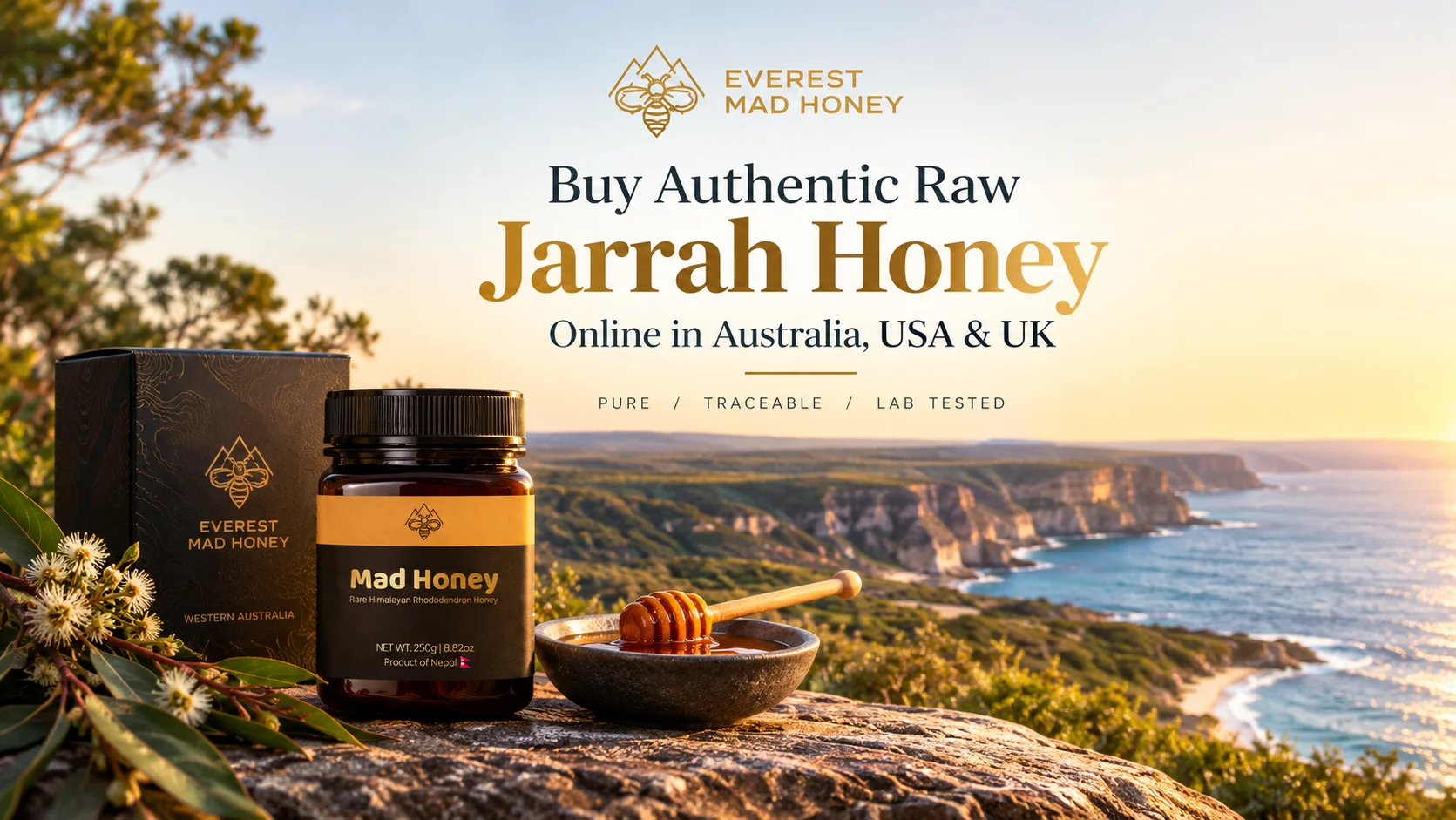
To buy authentic raw jarrah honey, buy a jar that names Western Australia as its origin, shows a lab-tested Total Activity (TA) rating, and carries a traceable batch number. Those three details separate real jarrah honey from the blends and relabelled eucalyptus honeys that fill online marketplaces.
Jarrah honey has gone from a West Australian secret to a premium shelf item in London, New York and Berlin. Holland & Barrett sells a TA50+ jar in the UK at £60 for 260g, and Harrods has listed a limited-edition TA35+ gift jar at £750. Prices like that attract fakes.
This guide shows you how to check what you are buying, how jarrah honey compares with manuka, and what changes when you order from Australia, the USA, the UK or Europe.
Jarrah honey is a monofloral honey made by bees from the nectar of the jarrah tree (Eucalyptus marginata). The tree grows only in the south-west of Western Australia, roughly from north of Perth down to Albany.
Jarrah trees can reach 40 metres and live for centuries. They typically flower every second year, usually in early summer from December to January. A poor season, a bushfire or a drought can wipe out a harvest, which is why supply stays tight.
The honey itself is dark amber and thick, with a flavour often described as caramel, malt or salted toffee. It is less cloyingly sweet than most table honey, so many people eat it straight from the spoon.
Three measurable traits drive the premium: lab-rated antimicrobial activity, a sugar profile that resists crystallising, and a lower glycaemic index than most honeys.
Jarrah honey is graded by Total Activity, a lab test of how strongly the honey stops bacterial growth. TA adds two systems together: peroxide activity, which comes from a bee enzyme that releases hydrogen peroxide, and non-peroxide activity, which comes from the plant.
The number on the jar (TA 10+, TA 20+, TA 35+, TA 50+) is the minimum tested strength. Higher is rarer and more expensive. Many sellers treat TA 30+ as the threshold for “high activity” jarrah.
Most raw honey turns grainy within months. Jarrah stays runny for far longer because it is high in fructose and low in glucose, and it carries little pollen to seed crystals. A 2024 University of Western Australia study measured authenticated jarrah at 42.5% fructose and 20.8% glucose.
This matters for buyers. If a jar sold as pure jarrah sets solid within a few weeks, ask the seller for its test report.
The same study puts jarrah honey’s glycaemic index at about 54, lower than many common honeys. It is still sugar, so anyone managing diabetes should treat it as sugar and speak to a doctor first.
Taste is the reason most people come back. Expect caramel, malt and a faint herbal finish. Take a teaspoon on its own, stir it into tea once the water has cooled slightly, or drizzle it on yoghurt and porridge. High heat damages the enzymes that create peroxide activity, so avoid baking with a high-TA jar.
Health note for publishing: UK and EU rules restrict health claims on food. Keep this section factual (test results, composition) and avoid words like “treats”, “cures” or “heals”. Never give honey to babies under 12 months.
Choose jarrah if you want a smooth, caramel honey that stays liquid and is graded on total antimicrobial activity. Choose manuka if you want the better-known name and a grading system (UMF or MGO) recognised in every market.
| Jarrah honey | Manuka honey | |
|---|---|---|
| Plant source | Jarrah tree (Eucalyptus marginata) | Manuka shrub (Leptospermum scoparium) |
| Origin | South-west Western Australia only | New Zealand, plus some Australian regions |
| Main activity | Mostly peroxide activity (bee enzyme) | Mostly methylglyoxal (MGO, from the plant) |
| Grading | TA rating, e.g. TA 10+ to TA 50+ | UMF rating or MGO mg/kg, e.g. MGO 263+ |
| Texture | Stays runny for a long time | Thick, often creamed, sets over time |
| Flavour | Caramel, malt, mild | Earthy, herbal, slightly bitter |
| Glycaemic index | About 54 (lab study) | Varies by grade; no single figure |
| Availability | Scarce; trees flower every second year | Wider supply, many brands |
Neither is simply “better”. They are measured on different scales, so a direct swap is guesswork. Some sellers claim TA 35+ equals MGO 2,100+, while others say MGO 2,000 equals only TA 30. Treat any fixed conversion as marketing, not science.
What you can compare is evidence on the jar. A tested TA number, a named beekeeper or region, and a batch code tell you more than any conversion chart.
Both honeys are priced by activity grade, so compare the cost per 100g at a similar grade rather than jar against jar. Jarrah supply swings with each flowering year, so prices can jump after a poor season. When you find a trusted batch, buying two or three jars is sensible.
Honey is one of the most faked foods in the world, and premium varieties are the main target. Run any jarrah honey through these checks before you pay.
Jarrah grows in native forest, far from farmland, so many producers describe it as naturally chemical-free. A legal “organic” claim still needs certification. In Australia look for ACO or NASAA; in the USA, the USDA Organic seal; in the UK and EU, a recognised organic certifier code on the label.
Australians can buy straight from the source; everyone else should buy from a local stockist or an exporter that handles food import paperwork for them.
Australia is the easiest market. Buy direct from Western Australian beekeepers or established brands such as Barnes Naturals, Fewster’s Farm, Nectar Honey and Forest Fresh. Their sites list TA ratings and many show the WA jarrah certification logo. Farmers’ markets around Perth and the south-west are another good source, and you can often taste before you buy.
Tip: harvests are announced after the summer flowering. Sign up to a producer’s mailing list to catch new high-TA batches before they sell out.
In the US, jarrah honey is mostly sold through importers, specialty grocers and marketplaces. If you order direct from an overseas seller, the FDA requires prior notice for food sent by mail or courier, even for personal use. Food you carry in your own luggage is exempt. Established exporters file this for you, so ask before you order.
If “organic” matters to you, look for the USDA Organic seal. Without it, a US seller cannot legally market the honey as organic.
UK buyers can find jarrah honey on the high street and online. Holland & Barrett stocks a TA50+ jar, and Harrods has carried luxury gift editions. Specialist online honey shops also import from WA producers.
Ordering from Australia yourself is possible. UK government rules allow up to 2kg of honey per person as a personal import. Expect import VAT and a courier handling fee on arrival.
EU rules allow personal consignments of honey from outside the EU up to 2kg per person. Import VAT applies, and parcels must carry clear commercial labels. For larger orders or regular supply, buy from an EU-based stockist that has already cleared the honey through official border checks.
| Retailer | Product | Price |
|---|---|---|
| Holland & Barrett (UK) | Honey for Life Super Jarrah TA50+, 260g | £60 |
| Harrods (UK) | Australian Rare TA35+ gift box, 250g | £750 |
| Forest Fresh (via Gumroad) | Jarrah Platinum TA50+ | US$50 |
| Little Farms (Singapore) | Nectar Jarrah TA35+, 250g | S$38.48 |
The Harrods jar is a luxury collectable; the other prices are a fairer guide to what everyday high-TA jarrah costs.
If jarrah appeals because it is rare, single-origin and lab-graded, Himalayan mad honey is the next step up in scarcity. It is a very different honey, though, and it is not an everyday sweetener.
Mad honey is harvested from wild cliff hives of the giant Himalayan honey bee (Apis laboriosa) in Nepal. The bees forage on rhododendron blooms above 3,000 metres. That nectar contains grayanotoxins, natural compounds that give mad honey its warming, relaxing effect, and that is why it is taken in small, measured servings.
The same buying rules apply as for jarrah. Look for a named origin, independent lab results and a batch code you can check.
At Everest Mad Honey, every flask is:
People searching for organic mad honey usually want exactly this: honey from wild hives, far from farmland and agricultural sprays, with proof of what is in the jar.
Use it safely. Start with one teaspoon, never exceed one tablespoon in 24 hours, and do not take mad honey if you are pregnant or on heart medication. Read our full mad honey dosage guide before your first serving.
Shop authentic Himalayan mad honey
What is jarrah honey good for?
Most people buy jarrah honey for its caramel flavour, its smooth texture and its lab-tested antimicrobial activity. It works as a daily spoonful, in warm (not boiling) tea, or over breakfast. Speak to a doctor before using any honey for a medical purpose.
Manuka honey vs jarrah honey: which is stronger?
They use different scales. Manuka is graded on MGO or UMF, and jarrah on Total Activity (TA). Conversion charts between the two vary by seller, so compare tested numbers within each type rather than across them.
What TA rating should I buy?
TA 10+ to TA 20+ suits everyday eating. TA 30+ and above is sold as high-activity jarrah and costs more. Whatever the number, check that it comes from an independent lab.
Why doesn’t jarrah honey crystallise?
It contains much more fructose than glucose and very little pollen, so sugar crystals have trouble forming. If it does set, stand the jar in warm water to soften it.
Can I buy jarrah honey in the UK?
Yes. High-street chains, department stores and specialist online honey shops sell it. You can also import up to 2kg per person for personal use from Australia.
Is organic jarrah honey available in the USA?
Yes, but only jars with the USDA Organic seal can legally be sold as organic in the US. Many jarrah honeys come from untreated native forest yet lack the certification.
Is jarrah honey the same as mad honey?
No. Jarrah comes from Western Australian eucalyptus trees and is eaten like normal honey. Mad honey comes from Himalayan rhododendrons, contains grayanotoxins, and should be taken only in small, measured servings.
To buy authentic raw jarrah honey anywhere in the world, insist on three things: Western Australian origin, an independent TA test, and a batch you can trace. Australians can buy direct from the forest; buyers in the USA, UK and Europe should use a local stockist or an exporter that handles import rules.
And if rare, single-origin honey is what draws you to jarrah, explore the honey that Himalayan honey hunters risk the cliffs for. Discover lab-tested organic mad honey from Everest Mad Honey.
Authentic Himalayan Mad Honey, ethically harvested in Lamjung , Nepal. Premium quality with fast delivery across the UK.
FDA Regulatory Sourcing & Legal Disclaimer: The statements, active biochemistry assessments, and traditional medicinal metrics presented inside this archive have not been fully cataloged by the United Kingdom Food and Drug Administration. Everest Mad Honey is not manufactured to treat, diagnose, mitigate, or systematically prevent clinical conditions. Mindful dosage limits must be strictly integrated into individual consumer protocols.
